
Farm Animal Pattern Worksheets for Preschool and Kindergarten
Patterns are one of those early math skills that can look deceptively simple.
Cow, pig, cow, pig. What comes next? Because recognizing an AB pattern is just the beginning. Kids eventually need to notice, extend, describe and work with more complicated repeating patterns too.
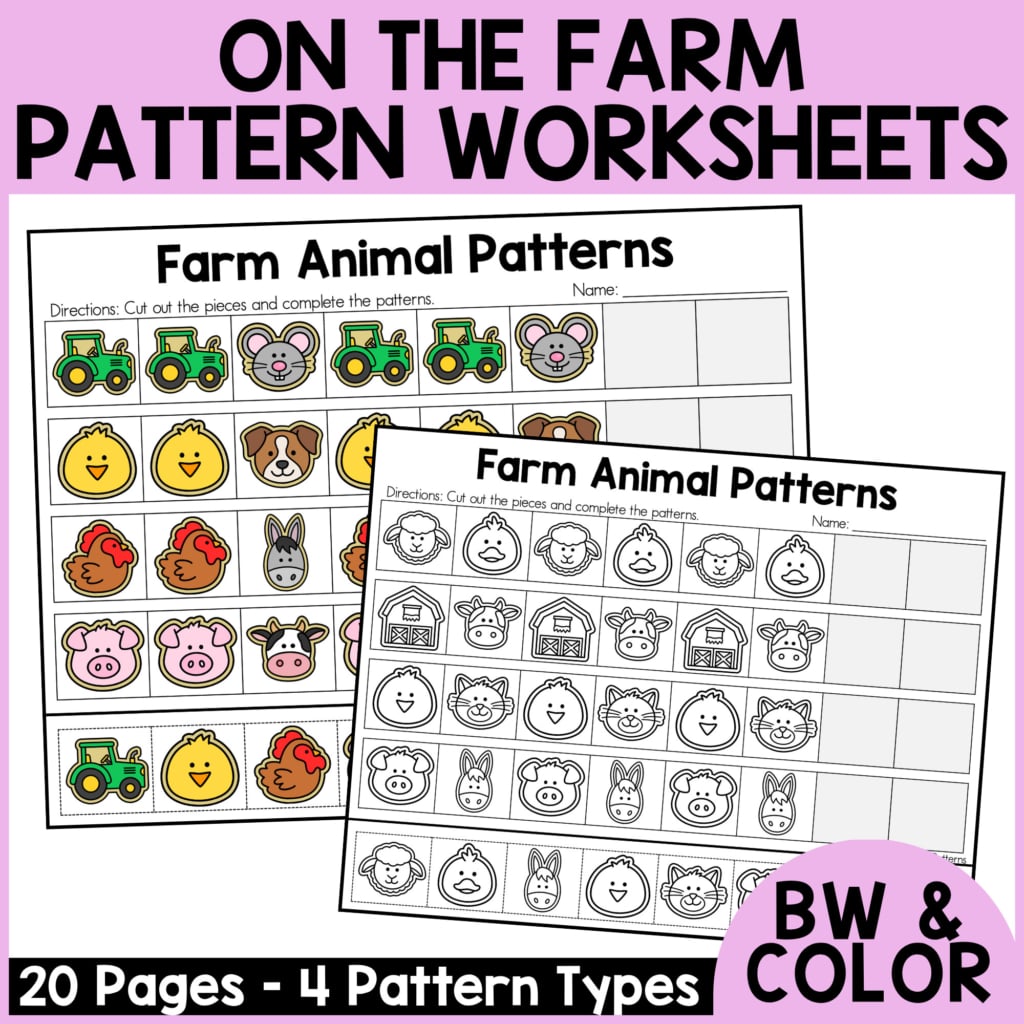
These farm animal pattern worksheets give kids practice with four different pattern types: AB, ABC, AAB and ABB patterns. And instead of writing or drawing the missing pictures, students cut out farm-themed pieces and use them to complete each pattern.
So yes, there are plenty of cows.
The complete packet has 40 printable pages, including both color and black-and-white versions.
Farm Animal Pattern Worksheets: AB, ABC, AAB and ABB Patterns
If you’re working on patterns with younger learners, start with the simplest pattern and build from there.
An AB pattern alternates two items: Cow, pig, cow, pig, cow, pig.
An ABC pattern repeats three different items: Cow, pig, sheep, cow, pig, sheep.
Then things get a little more interesting.
An AAB pattern repeats the first item twice before adding a different item: Cow, cow, pig, cow, cow, pig.
An ABB pattern has one of the first item followed by two of the second: Cow, pig, pig, cow, pig, pig.
That progression is one reason I like having more than one kind of pattern worksheet available. A student who can complete an AB pattern may still need instruction and practice before recognizing an AAB or ABB pattern.
Download the Farm Animal Pattern Worksheets
This printable set includes 40 farm animal pattern worksheets covering AB, ABC, AAB and ABB patterns, with 20 activities in color and 20 corresponding black-and-white pages. Each worksheet contains four patterns and cut-apart farm-themed pieces students use to complete them.
Use them for preschool or kindergarten math, farm units, math centers, small-group instruction, intervention, special education or homeschool.
Start with the pattern your student is ready for and move on when they’re actually showing you they understand it.
If you are looking for other farm or pattern content for this age group:
Start With AB Patterns
I wouldn’t hand a student all four pattern types at once and hope for the best.
Start with AB patterns if repeating patterns are new.
You can even practice with real objects before using the worksheets. Line up two types of counters, blocks, toy animals or whatever you already have.
Cow, pig, cow, pig…Then stop. “What comes next?”
Once the student understands that the unit repeats, move to the worksheet.
That little bit of hands-on practice can be much more useful than explaining a pattern six different ways while everyone slowly loses the will to live.
Moving Beyond AB Patterns
Once AB patterns are solid, you can introduce ABC patterns and then AAB and ABB patterns.
The packet makes that progression easy because the worksheets are already separated by pattern type. The first section practices AB patterns, followed by ABC, AAB and ABB patterns. The same sequence is repeated in black and white in the second half of the packet.
That also means you don’t have to use all 40 pages. Choose the pattern type the student is learning and use the pages you need.
Patterns Are More Than “What Comes Next?”
When a child gets the right answer, ask how they figured it out. Learning and recognizing patterns is an important executive functioning skill. Mind you, I’m not say that if a child cannot do this–that doesn’t necessarily mean it’s time to whip up an IEP.
However, if they consistently struggle with this and other basic skills, it’s worth paying attention to, perhaps for RTI.
Instead of only asking, “What comes next?” try:
- “How do you know?”
- “What part keeps repeating?”
- “Can you show me the pattern?”
- “What would come after that?”
Those questions can tell you more than a completed worksheet.
A child might correctly choose the cow because they genuinely recognize the repeating unit. Or they may be guessing based on the picture immediately before the blank.
Cut and Paste Pattern Worksheets
These are cut-and-paste pattern worksheets, which adds a fine motor component to the activity.
For many students, that’s useful additional practice. For others, it can get in the way.
If you’re trying to find out whether a student understands an ABB pattern, their ability to cut around a cartoon chicken isn’t really relevant.
Pre-cut the pieces when needed. Students can point to the correct picture, place it in the box, use Velcro pieces on laminated pages, or tell you which picture belongs next.
Keep the skill you’re actually teaching in mind. Pattern recognition is math. Scissor skills are something else. But I have worksheets for that too, and these barber/hairstylist cutting worksheets are adorable!
Color and Black-and-White Pattern Worksheets
The packet includes 20 full-color worksheets and the same 20 worksheets in black and white, for a total of 40 pages. That gives teachers and parents a few options.
Use the color pages when the visual distinction helps students identify the pictures quickly. Use the black-and-white pages to save ink or let students color the farm pictures before completing the patterns.
You could also laminate the color pages and reuse them in a math center rather than printing a new copy every time.
Farm Pattern Activities for Preschoolers
These worksheets fit especially well with preschool, Pre-K and kindergarten farm themes.
You can pair them with toy farm animals and make the patterns first. Have students create an AB pattern with cows and pigs, then challenge them to make an ABC pattern using three animals.
You can also make movement patterns.
Clap, stomp, clap, stomp.
Clap, clap, stomp, clap, clap, stomp.
Now you’re practicing the same mathematical idea without a worksheet at all.
That’s much more useful than completing 10 nearly identical rows and calling it pattern mastery.
And then you can bring the worksheet back in and see whether the student recognizes that the structure is the same even though the objects have changed.