
School Refusal: What Causes It + Why Is It Increasing?
School refusal is often treated as the problem to solve. But in most cases, it is a signal and not the root issue.
That’s where many families and schools get stuck. The focus stays on attendance: how to get the student back into the building, how to increase time, how to enforce expectations. Meanwhile, the underlying reasons the student is avoiding school are not fully explored.
Understanding the cause is what determines whether any plan will work. Two students may both refuse school, but for entirely different reasons—one may be dealing with anxiety, another with academic gaps, another with sensory overwhelm, and many with a combination of factors.
Without identifying those causes, supports and interventions can miss the mark. The goal of this section is to move beyond general explanations and look at what is actually driving school refusal, so that responses can be more targeted and effective. If you’re new to school refusal, start here.
Quick Answer: What Causes School Refusal
School refusal is rarely caused by a single issue. In most cases, it is the result of multiple factors interacting at the same time.
Anxiety is one of the most common contributors. This can include generalized anxiety, social anxiety, or school-specific stressors such as transitions or performance demands. For some students, the anxiety becomes so significant that attending school feels overwhelming or unmanageable.
Skill deficits also play a role. Students who struggle with reading, writing, executive functioning, or social skills may begin to avoid situations where those difficulties are exposed. Over time, avoidance can become a pattern.
Environment matters as well. Sensory overload, unpredictable routines, or a lack of appropriate supports can make the school setting difficult to tolerate. When the environment does not match the student’s needs, attendance becomes harder to sustain.
Understanding school refusal requires looking at all of these factors together. The goal is not just to identify what is happening, but why it is happening in that specific context.
Why School Refusal Is Becoming More Common
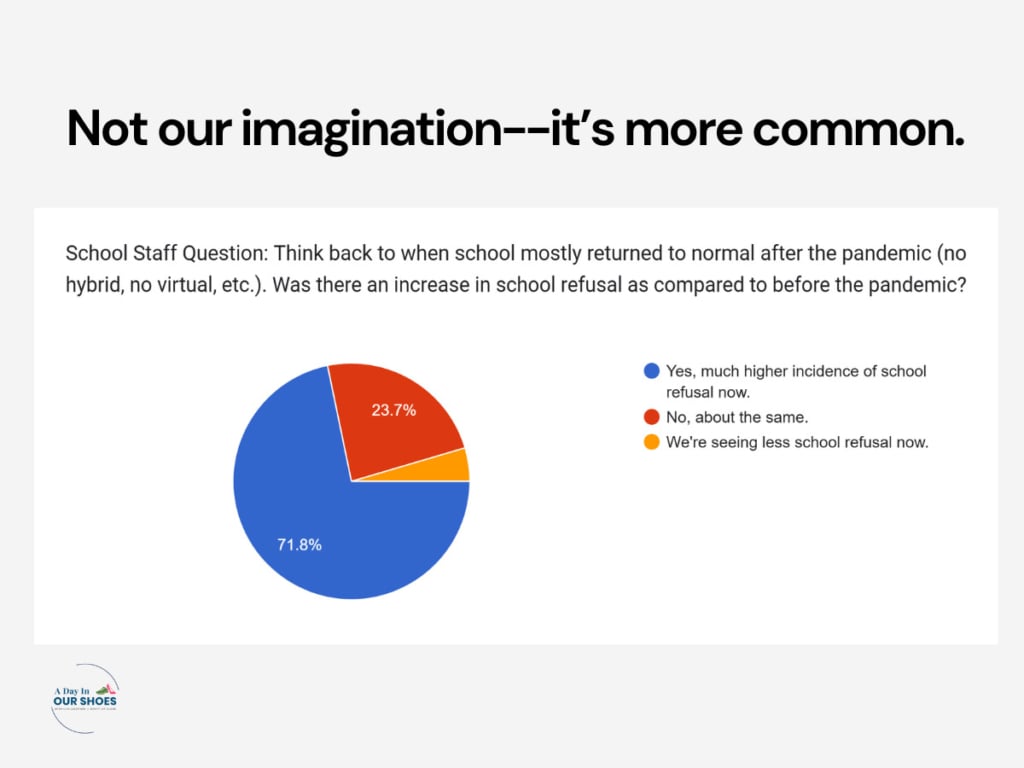
School refusal is not a new issue, but many families and educators are noticing that it is becoming more frequent, and more complex. There is no single reason for this shift. Instead, several factors are contributing at the same time.
Student needs have changed. There is increased awareness of anxiety, executive functioning challenges, and sensory differences, but school systems have not always adapted at the same pace. As a result, more students are attending environments that may not fully meet their needs.
Academic demands have also increased. Expectations around performance, testing, and workload can create pressure for students who are already struggling. For those with skill gaps or learning differences, this pressure can build over time and lead to avoidance.
At the same time, schools are facing resource limitations. Staffing shortages, larger class sizes, and competing priorities can make it more difficult to provide individualized supports. When supports are limited, small challenges can escalate into larger issues.
There is also greater awareness among families. Parents are more likely to recognize when something is not working and to question whether the current approach is appropriate. This can bring attention to situations that may have previously gone unaddressed.
Taken together, these factors create a situation where more students are struggling to attend school, and schools are not always equipped with consistent frameworks to respond. Understanding this broader context can help explain why school refusal is appearing more frequently and why it can be difficult to resolve.
The Elephants in the Room: Pandemic and School Climate
There are also a few factors that are harder to quantify, but come up repeatedly in real conversations with families and students. I’ll say the things that many don’t want to talk about–that school is just downright unpleasant, to the point of being unbearable, for many students.
That doesn’t mean that teachers don’t care, that you all don’t work hard, or that you’re not trying. All those things can be true at the same time. In fact, many teachers say the same thing–that school is unpleasant for you, and that many regret choosing teaching as a profession. If you agree that public education is failing teachers, why do we act surprised when kids tell us the same thing?
The pandemic changed how many students experience school. For some, it disrupted academic progress, leaving gaps that are still affecting confidence and performance. For others, it altered routines and tolerance for the structure of a full school day. Students who became accustomed to learning at home, or who experienced reduced demands during that time, may find the transition back to traditional expectations more difficult. Yes, even after five years or more.
For many kids, the pandemic was an extremely influential time over their upbringing, and came at a critical phase in life.
Just as important is school climate. For some students, the issue is not academics, but the environment itself. Bullying—whether overt or subtle—can make school feel unsafe. Even when it is not formally reported or substantiated, peer interactions can have a significant impact on a student’s willingness to attend.
Sensory needs are another often overlooked factor. Classrooms and school environments are busy, noisy, and unpredictable. For students who are sensitive to sound, movement, or crowding, this can create a constant level of stress throughout the day. When those needs are not recognized or supported, avoidance can become a way to cope.
These factors are not always reflected in data or formal evaluations, but they play a meaningful role in how students experience school. When they are not addressed, they can contribute to ongoing difficulty with attendance, even when other supports are in place.
The Most Common Causes (From Real Parents)
When parents describe school refusal, the same themes come up repeatedly. While each situation is different, there are consistent patterns in what families are experiencing.
Anxiety and overwhelm are at the center of many cases. Students may struggle with transitions, fear of failure, or social pressures. For some, even entering the building can trigger a stress response that makes attendance feel impossible.
Sensory challenges are another common factor. Busy hallways, loud classrooms, and constant stimulation can be difficult for students who are sensitive to their environment. When these factors are present throughout the day, the cumulative effect can lead to avoidance.
Academic gaps also contribute. Students who are behind may feel a constant sense of frustration or embarrassment. Without appropriate supports, the effort required to keep up can become unsustainable, leading to increased avoidance over time.
In many cases, these factors overlap. A student may be dealing with anxiety, academic challenges, and environmental stressors simultaneously. When that happens, school refusal is not a single issue to solve, but a combination of needs that require a coordinated response.
Why Schools Get This Wrong
One of the most common challenges is how school refusal is interpreted. In many cases, the initial response focuses on attendance or behavior, rather than exploring underlying causes.
This can happen for practical reasons. Attendance is measurable, and behavior is observable. It is often easier to respond to what can be seen than to investigate what may be happening internally.
However, when the focus remains on surface-level concerns, important information can be missed. If anxiety, skill deficits, or environmental factors are not identified, the supports put in place may not address the actual issue.
Another factor is consistency. Without a clear framework for addressing school refusal, responses can vary widely between teams and schools. This can lead to gaps in how needs are identified and supported.
When underlying causes are not fully understood, interventions may be less effective. A more comprehensive approach requires looking beyond attendance and behavior to understand the broader context.
Behavior vs Disability (Critical Distinction)
A key distinction in school refusal is whether the behavior is being interpreted as a matter of choice or as a response to an underlying need.
When school refusal is viewed primarily as behavior, the response often focuses on increasing compliance. This may include incentives, consequences, or expectations around attendance. While these approaches can be appropriate in some situations, they may not be effective if the behavior is driven by factors such as anxiety or skill deficits.
If the behavior is connected to a disability or unmet need, the approach needs to shift. In these cases, the behavior can be understood as a form of communication—indicating that something in the environment, expectations, or supports is not working for the student.
Mislabeling can affect the types of supports a student receives. If the focus remains on behavior alone, opportunities to provide targeted interventions may be missed.
Clarifying this distinction is an important step in determining what supports are appropriate and how to address the situation effectively.
How to Identify YOUR Child’s Root Cause
Identifying the underlying cause of school refusal requires looking for patterns over time. Rather than focusing on isolated incidents, it is helpful to consider when the difficulty occurs and what factors may be contributing.
Start by noting specific triggers. This might include certain classes, times of day, transitions, or environments. Patterns can often be seen when these factors are tracked consistently.
It can also be helpful to consider what happens before and after the refusal. For example, does the student become more distressed when academic demands increase? Do certain environments lead to avoidance more than others?
Data collection does not need to be complicated. Simple notes about attendance, duration, and context can provide useful information. Over time, these observations can help clarify whether the issue is primarily related to anxiety, skill gaps, environmental factors, or a combination.
Understanding the root cause is an ongoing process. As more information becomes available, supports can be adjusted to better match the student’s needs.
Understanding the “Why” Behind School Refusal
School refusal is rarely about a single issue, and it is almost never solved by focusing on attendance alone. It is the result of multiple factors—anxiety, skill gaps, environmental challenges, and broader systemic pressures—interacting over time.
The challenge is that these factors are not always immediately visible. What looks like avoidance on the surface may reflect overwhelm, unmet needs, or a mismatch between the student and their environment. When those underlying causes are not clearly identified, supports and interventions are less likely to be effective.
Understanding the “why” is what allows the next steps— school refusal accommodations, interventions, and reintegration—to be more targeted and realistic. Without that foundation, plans tend to focus on symptoms rather than solutions.
A more effective approach starts with careful observation, identifying patterns, and considering the full context of the student’s experience. From there, supports can be aligned in a way that addresses both access to school and the ability to sustain participation over time.