
School Refusal Evaluations, FBAs, and Behavior Plans
School refusal is a behavior. It might seem controversial for me to state that, but I don’t think so, and here’s why.
I’ve been a vocal critic of poorly done FBAs and behavior plans, and pointing out why many behavior plans fail. But, when you look at what is happening with school refusal–it is a behavior and it’s a manifestation of disability. Whether that disability is anxiety, PTSD, depression or something else–that disability is manifesting itself in the student refusing to go to school.
So, by saying that school refusal is a behavior, I am not suggesting we reward and punish the child into attending school. I don’t believe that will work for this behavior or any other behavior for that matter. The fact is, one of the main causes of school refusal is due to lagging skills–the student does not have the coping mechanisms to get themselves to school, and must be taught the skills to overcome school refusal.
I remember going back and forth over text with one client whose school FBA said her son refused to go to school because “he has school refusal.” I wish I was making that up. She ended up getting her child an IEE, which determined the very specific reasons his anxiety was exacerbated by the thought of going to school. Little by little, he got back there.
A solid FBA will tell you the cause or trigger of the anxiety or PTSD. Whether that’s unsupported sensory issues or bullying or not being able to keep up with academics–a good FBA will tell you the lagging skills that need to be taught.
Let’s dig in–school refusal, evaluations and more. If you’re new to school refusal, start here.
What Evaluations Are Needed
When a child is struggling to attend school, the most effective starting point is a comprehensive look at why the difficulty is occurring. There is no single evaluation that addresses school refusal on its own. Instead, multiple assessments are often needed to understand the full picture.
A Functional Behavior Assessment (FBA) is commonly recommended, particularly if the school views the issue through a behavioral lens. An FBA examines patterns (what happens before, during, and after a behavior) to identify possible triggers and functions.
A psychological evaluation can provide additional insight into anxiety, depression, or other emotional factors that may be contributing. This type of evaluation helps determine whether the difficulty attending school is connected to an underlying mental health need.
Other functional assessments may also be appropriate, depending on the situation. These can include evaluations related to executive functioning, sensory processing, or academic skill gaps.
The key is not choosing one evaluation, but ensuring that the assessments requested match the suspected areas of need. School refusal is rarely caused by a single factor, and the evaluation process should reflect that complexity.
Here’s the part that trips up a lot of parents. They’re told, “Let’s do an FBA,” and it sounds official and helpful. So they agree. But no one stops to ask: Is this even the right tool?
Because school refusal is rarely just one thing. And it definitely doesn’t fit into one evaluation box.
If you don’t match the evaluation to the actual problem, you end up with a very official-looking report…that doesn’t help your child get back to school.
When to Request an FBA (And When NOT To)
I see this all the time-teams jump straight to an FBA because it’s familiar and easy to initiate.
And sometimes, it is appropriate. But sometimes it’s being used because it’s what the school knows how to do, not because it’s what the child actually needs.
If a child is having panic attacks, shutting down, or physically unable to enter the building, you have to ask: Are we measuring behavior, or are we missing what’s underneath it?
An FBA can tell you what’s happening on the surface. It cannot diagnose anxiety, trauma, or overwhelm.
An FBA can be a useful tool, but it is not appropriate in every situation. It is most helpful when there are observable behaviors that can be measured and analyzed—such as refusal, avoidance, or leaving the classroom—and when the goal is to understand what is triggering those behaviors.
For example, if a student consistently refuses to enter a specific class or becomes distressed during certain transitions, an FBA can help identify patterns and contributing factors. It may reveal whether the behavior is related to task difficulty, environmental stressors, or social dynamics. In my years as an advocate, I have seen the reasons discovered as bullying, not being able to read and sometimes even buzzing overhead lights.
However, an FBA has limitations. If the primary concern is internal—such as anxiety, panic, or emotional overwhelm—an FBA alone may not capture the full picture. These experiences are not always visible or easily measured through observation.
In those cases, relying solely on an FBA can lead to incomplete conclusions. Additional evaluations, such as psychological or emotional assessments, may be necessary to better understand the underlying causes. Any of these assessments should not just observe behavior, but also interview the student and the parent.
The decision to request an FBA should be based on whether observable behavior patterns can provide meaningful insight. If the issue appears to be primarily internal or emotional, a broader evaluation approach is often more appropriate.
Why Behavior Plans Often Fail
Behavior plans are frequently used as a response to school refusal, but they are not always effective. One common reason is that the plan is based on an incomplete understanding of the underlying issue.
If school refusal is treated primarily as a compliance problem—rather than as a response to stress, anxiety, or unmet needs—the resulting plan may focus on rewards and consequences without addressing the root cause. In these situations, the plan may not lead to meaningful or lasting change. In other words, is the IEP team treating this as “the child won’t go to school” or “the child cannot go to school,” the old “can’t vs won’t” discussion in advocacy.
Parents will often say to me, “We have a behavior plan, but it’s not working.” And when I look at the plan, it’s usually very polished. It checks all the boxes and sounds good in an IEP meeting.
But it’s built on the wrong assumption. If the plan assumes the child won’t comply, when the reality is they can’t, everything that follows is off.
You can’t reward your way out of anxiety. You can’t consequence your way out of overwhelm. And yet, that’s exactly what many plans are trying to do.
Another factor is the lack of individualized data. Effective behavior plans rely on accurate, consistent information about what is happening and why. When plans are developed without clear data or are based on assumptions, they may not align with the student’s actual needs.
Consistency in implementation also plays a role. Even a well-designed plan requires consistent follow-through across staff and settings. Variability in how the plan is applied can limit its effectiveness and make it difficult to evaluate whether it is working. Much of the school refusal behavior occurs in the home, and so this requires extra coordination between parents and staff, which requires more time and resources.
Behavior plans can be helpful when they are grounded in a clear understanding of function, supported by data, and tailored to the individual student. Without those elements, they may not produce the intended outcomes.
What a Good FBA Should Include
A well-conducted FBA goes beyond identifying that a behavior is occurring; it explains why it is happening. This begins with identifying antecedents, or the events and conditions that occur before the behavior. These may include specific tasks, environments, transitions, or social interactions.
The next component is understanding the function of the behavior. This refers to what the student is gaining or avoiding. For example, a behavior may function to escape a difficult task, avoid a stressful situation, or seek support or attention.
IEP data collection is a critical part of the process. A strong FBA includes systematic observation over time, rather than relying on isolated incidents. This allows patterns to emerge and supports more accurate conclusions.
Finally, the FBA should lead directly to actionable recommendations. The goal is not simply to describe behavior, but to inform strategies that address the identified function. This may include environmental adjustments, skill-building supports, or changes to expectations.
When these elements are present (antecedents, function, and data) the FBA becomes a useful tool for guiding intervention.
Other Evaluations Schools Avoid (But You Should Request)
In some cases, additional evaluations may be needed to fully understand school refusal, particularly when behavior alone does not explain the situation.
Anxiety assessments can help identify whether emotional factors are contributing to school avoidance. These evaluations may provide insight into patterns of stress, triggers, and coping capacity.
Occupational therapy evaluations can be useful when sensory processing or regulation challenges are suspected. For some students, environmental factors such as noise, lighting, or physical demands can significantly impact their ability to participate in school.
Executive functioning assessments may also be relevant. Difficulties with task initiation, organization, or planning can contribute to avoidance behaviors, particularly as academic demands increase.
These evaluations are not always offered automatically, but they can provide important information when behavior-based approaches are not sufficient. Requesting a broader evaluation can help ensure that all relevant factors are considered.
This is where things get uncomfortable sometimes. Because the more complex the evaluation, the more complex the solution.
And not every school has:
- the staff
- the time
- or the resources
to address those needs easily. So the evaluation process can sometimes stay in the lane that is easiest to manage. That doesn’t mean it’s intentional. But it does mean you may have to ask for a broader look.
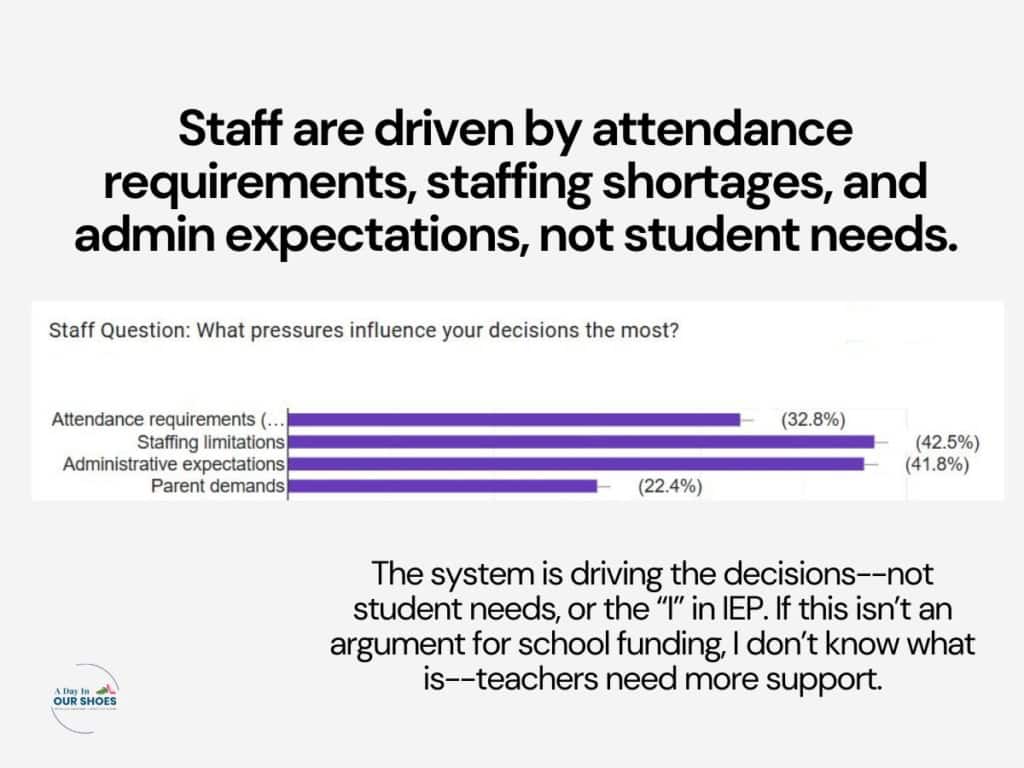
In fact, a recent survey on school refusal revealed that staff and resource availability drives a lot of school refusal decisions.
How to Use Evaluation Data to Get Services
Evaluation results are most useful when they are clearly connected to educational needs. Data should describe not only what a student is experiencing, but how it affects their ability to access and participate in school.
When reviewing evaluation reports, look for specific findings that relate to school performance—such as difficulty with transitions, sustained attention, or emotional regulation. These connections form the basis for requesting supports and services.
It is important to communicate requests in writing. Written communication creates a record and allows for more precise requests tied to evaluation findings. This may include asking for specific accommodations, services, or changes to placement.
Follow-up is also an important part of the process. If recommendations are made but not implemented, or if supports are not effective, additional discussion may be needed to adjust the plan.
Evaluation data is not the end of the process, it is a tool. When used effectively, it can support clearer decision-making and help ensure that services align with the student’s needs.