School Refusal: Why Schools Say No (And What to Do)
When a child is refusing school, many families eventually reach the same point: asking for help and being told no.
Sometimes it is a direct no. Other times it is more subtle—delays, vague answers, or suggestions that nothing more can be done. The reasons given often sound reasonable: lack of data, limited resources, or policies that “don’t allow” certain supports.
What is less clear is how these decisions are actually being made, and what they mean for your child. In many cases, the issue is not just whether support is available, but how schools determine what is appropriate, what is possible, and what they are willing to offer.
Understanding these dynamics can help you respond more effectively. It shifts the conversation from “why are they saying no?” to “what is driving that decision, and how do we address it?”
If you’re new to school refusal, start here.
Why Schools Say No
When families ask for help with school refusal, the answer is often some version of “no.” That response usually comes down to three things: lack of data, limited resources, and concern about setting precedent.
If a school does not have clear data showing what is happening and why, they may hesitate to make changes. Without that information, decisions feel uncertain, and teams often default to what they are already doing.
Resource limitations are also a factor. Staffing shortages, limited program options, and competing demands can make it difficult to implement new supports, even when they are needed.
There is also a concern—sometimes stated, sometimes not—about consistency. Schools may worry that offering a certain support to one student means they will need to offer it to others.
Understanding these factors does not mean accepting them as the final answer. It does mean knowing what is driving the response so you can address it more effectively.
The Data Problem: No One Is Measuring the Right Things
In many school refusal situations, there is data—but it is not the kind of data that helps solve the problem.
Attendance records show how many days a student has missed. Grades may show whether work is being completed. But neither of those explains why the student is struggling to attend.
What is often missing is baseline data. When did the problem start? What patterns are consistent? Are there specific times, classes, or triggers that make attendance more difficult?
Without that information, teams are left making decisions based on incomplete understanding. This can lead to supports that are too general or that do not address the actual issue.
There is also often a lack of ongoing tracking. A support may be put in place, but there is no clear way to measure whether it is helping. Without that feedback, it becomes difficult to adjust the plan.
In some cases, data can even be misleading. A student may have passing grades, which can suggest that they are managing academically, even if they are missing significant instruction or relying on incomplete participation.
Better data does not have to be complicated. It can include:
- patterns of attendance
- specific triggers or barriers
- how the student responds to different supports
When the right data is available, it becomes easier to move the conversation from opinion to problem-solving.
When “We Need More Data” Becomes a Stall
It is common for teams to say they need more data before making changes.
On the surface, that sounds reasonable. Decisions should be based on information. But in school refusal situations, this can sometimes become a way to delay action.
If a student has missed weeks of school, struggles to enter the building, or cannot sustain attendance, that is already meaningful data. The issue is not a lack of information—it is how that information is being interpreted.
In these situations, it can help to clarify:
- What specific data is missing?
- How will that data be collected if the student is not attending?
- What will happen in the meantime?
This keeps the conversation moving forward. Data collection and action do not have to be separate steps. Supports can be put in place while additional information is gathered.
When the Answer Is “That’s Not Available”
Another common response is that a requested support or option is not available.
Sometimes this reflects real limitations. But sometimes it reflects how the request is being framed.
If the conversation is about a specific program or service, the answer may be no. If the conversation is about the student’s need—what is preventing them from accessing school—the discussion becomes broader.
For example:
- Instead of “We need this specific program,”
- the focus becomes “My child cannot access school because of X—what can be put in place to address that?”
It moves the discussion away from what is already built and toward what is needed.
Decisions Are Often Made Before the Meeting
This is something most parents are not told.
In many cases, teams have already discussed options, limitations, and likely outcomes before the formal meeting takes place. By the time the meeting happens, there may already be a shared understanding among staff about what they are prepared to offer.
That does not mean decisions are final. But it does mean that what is presented in the meeting may reflect prior internal discussions.
This is one reason written communication matters. When concerns, data, and requests are clearly documented ahead of time, they are more likely to be part of those internal conversations.
It also helps explain why follow-up matters. If something is not addressed in the meeting, putting it in writing afterward ensures it is part of the ongoing discussion. IEP predetermination is real–but proving it is whole ‘nother thing.
Resource Limitations Are Real (But Not Your Problem)
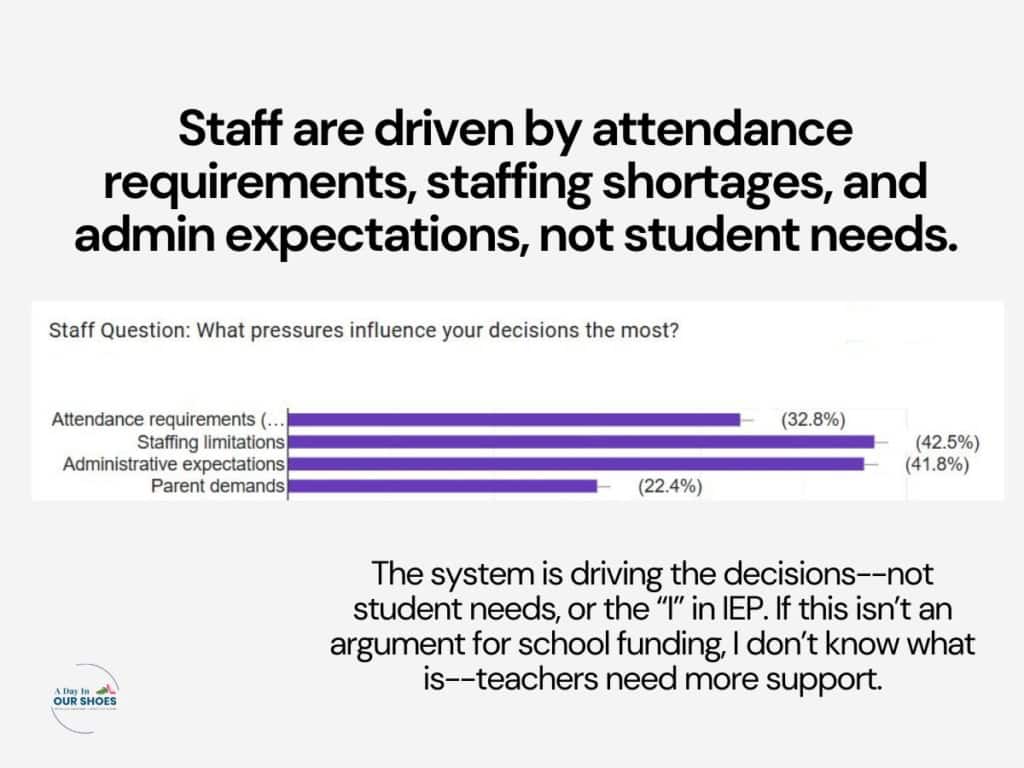
Schools are working within real constraints. Staffing shortages, limited program availability, and increasing demands all affect what can be offered.
It is reasonable to acknowledge that these limitations exist. At the same time, they do not change the requirement to provide an appropriate education.
A school may not have a specific program in place, but that does not mean no support can be provided. It may mean that supports need to be created, adjusted, or delivered differently.
This is where conversations can become challenging. Families may hear statements like:
- “We don’t have the staff for that”
- “We’ve never done that before”
These statements reflect real limitations, but they are not, by themselves, a complete answer.
The focus should remain on what the student needs to access their education. How that need is met may require flexibility, creativity, or adjustments within the system.
These are the results from a survey of teachers on my email list–
“We Don’t Do That Here”: Fear of Setting Precedent
Another common response is that a requested support is not something the school typically offers.
This is sometimes framed as policy or standard practice. However, special education is based on individual need, not what is commonly done.
Each student’s program is supposed to be developed based on their specific needs. If a support is necessary for that student to access their education, the fact that it is not widely used does not automatically make it inappropriate.
Concerns about precedent often reflect a desire for consistency. Schools aim to apply policies fairly across students. But consistency does not mean identical services—it means responding appropriately to each student’s needs.
When this issue comes up, it can help to bring the focus back to the individual:
- What does this student need to access their education?
- What has been tried, and what has not worked?
- What would address the current barriers?
This shifts the conversation away from policy alone and toward individualized decision-making.
How to Build a Case They Can’t Ignore
When supports are being denied or delayed, a clear and organized approach can make a difference.
- Start with documentation. Keep records of attendance, communication, and what you are observing. Patterns over time are often more persuasive than isolated examples.
- Collect relevant data. This can include notes on triggers, duration of attendance, or how your child responds to different situations. The goal is to show not just that there is a problem, but what that problem looks like.
- Put requests in writing. Clearly state what you are asking for and why. Connect your request to your child’s ability to access and participate in school.
- Follow up consistently. If there is no response, or if the response does not address the concern, continue the conversation. Ask what the next steps are and how decisions are being made.
Over time, this builds a record that makes it easier to move the discussion forward. It shifts the conversation from general concerns to specific, documented needs that require a response.
When schools say no, it is often not about a single decision. It is the result of how data is being interpreted, what resources are available, and how requests are framed within the system.
Understanding these factors does not make the situation easier, but it does make it clearer. It allows you to respond in a way that keeps the focus on your child’s needs, rather than getting stuck on the initial answer.
The goal is not to challenge every response, but to make sure the process is moving toward a solution. When decisions are grounded in clear data, connected to access, and followed up in writing, it becomes more difficult for the conversation to stall.
Progress may not happen all at once, but it is more likely when the focus stays on what the student needs, and how the system can respond to meet that need.