
Attendance vs FAPE: School Refusal Explained
When a child is not attending school, the conversation often shifts quickly to attendance—how many days have been missed, what policies apply, and what steps come next. What is less often discussed is how attendance connects to a student’s right to access their education.
This is where the tension between attendance requirements and FAPE begins. Schools are expected to monitor and respond to absences, but they are also responsible for ensuring that students with disabilities can access and benefit from their education. When those two responsibilities collide, it can be unclear how decisions are being made—or what should happen next.
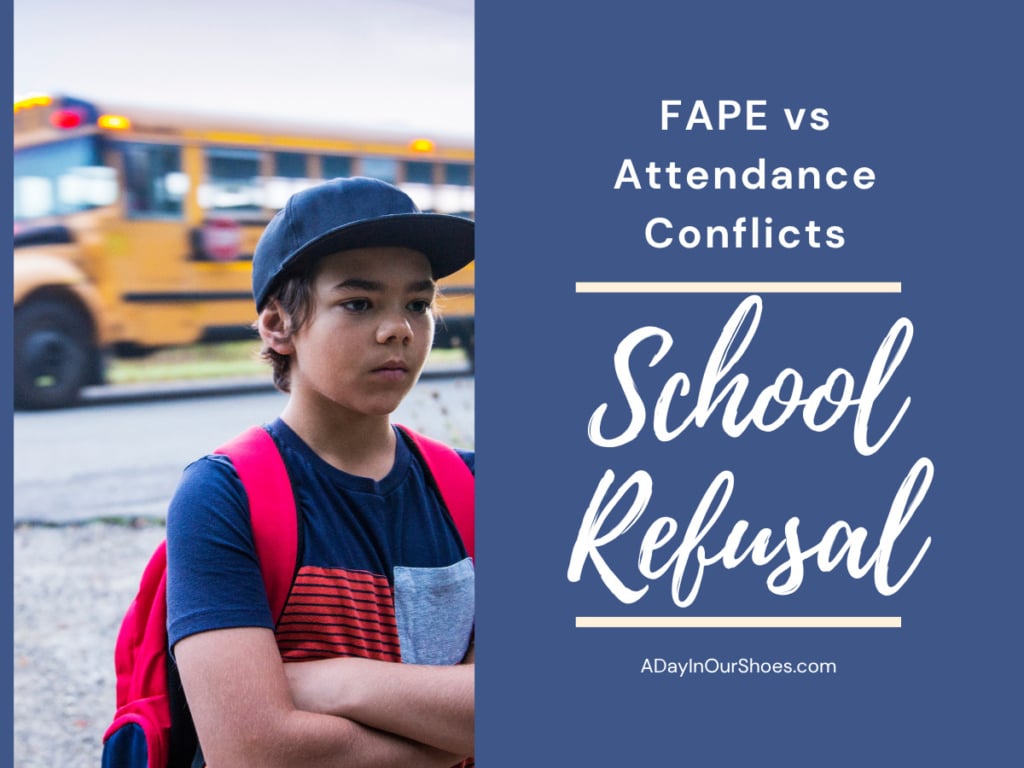
Understanding how these two obligations interact is key. It helps explain why some situations are treated as truancy, while others require evaluation, supports, and program changes. More importantly, it provides a framework for how to move the conversation from enforcement to problem-solving when a student is unable to attend. If you’re new to school refusal, start here.
Attendance vs FAPE
When attendance and a student’s needs conflict, the school’s obligation to provide a Free Appropriate Public Education (FAPE) does not disappear. Schools are required to address the barriers preventing a student from accessing education, not just enforce attendance policies.
Attendance laws still exist, and schools are responsible for monitoring and responding to absences. However, if a student is unable to attend due to a disability or unmet needs, the response should include evaluation, supports, and adjustments—not just enforcement.
In practice, this means that attendance concerns should trigger problem-solving. If a student cannot access school in its current form, the question becomes what needs to change so that they can.
Why This Conflict Happens
The tension between attendance and FAPE exists because schools are operating under multiple obligations at the same time.
On one hand, schools are responsible for enforcing attendance laws. These requirements are often closely monitored and tied to reporting, funding, and accountability measures. As a result, attendance is treated as a priority across most systems.
On the other hand, schools are required under IDEA to provide an appropriate education to students with disabilities. This includes identifying needs, providing supports, and adjusting programs when necessary.
The challenge is that there is no clear, unified framework for how to handle situations where a student cannot attend due to those needs. As a result, teams are often left to interpret how to balance these responsibilities.
In practice, this can lead to a focus on attendance first, particularly when systems are under pressure to improve attendance rates. Without a clear process for addressing school refusal, responses can vary widely, and the underlying issues may not be addressed consistently.
IDEA Doesn’t Say “School Refusal”—Now What?
One of the reasons this issue can be difficult to navigate is that IDEA does not use the term “school refusal.” Instead, it focuses on eligibility categories and educational needs.
This means that school refusal, on its own, is not a category that automatically triggers services. Instead, teams must determine whether the student qualifies under an existing category, such as emotional disturbance, other health impairment, or another applicable classification.
The focus should be on how the student’s needs impact their ability to access education. If anxiety, medical conditions, or other factors are preventing attendance, those needs can still be addressed within the framework of IDEA.
This can create challenges in interpretation. Some teams may focus on whether the student meets criteria under a specific category, while others may look more broadly at how the student’s needs are affecting access to school.
For families, this often means connecting the dots between the student’s difficulties and their educational impact. It is not just about identifying that a student is missing school, but explaining why and how that relates to their ability to learn.
What Schools Are Legally Required to Do
When school refusal occurs, there is often confusion about what schools are actually required to do. While laws do not specifically use the term “school refusal,” there are clear obligations that apply when a student is unable to attend due to suspected or identified needs.
First, schools have a Child Find obligation. This means that if there is reason to suspect a disability—such as anxiety, emotional distress, or other factors impacting attendance—the school must consider whether an evaluation is needed. They cannot wait for the situation to resolve on its own if there are clear signs that a student is struggling to access education.
Second, schools are required to evaluate in all areas of suspected need. If attendance issues may be related to anxiety, executive functioning, sensory needs, or other factors, evaluations should reflect those areas—not just behavior or academics.
Third, if a student is eligible, schools must provide a Free Appropriate Public Education (FAPE). This includes developing and implementing an IEP that allows the student to access and make progress in their education. If the current plan is not working—such as when a student cannot attend consistently—the team is required to revisit and adjust it.
Schools are also responsible for implementing agreed-upon supports and services. An IEP or 504 plan is not just a document; it must be followed in practice. If supports are not being implemented, or are not effective, that needs to be addressed.
Finally, schools must consider placement and program changes when necessary. If a student cannot access their education in the current setting, the team may need to consider alternatives, such as schedule adjustments, different environments, or other options that better meet the student’s needs.
These responsibilities do not replace attendance requirements, but they do shape how attendance issues should be addressed. When a student is unable to attend, the response should include evaluation, support, and adjustment, not just enforcement.
When Attendance Issues Become a Denial of FAPE
Attendance becomes a FAPE issue when a student is unable to access their education due to unmet needs, and appropriate adjustments are not made.
One way to think about this is through a series of questions:
- Is the student able to attend and participate in their current program?
- If not, what barriers are preventing that?
- What has the school done to address those barriers?
If a student is missing significant amounts of school and there is no effective plan in place to address the cause, it raises concerns about whether the program is appropriate.
Missed instruction is not just a matter of attendance—it directly affects a student’s ability to make progress. If the current program does not allow the student to access instruction, changes may be needed.
This does not mean that every absence automatically results in a denial of FAPE. However, when absences are ongoing and connected to unmet needs, and when adjustments are not being made, it becomes an issue that should be addressed through the IEP process.
How to Advocate When Schools Focus Only on Attendance
When conversations focus only on attendance, it can be helpful to shift the discussion toward access and need.
Instead of focusing solely on the number of days missed, describe how the situation is affecting your child’s ability to participate in school. For example:
- “My child is currently unable to access their education due to…”
- “This is impacting their ability to attend and participate consistently…”
This reframing connects the issue to the school’s responsibility under IDEA.
Documentation is also important. Keep records of absences, communication, and any patterns you are observing. This helps establish that the issue is ongoing and requires attention.
Request meetings and follow up in writing. If the current supports are not effective, ask what changes can be made and how the team will measure whether those changes are working.
The goal is not to avoid discussions about attendance, but to ensure that those discussions include the reasons behind it and the supports needed to address it.
Where Attendance and FAPE Meet
Attendance and FAPE are often treated as separate issues, but in practice, they are closely connected. When a student is able to attend and participate, attendance systems function as intended. When a student cannot, the situation requires a different approach.
The key question is not simply whether a student is attending, but whether they are able to access their education in its current form. If they are not, the responsibility shifts toward identifying barriers and making adjustments.
This does not eliminate the importance of attendance, but it does change how it should be addressed. A focus on access, supported by documentation and clear communication, helps ensure that decisions are based on the student’s needs rather than attendance alone.
When these two areas are aligned—attendance expectations and appropriate supports—students are more likely to return to school in a way that is both realistic and sustainable.