Community Helper Sorting Activity: Free Printable Sorting Mats PDF
One of my favorite questions to ask young children is, “How do you know?” Not because I’m trying to stump them, but because it’s amazing to hear how they think.
Show a child a stethoscope and they’ll probably tell you it belongs to a doctor. Show them a fire hose, and they’ll point to the firefighter. But ask why those tools belong to those community helpers, and now you’re building vocabulary, reasoning, and language instead of just memorizing pictures.
That’s why I like sorting activities.
They’re simple enough for young learners to understand, but they also encourage children to notice details, compare objects, and explain their thinking.
You may also find the activities below a nice complement if teaching a Community Helpers unit.
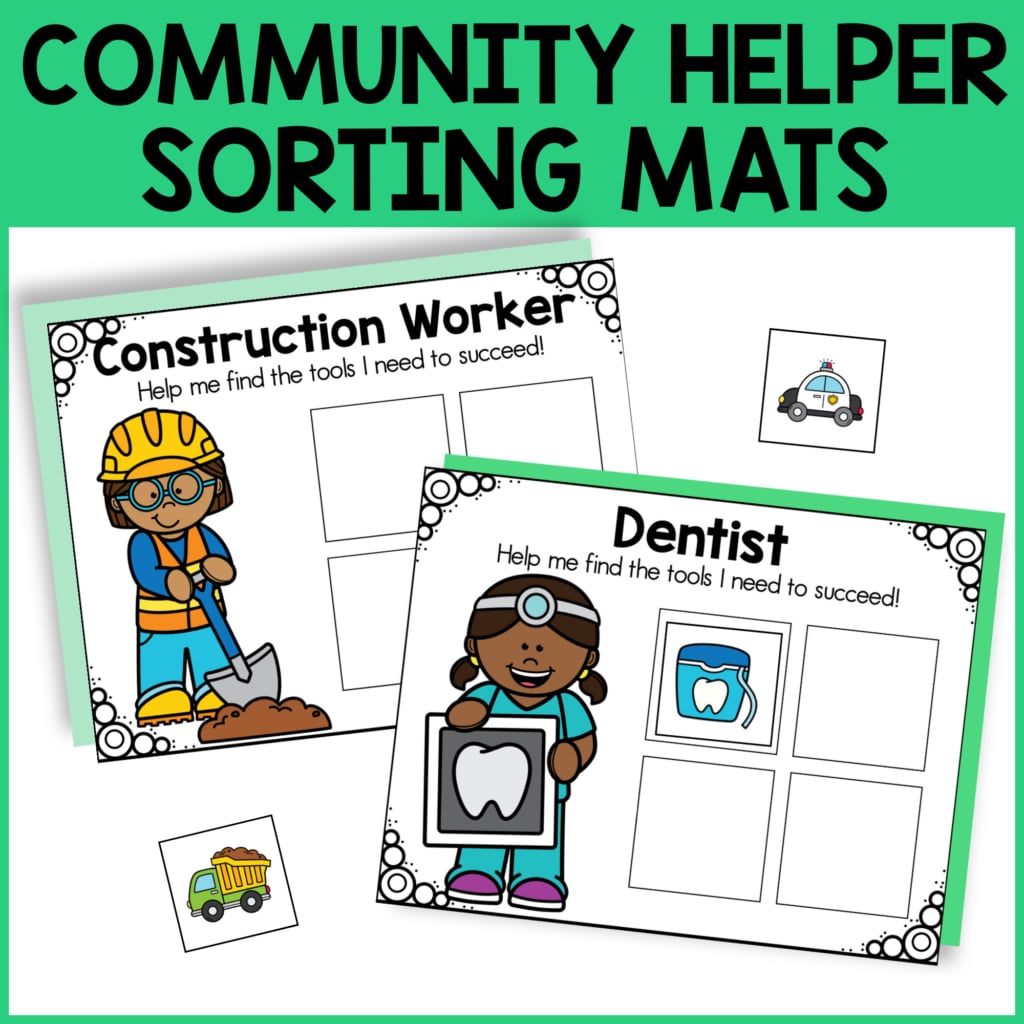
These printable community helper sorting mats ask children to match tools and objects with the people who use them every day. The set includes familiar occupations like police officers, firefighters, teachers, doctors, dentists, librarians, veterinarians, mechanics, farmers, cashiers, construction workers, and mail carriers, along with picture cards that children sort onto the correct mat. Both color and black-and-white versions are included.
While this looks like a simple matching game, there’s quite a bit of learning happening.
Children are practicing categorization as they decide which objects belong together. They’re expanding their vocabulary by learning the names of tools they may not have seen before. They’re also strengthening visual discrimination skills as they compare pictures that are sometimes very similar.
Community Helpers Sorting Activity Mats
If you teach preschool or kindergarten, these community helper sorting mats make an easy literacy center or small-group activity. I also like using them as a whole-class discussion before letting children work independently.
Instead of immediately telling them whether an answer is right or wrong, ask them to explain their thinking. Sometimes the conversation is more valuable than the sorting itself.
This printable also works well as a community helper sort and classify activity. Sorting and classifying are foundational skills for math, science, reading, and everyday problem solving. Long before children are expected to analyze information in school, they’re learning to group objects by what they have in common. Community helpers provide a familiar, engaging way to practice those skills.
And, as you’ve probably noticed if you’ve spent any time on my site, I don’t get too attached to age recommendations. Yes, these mats are perfect for preschool and kindergarten, but many older students with autism, intellectual disabilities, language delays, or other developmental disabilities are working on the same underlying skills.
Matching, categorizing, answering WH questions, describing objects, and building functional vocabulary are all important IEP goals. I would always choose an activity based on the student’s instructional level and goals rather than the number of candles on their birthday cake.
There are plenty of ways to extend this activity beyond simply matching the pictures. Ask children to name another tool each community helper might use. Talk about where each person works. Compare occupations that use similar tools, or discuss which community helpers they have met in real life.
Before long, a simple community helper sorting activity has turned into a conversation about neighborhoods, jobs, problem-solving, and how people work together to help a community function.
If you’re putting together a complete community helpers unit, these sorting mats pair nicely with coloring pages, foldouts, pretend play, and other hands-on activities. The more opportunities children have to see these occupations in different contexts, the more meaningful the learning becomes.