
Sports Math Activities: Using Patterns to Build Early Math Skills
You don’t have to convince every child that worksheets are exciting. Sometimes you just need to meet them halfway.
If you’ve got a child who can name every NFL team but suddenly has somewhere very important to be when the math work comes out, try bringing some of that interest into the lesson.
These sports math activities use basketballs, footballs, soccer balls, baseballs, trophies, jerseys and other familiar sports pictures to practice an important early math concept: recognizing and extending patterns.
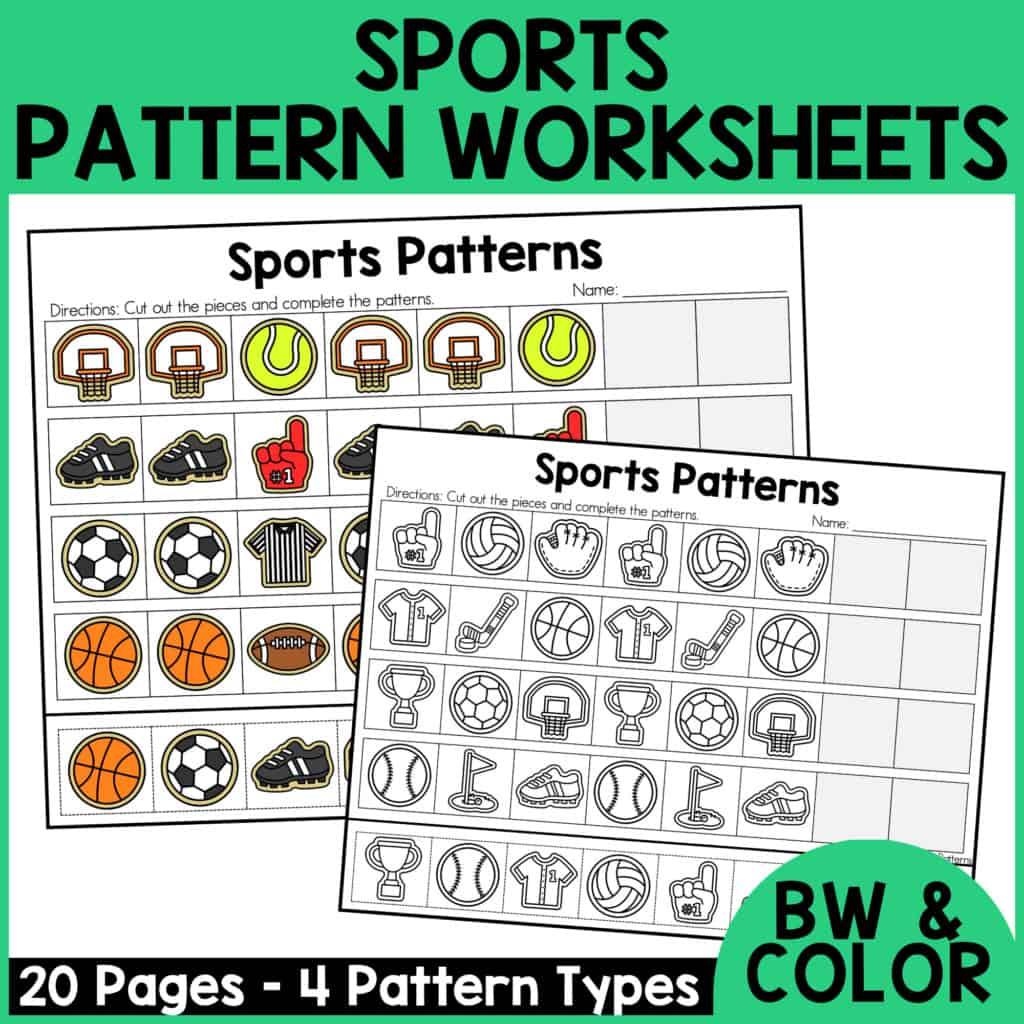
I’ve also included a set of 40 printable sports pattern worksheets with AB, ABC, AAB and ABB patterns, so you can take the same skill from hands-on practice to paper.
More Patterns Worksheets:
Why Teach Math Patterns?
Pattern activities can look simple. Football, basketball, football, basketball. What comes next?
But there’s more going on than choosing the basketball. Students have to look at the sequence, compare the items, identify what is repeating and use that information to predict what comes next.
And that’s the part I want adults to pay attention to. A child getting the answer right doesn’t always mean they understand the pattern.
They may have guessed. They may have looked only at the picture immediately before the blank.
Or they may actually understand that a specific sequence is repeating. So don’t stop at, “Yep, basketball. Good job.” Ask, “How did you know?”
And, I have basketball worksheets too–if that works.
Printable Sports Pattern Worksheets
Once students have practiced making and extending patterns, these sports pattern worksheets provide structured practice.
The complete printable has 40 worksheets.
The first 20 are in color, followed by matching black-and-white versions. Students work through AB, ABC, AAB and ABB patterns using pictures from several different sports. Each page contains four patterns with two empty spaces to complete and cut-apart picture choices along the bottom.
The pictures include sports balls and equipment from football, basketball, baseball, soccer, volleyball, tennis, hockey and golf, along with jerseys, helmets, trophies, referees, athletic shoes and other sports-themed images.
Download the Sports Math Pattern Worksheets
The printable set includes 40 sports pattern worksheets for preschool and kindergarten students working on AB, ABC, AAB and ABB patterns.
Students identify what is repeating and cut and paste the missing sports pictures to extend each pattern. There are 20 full-color worksheets plus 20 matching black-and-white worksheets.
Use them for math centers, small groups, special education, intervention, homeschool or as follow-up practice after hands-on pattern activities.
Turn Sports Into a Hands-On Math Activity
Before using the worksheets, try building sports patterns with objects. If you have small sports toys, stickers or counters, great.
If you don’t, don’t go buy them. Your preschool math lesson does not need its own equipment budget.
Print or draw simple pictures of two sports balls and create an AB pattern: Basketball, soccer ball, basketball, soccer ball.
Ask the child what comes next.
Then change the pictures but keep the pattern structure the same: Football, baseball, football, baseball. The pictures changed. The AB pattern didn’t.
That’s an important concept because it helps students learn that “AB” describes the relationship between the items, not the specific pictures.
Use Student Interests Without Changing the Goal
Sports are a strong interest for some kids. Use that.
If a child loves basketball, let them create a basketball-themed pattern. If another child couldn’t care less about basketball but loves soccer, use soccer.
Student interests can be a doorway into an activity without becoming the entire activity. And, as always, interest is individual.
Slapping a football on something doesn’t automatically make it engaging. If it did, educational publishing would be much easier.
Don’t Let Cutting Become the Assignment
These are cut-and-paste worksheets, and that’s useful for students who also need fine motor practice.
But watch what happens.
If a student spends 15 minutes trying to cut out a tiny soccer ball and 30 seconds working on the pattern, you’ve accidentally created a cutting activity with a little math on the side.
If pattern recognition is your goal, you can pre-cut the answer choices.
You can also laminate the color pages and add Velcro, have the student point to the correct picture, or let them place a counter over their answer.
This is particularly important for students with motor disabilities or fine motor needs.
An accommodation should remove the barrier without removing the skill you’re trying to teach.
Add Language Without Turning It Into a Language Test
Sports pattern activities also give you opportunities to work on descriptive and positional language.
You can model phrases such as:
“The football comes after the basketball.”
“The soccer ball repeats every other picture.”
“I see two basketballs and then one football.”
But don’t require a child to know the name of every piece of sports equipment to demonstrate that they understand patterns.
A child may recognize exactly what repeats while having no idea that the picture is a hockey stick.
Make Your Own Sports Patterns
Once students can complete patterns you’ve created, turn the activity around.
Have them make the pattern.
Give the student several sports pictures and ask them to create an AB pattern for you to finish.
Then try ABC.
If they’re ready, challenge them to make an AAB or ABB pattern.
You can even make a mistake on purpose.
Complete their pattern incorrectly and see whether they catch you.
Kids tend to find correcting adults considerably more entertaining than completing worksheets. Might as well use that to our advantage.
How I Would Use These in a Classroom
I wouldn’t print all 40 worksheets and staple them together.
The variety is there so you can choose what you need.
If students are learning AB patterns, use those pages. Once they consistently recognize and extend AB patterns, introduce ABC patterns.
Then move into AAB and ABB.
You can use the color pages for reusable centers and the black-and-white versions for independent practice, morning work, take-home practice or quick checks.
And if you’re collecting data, don’t just record whether the worksheet was completed.
Look at how much support the student needed.
- Did they complete the pattern independently?
- Did they need the choices reduced?
- Did you have to identify the repeating unit for them?
- Could they explain or demonstrate why their answer was correct?
That’s much more useful information than a percentage written at the top of the page.