
Free Behavior Reflection Sheet PDF: Think Sheets for Elementary and Middle School
A student has a rough moment at school. Maybe they yelled or they refused to do the work. Or maybe even left the classroom. And then out comes the behavior reflection sheet from your stash of resources.
You may also hear it called a think sheet, student reflection sheet, or PBIS reflection sheet. Ideally, these worksheets are supposed to help a student slow down, think about what happened, and figure out what they can do differently next time.
In practice? Well, handing a dysregulated kid a worksheet and telling them to “reflect on their choices” does not magically teach emotional regulation.
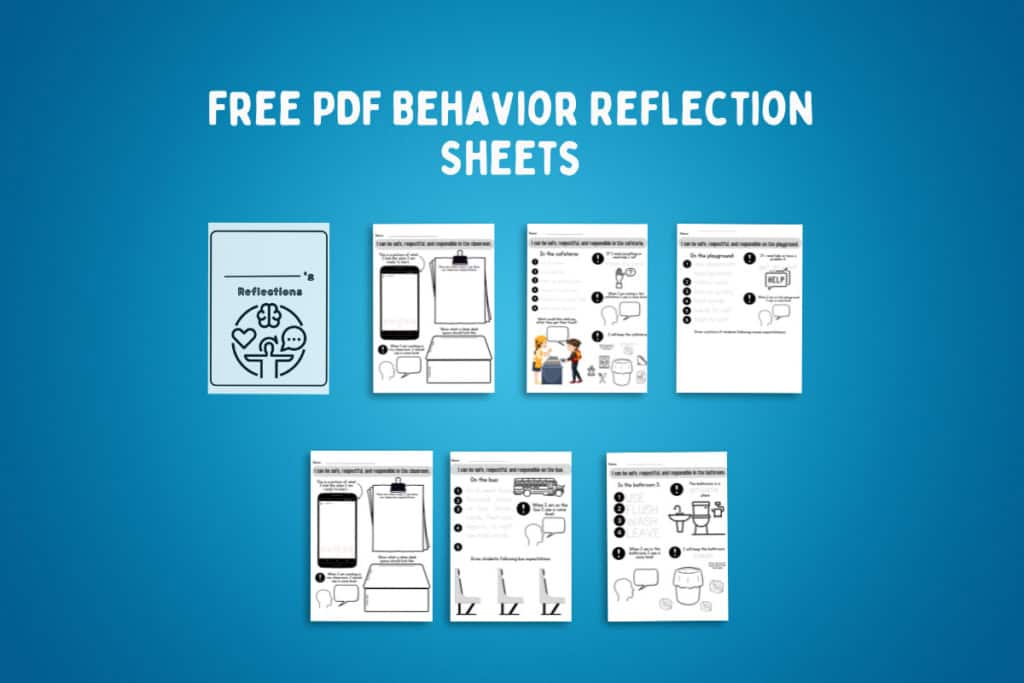
Wouldn’t that be convenient, though? This free behavior reflection sheet PDF is a set of simple, visual worksheets for students. The printable includes reflection pages for the classroom, bathroom, hallway, bus, playground and cafeteria. Each page focuses on being safe, respectful and responsible in that particular setting.
You Need IEP Data. You Also Need to Teach.
IEP progress monitoring has to get done, but it shouldn’t take hours. You need a system that’s simple enough to actually use in a real classroom.
Get teacher-created, ready-to-use tools that help you track IEP goals, document meaningful progress, and write progress reports faster, without adding more paperwork to your day. Save time, stay compliant.
But before you download your free printable think sheets, there are a few things parents and teachers should know about using them.
What Is a Behavior Reflection Sheet?
A behavior reflection sheet is a worksheet used to help a student review expectations after a behavior incident or as part of teaching expected behavior.
Sometimes schools use a student behavior reflection sheet after something has already happened. Other times, teachers use one proactively to teach or review expectations.
Reflection should help a child learn a skill. It shouldn’t just be punishment with a pencil.
A good behavior reflection worksheet can help a student identify things such as:
- what the expectation is
- what safe behavior looks like
- what respectful behavior looks like
- what responsible behavior looks like
- what they can do in a particular school setting
- who they can ask for help
The printable included here uses pictures, drawing prompts, tracing and short responses rather than expecting students to write an essay about what happened.
Free Printable Behavior Reflection Sheets for School
You can download the complete free behavior reflection sheet PDF below.
It includes printable pages for:
- classroom expectations
- bathroom expectations
- hallway expectations
- bus expectations
- playground expectations
- cafeteria expectations
Each page reinforces the same basic theme: I can be safe, respectful, and responsible.
Free Behavior Reflection Sheet PDF
This printable contains six student reflection pages covering common school environments:
- Classroom: Students identify what being ready to learn looks like, appropriate voice level, what a clean desk looks like and other classroom expectations.
- Bathroom: Students review privacy, voice level, cleanliness and the sequence “use, flush, wash, leave.”
- Hallway: Students review walking appropriately, keeping hands and feet to themselves, going directly to their destination, returning to class and using a nurse pass when appropriate.
- Bus: Students review sitting in their seat, facing forward, listening to the driver, keeping hands, feet and objects to themselves and using kind words.
- Playground: Students review appropriate equipment use, following rules, lining up, using kind words and getting an adult when they need help.
- Cafeteria: Students review staying seated, cleaning their eating area, throwing away trash, standing in line when directed and raising a hand when they need help.
Think Sheet for Behavior: Free Printable vs. Punishment
Here’s where I want parents to pay attention. A think sheet for behavior free printable is a tool.
That’s it. It isn’t a behavior plan or an FBA or specially designed instruction. It can be an activity that is done after incidents if the child has behavior IEP goals.
And repeatedly sending a child to complete a sheet doesn’t address why a behavior keeps occurring.
If a student repeatedly struggles with the same behavior, we need to move beyond: “You know the rules.” Knowing an expectation and being able to consistently meet that expectation are two very different things.
A child may know perfectly well that they’re supposed to keep their hands to themselves and still lack the impulse control, communication skills, emotional regulation, sensory regulation or other skills necessary to do that consistently.
That’s where adults have to do some thinking too. Yes, us. Rude, I know.
Behavior Reflection Is Not the Same as Behavior Support
Parents tell me all the time that schools are struggling to get past punitive consequences and actually address emotional regulation and executive functioning needs. Others report having behavior plans that simply aren’t working.
That’s why behavior reflection should not become the entire intervention.
If your child keeps bringing home a reflection sheet for kids behavior, don’t focus only on what your child wrote on the sheet.
- Ask what the data says.
- Look for patterns.
- When is this happening?
- Where?
- During which activities?
- What happened immediately before the behavior?
- What happened afterward?
- What skill does the child appear to need?
If the behavior is interfering with learning, the IEP team may need to look more closely at behavioral needs and appropriate supports.
A stack of completed worksheets isn’t meaningful progress monitoring simply because someone put dates on them.
Elementary Behavior Reflection Sheet
An elementary behavior reflection sheet should be developmentally appropriate.
A young child who struggles with language, writing, executive functioning or emotional regulation shouldn’t need to produce three paragraphs explaining the socioeconomic consequences of throwing a crayon.
For younger students, keep it concrete and visual. That’s one reason this behavior reflection sheet elementary PDF uses drawing, tracing, pictures and simple prompts.
For example, students can draw what a clean desk looks like, illustrate children following hallway expectations, show where trash belongs and identify appropriate voice levels.
That makes the worksheet more accessible than relying entirely on written responses.
Middle School Behavior Reflection Sheet
A middle school behavior reflection sheet should look different from one designed for a first grader.
Middle school students still need explicit instruction. Getting older doesn’t magically install executive functioning skills overnight. I wish.
For a middle school reflection sheet, I would focus less on tracing basic rules and more on helping the student identify:
- what happened
- what they were expected to do
- what they were thinking or feeling
- what made the situation difficult
- what strategy they could use
- what support they needed but didn’t have
- what they can try next time
A behavior reflection sheet middle school PDF can be useful, but only if the student has the skills necessary to complete it meaningfully.
If you’re searching specifically for a middle school think sheet.pdf, don’t assume any worksheet labeled “middle school” is automatically appropriate. Look at the student’s actual disability-related needs, communication abilities and developmental level.
Student Reflection Sheet vs. Student Behavior Reflection Sheet
A student reflection sheet doesn’t always have to follow a negative incident.
In fact, reflection can be much more useful when we stop treating it as something children only do when they’re “in trouble.”
A student behavior reflection sheet PDF can also be used proactively.
- Before a field trip, review expectations.
- Before the first bus ride, review bus expectations.
- If cafeteria noise is difficult, talk about what the student can do and whom they can ask for help.
- Before returning from a long school break, review routines.
Now we’re actually teaching.
PBIS Reflection Sheet and PBIS Think Sheet
A PBIS reflection sheet or PBIS think sheet may be used as part of a school’s Positive Behavioral Interventions and Supports framework.
Again, the worksheet itself isn’t the intervention.
The important part is what adults do with the information.
If the student is repeatedly completing the same behavior reflection sheet PDF for the same problem, I’d want to know why the intervention isn’t changing.
Because at some point, repeatedly documenting that a child cannot do something without changing the support isn’t terribly useful.
We already know they can’t do it.
Now what?
How to Use Free Printable Think Sheets
If you’re using free printable think sheets, I recommend treating them as teaching and communication tools rather than automatic consequences.
Use the sheet when the student is calm enough to participate. Review the answers with the child rather than merely collecting the paper. Adjust the amount of writing to the student’s abilities. Allow drawing, pointing, dictation or other response methods when appropriate.
Most importantly, use what you learn.
- If the student identifies noise as a trigger, that’s information.
- If transitions repeatedly cause problems, that’s information.
- If they don’t know what to do when frustrated, that’s information.
- If they can recite every expectation perfectly but still cannot perform it consistently, that’s information too.
When Behavior Reflections Keep Coming Home
One behavior reflection sheet after an unusual incident is one thing.
A folder full of them is another. If your child has an IEP and you’re seeing repeated behavior incidents, start documenting.
Don’t settle for “He had another bad day.” Ask for specifics.
What happened? How often? How long did it last? What was happening immediately beforehand? What intervention was attempted? Did it work? Is there a pattern across days, settings, staff or demands?
Parents consistently tell me that behavior, inadequate data, inconsistent implementation and ineffective behavior supports are among their biggest IEP concerns.
You cannot make good IEP decisions without good information. Use them to teach expectations, start conversations and gather information. Just don’t confuse completing a worksheet with actually teaching a missing skill.
Because if think sheets alone fixed behavior, I’d print 500 of them and retire.