Types of Clouds for Kids: Free Cloud Worksheets and Activities
Clouds are one of those science topics that are conveniently available pretty much everywhere.
No special equipment or trip to the science museum. No supplies you forgot to buy even though they’re somehow essential to tomorrow’s lesson. Just go outside and look up.
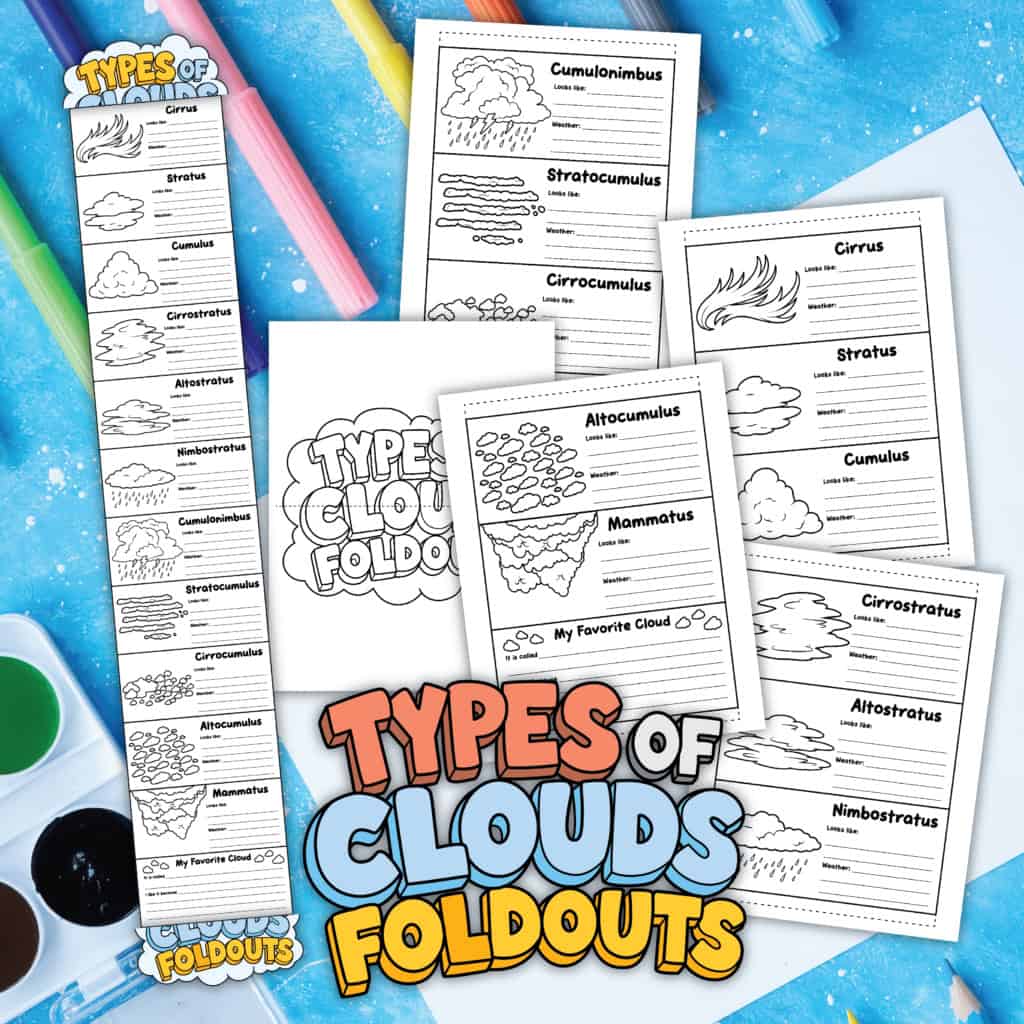
These types of clouds worksheets give kids a way to take what they’re learning about clouds and organize it. Students explore different cloud types, describe what each one looks like, and record the kind of weather associated with it.
The printable covers 11 different types of clouds, including some of the familiar ones kids usually learn first and several they may not have encountered yet.
- Natural Disasters Coloring and Learning Activity
- School/Child Care Emergency Plan PDF (not a kids’ activity, adult resource for storms and emergencies)
What Are the Different Types of Clouds?
Most elementary cloud lessons begin with three types: cirrus, cumulus and stratus. That’s a good starting point because these clouds have noticeably different appearances.
But there are many more cloud types, and this printable goes beyond the basic three.
Students will be introduced to:
- Cirrus
- Cumulus
- stratus
- cirrostratus
- altostratus
- nimbostratus
- cumulonimbus
- stratocumulus
- cirrocumulus
- altocumulus
- mammatus
That’s a lot of cloud vocabulary. And no, I wouldn’t expect a young child to memorize all 11 because we handed them four pieces of paper.
The worksheets are better used as a tool for exploring and comparing the different clouds.
A Note for Students With Language or Communication Needs
Cloud vocabulary can be tricky, especially for students with speech, language, reading, or processing difficulties. Many of these words look and sound very similar: cirrus, cirrostratus, cirrocumulus, cumulus, cumulonimbus, stratus, stratocumulus, altostratus, altocumulus, and nimbostratus are a lot to sort out.
Instead of expecting students to memorize all 11 names at once, introduce just two or three at a time and pair each word with a clear picture. Color coding the word parts can help too. For example, students can begin noticing that cirro-, alto-, stratus, and cumulus show up in more than one cloud name.
Keep the visual available while students answer questions, and allow pointing, matching, selecting from choices, or using AAC instead of requiring students to pronounce or recall every cloud name independently. Fact is, most adults would struggle to learn all 11 of these words and sort them out in our head.
Learning Types of Clouds
Start with clouds kids can easily distinguish.
- Cumulus clouds are probably what many kids picture when someone says “cloud.” They have the puffy, cotton-like appearance that has inspired generations of children to announce that one looks exactly like a dinosaur.
- Cirrus clouds look thinner and more wispy.
- Stratus clouds tend to form flatter layers or sheets across the sky.
Once kids understand those basic differences, you can introduce some of the other cloud types and start looking for similarities in their names and appearances.
For example, they’ll encounter both cirrus and cirrostratus, cumulus and cumulonimbus, and stratus and stratocumulus.
Rather than treating those as a giant list of words to memorize, use them to look for patterns.
Download the Free Types of Clouds Worksheets
This printable includes four pages of cloud activities covering 11 different cloud types. Students can describe what each cloud looks like and the weather associated with it, then choose and write about their favorite cloud.
Use the worksheets for a weather unit, elementary science lesson, homeschool activity, cloud observation project or alongside books and videos about weather.
Then go outside and see what’s actually up there.
Types of Clouds Worksheets
Here are some suggestions for how to use these worksheets on the types of clouds. Each section of the printable gives students an illustration of a particular cloud type along with two prompts:
Looks like:
Weather:
Students can research the cloud and write what they’ve learned in those spaces.
You could use books, classroom materials or an age-appropriate weather resource to complete the pages.
But I’d also take the activity outside.
Have students look at the actual sky and compare what they see with the cloud illustrations they’re studying.
- Can they identify any clouds?
- What do they notice about the shape?
- Are the clouds high and wispy, low and flat, or big and puffy?
- What is the weather doing?
Now the worksheet is connected to something they can actually observe rather than being another science vocabulary exercise.
Make a Cloud Observation Journal
This is also an easy activity to extend over several days.
Have students check the sky at roughly the same time each day. They can draw the clouds they see and record the weather.
- Sunny?
- Cloudy?
- Rainy?
- Windy?
Then compare the observations at the end of the week.
You don’t need a complicated meteorology unit. A notebook and five minutes outside can give kids plenty to observe.
And if you live somewhere where the sky does essentially the same thing for five days straight, well, congratulations. You’ve collected very consistent data.
Clouds and Weather
One reason clouds are a useful science topic is that kids can begin connecting what they see in the sky with weather.
The printable intentionally asks students to record both what each cloud looks like and the weather associated with it.
- That opens up questions beyond simply “What is this cloud called?”
- Which clouds are associated with rain?
- Which might appear during a thunderstorm?
- What kinds of clouds do we see on fair-weather days?
- Do some clouds look similar even though they form at different heights?
For younger learners, keep those conversations simple. Older or more advanced students can research cloud height, formation and precipitation in more detail.
Cumulonimbus Clouds Are Usually the Crowd-Pleaser
If you’re teaching clouds to kids, cumulonimbus tends to get some attention.
Thunder! Lightning! Big dramatic clouds!
The cumulonimbus section of this printable even shows the cloud with rain and lightning underneath it, giving students a strong visual clue about the weather they should investigate.
Then there are mammatus clouds on the final page, which have a very different appearance from the other cloud illustrations.
That’s a good opportunity to compare two unusual-looking cloud formations and talk about how different the sky can look depending on weather conditions.
Basically, clouds are considerably more interesting once we get past “white fluffy thing.”
My Favorite Cloud Activity
The final section is simple, but I like it. Students choose their favorite cloud, write what it is called, and explain why they like it.
That adds a little writing to the science lesson without requiring a five-paragraph essay on cumulonimbus clouds.
Students could also draw their favorite cloud in the space or explain where they might expect to see it.
For students who have difficulty writing, let them dictate their response, point to a cloud, draw it, or answer verbally. Knowing something about clouds and physically writing a sentence about clouds are two separate skills.
What Grade Level Are These Cloud Worksheets For?
I’d primarily use these with first through third grade, depending on how much support students receive.
Younger students can focus on the most recognizable cloud types and complete the activity orally or with adult support. Older students can research all 11 types and provide more detailed descriptions.
For special education, I’d select the number of clouds and response method based on the student’s instructional needs.
Eleven unfamiliar science terms can be a lot.
There’s no reason a student has to complete all of them in one lesson just because they are in the same free PDF cloud packet.