
Scissor Skills Activities PDF | Free Haircut Worksheets
Scissor skills take practice, and handing a kid a pair of scissors and hoping for the best usually isn’t much of a lesson plan. These free scissor skills worksheets give kids a fun way to practice using scissors while working on control, coordination, and following cutting lines.
The scissor skills activities PDF includes printable worksheets you can use at home, in preschool or kindergarten, in a fine motor center, or with students who need additional practice.
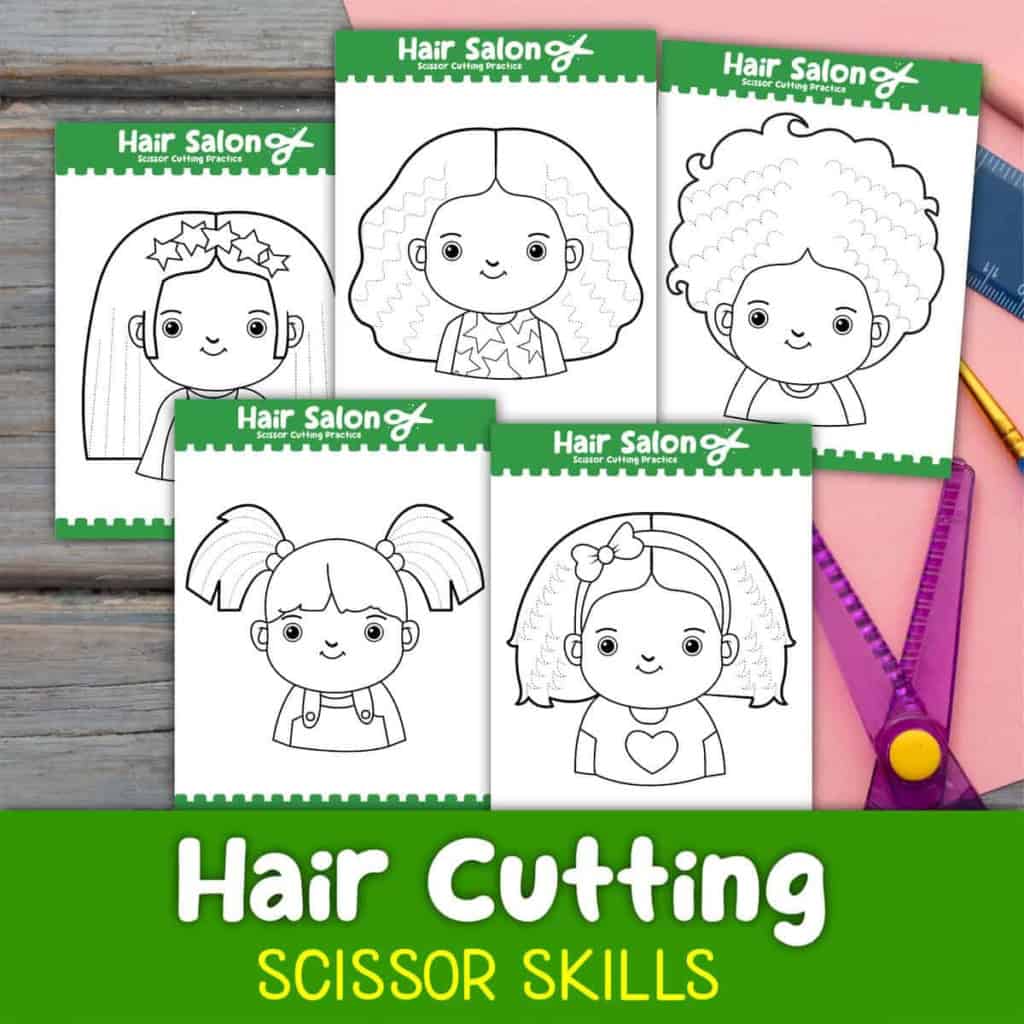
And because cutting another random dotted line gets old pretty quickly, this set includes scissor skills haircut worksheets that turn practice into a pretend hair-cutting activity. Kids can give the characters a haircut while practicing their scissor skills, and the paper is considerably more forgiving than your kid’s bangs. Download the free scissor skills activities PDF below and print the worksheets you want to use.
I just love these scissors skills worksheets. Combining scissors skills for kids with going to the barber or hairdresser, just genius! Scissors skills are an advanced fine motor skill.
If your child needs more basic practice before trying the haircut activities, I also have a separate set of free cutting practice worksheets with activities for working on those beginning cutting skills. (and they have a school theme)
Free Scissor Skills Haircut Worksheets
Something about cutting pretend hair is considerably more interesting to many kids than cutting another dotted line across a blank piece of paper.
These scissor skills haircut worksheets turn cutting practice into a pretend hair salon activity. Kids can cut along the lines to give the characters a “haircut” while practicing opening and closing scissors, controlling the direction of the scissors, and stopping at a designated point.
They’re an easy option for preschool and kindergarten cutting practice, fine motor centers, occupational therapy activities, or just extra practice at home.
And, unlike practicing on their sibling, the worksheet won’t complain about the results.
Download the Free Scissor Skills Haircut Worksheets
Here are those scissors skills worksheets for you. Just click the little down arrow button to download, then print them from your computer. (phone or device not recommended)
How to Teach Scissors Skills
Teaching scissor skills to kids can be a fun and rewarding process. It’s also an activity that can be done at home or at school so there are many opportunities for practice.
Here are some steps and tips to help teach children how to use scissors effectively:
- Choose the Right Scissors: Start by selecting child-safe scissors that are specifically designed for small hands. These scissors should have blunt tips and comfortable handles that are easy for kids to grip.
- Demonstrate Proper Technique: Show the child how to hold the scissors correctly. Their thumb should be in one handle loop and their middle finger in the other, while the index finger rests on the outside of the loop for stability. The remaining fingers can curl around the handle or be used for support.
- Practice Cutting Air: Before cutting paper, encourage the child to practice opening and closing the scissors while cutting through the air. This helps them get a feel for the motion and control of the scissors without the added pressure of cutting paper.
- Start with Simple Tasks: Begin with simple cutting tasks, such as cutting along straight lines or making snips along the edge of a piece of paper. Use paper with thick, straight lines to make cutting easier in the beginning.
- Provide Guidelines: Draw or trace lines and shapes on paper for the child to cut along. This gives them a visual guide to follow and helps them practice cutting with more precision.
- Use Playdough or Clay: Cutting through playdough or clay with scissors can be a fun way for kids to practice their cutting skills. It offers resistance similar to cutting paper but is often easier for beginners to manage.
- Offer Support and Encouragement: Be patient and provide plenty of positive reinforcement as the child practices. Encourage them to keep trying, even if they make mistakes, and offer assistance when needed.
- Gradually Increase Difficulty: As the child becomes more confident with basic cutting tasks, gradually introduce more challenging activities, such as cutting out shapes or cutting along curved lines.
- Make it Fun: Incorporate games, crafts, and activities that involve cutting to keep the child engaged and motivated. For example, cutting out pictures from magazines to make a collage or creating paper snowflakes.
- Supervise and Ensure Safety: Always supervise children while they are using scissors to ensure they are using them safely. Teach them never to run with scissors or to cut anything other than paper or approved materials.
By following these tips and providing plenty of opportunities for practice, children can gradually develop their scissor skills and gain confidence in using scissors effectively.
Scissors Skills for Preschool and Kindergarten
Children typically begin to develop basic scissor skills around the age of 2 to 3 years old, although the exact age can vary from child to child. Initially, they may start by simply snipping at paper with scissors, exploring how they work and gaining control over their hand movements.
As they grow older and their fine motor skills develop further, usually around ages 3 to 4, they begin to refine their scissor skills, cutting along lines and shapes with more precision and control. By around age 5, most children have developed the necessary hand-eye coordination and motor skills to cut more complex shapes and patterns with scissors.
However, it’s important to remember that every child develops at their own pace, so some may acquire scissor skills earlier or later than others. Giving a haircut to a face on paper is just too adorable. And there is so much to be learned. You can surround the activity with lots of language and storytelling. You can do role playing activities.
Autism and haircuts are a big “thing.” Many kids struggle with it. This scissors skill activity can help with that. If your child is struggling with scissors skills or any fine motor activity, you may want to ask for an OT evaluation.