
How Often Should You Receive IEP Progress Reports?
“How often should I receive an IEP progress report?” sounds like one of those IEP questions that should have a simple answer. And, like most things with IEPs, it sort of does.
Most parents are used to receiving IEP progress reports at the same time report cards come home, and there’s a reason for that. IDEA requires every IEP to state how the child’s progress toward annual goals will be measured and when periodic reports on that progress will be provided.
The regulation, at 34 CFR §300.320(a)(3), gives this as an example: “quarterly or other periodic reports, concurrent with the issuance of report cards.”
So yes, receiving IEP progress reports when report cards are issued is common and, for many students, completely appropriate.
But I want parents to pay attention to the actual wording because IDEA does not say that progress reports may only be provided with report cards. In fact, the regulation uses the words “such as” before giving quarterly reports and reports concurrent with report cards as examples. That leaves room for the IEP team to determine what makes sense for the individual child.
- IEP Present Levels: Why this is the most important part of an IEP.
- How to Write an IEP Parent Concerns Letter
- Why So Many IEP Behavior Plans Fail
What Does Concurrent With Report Cards Mean?
Concurrent just means “at the same time.”
If your school issues report cards four times a year, your child may receive four formal IEP progress reports each year. If your district uses trimesters, you may receive three. For plenty of kids, that schedule gives parents and the IEP team enough information to determine whether the student is making appropriate progress.
If your child’s needs are relatively stable, services are being provided consistently, the data shows expected progress and you don’t have concerns about implementation, I probably would not spend a lot of advocacy energy fighting for a progress report every two weeks.
But “we send IEP progress reports with report cards” is not the end of the discussion if your child’s needs warrant something different. Receiving more frequent progress monitoring reports is a small change to an IEP, and an IEP change that you can consent to via email.
The IEP itself is supposed to state when periodic reports on progress will be provided. The frequency should make sense for the child, the goal and the intervention being used. If waiting until the end of a nine-week marking period means a child could spend nine weeks receiving an intervention that isn’t working, I think it is reasonable for the IEP team to discuss whether more frequent reporting is necessary.
Nine weeks can be a really long time when a child is already struggling. And, I just heard from a reader yesterday who said her high school went to two semesters. That means the IEP students may not receive their first progress report until January!
Data Collection vs IEP Progress Monitoring
Data collection and progress monitoring are related, but they aren’t quite the same thing.
- Data collection is the actual gathering of information, such as how many times a behavior occurred, words read correctly per minute, percentage of problems solved correctly, level of prompting needed, and so on.
- Progress monitoring is what we do with that data over time: compare it to the baseline and IEP goal, look for trends, and determine whether the child is actually making progress. A teacher might collect data several times a week but review and summarize it for progress monitoring every few weeks.
The data points are the pieces; progress monitoring is looking at those pieces together to see what they’re telling us.
When I Would Ask for More Frequent IEP Progress Reports
There is no magic number that works for every IEP goal, and I don’t recommend asking for weekly reports simply because more sounds better. I would look at the severity of the need, how quickly you would expect to see measurable change, and how much instructional time could be lost before the team realizes that something isn’t working.
Here are some examples of situations where I would consider asking for something more frequent than the regular report-card schedule.
Moderate Behavior Concerns
If a student has an IEP goal addressing emotional regulation, task refusal, elopement, aggression or another behavior that regularly interferes with learning, I might ask for summarized progress information every four to six weeks rather than waiting until report cards.
What I want to see will depend on the behavior and how the goal is written. It might be frequency, duration, intensity, level of prompting, successful use of a replacement behavior or some combination of those things. The important part is that the data being collected actually tells us whether the student is progressing toward the goal.
If a behavior is happening several times a week and we wait nine weeks to look at the data, we may have lost a significant amount of instructional time before realizing that the current intervention needs to be adjusted.
Severe or Dangerous Behaviors
For severe aggression, frequent elopement, self-injurious behavior, significant school refusal or another behavior that affects safety or substantially limits a student’s access to education, I would expect much more frequent data collection and would likely ask for progress information weekly or every other week, depending on the circumstances.
This is also where I want to again distinguish between incident notification and progress monitoring. If the school calls me three times this week because my child hit someone, I know three incidents occurred. That does not necessarily tell me whether the behavior plan is working, whether the overall frequency or intensity of the behavior is changing, or whether the child is making progress on an IEP goal.
And yes, I can already hear some teachers saying, “Daily data? Are you kidding me?” In some situations, I really do mean daily data. That does not mean administering a formal assessment every day or spending half of a planning period filling out another ridiculous form. If a student has significant elopement, aggression, self-injury, school refusal or another behavior occurring throughout the school day, staff are already seeing whether it happened. Recording whether it occurred, how many times, how long it lasted or another agreed-upon measure is data collection.
Good data collection should be designed so that it is realistic for staff to implement and useful to the IEP team. If a child’s needs are significant enough that the team needs daily information to determine whether an intervention is working, or whether that child is safe and accessing their education, staff workload should influence how the data collection system is designed. It doesn’t make the need for the data disappear.
As an aside, I have IEP data collection and progress monitoring tools that do just this–save you time but still give you meaningful data.
Severe Reading Discrepancies
Let’s say you have a fifth grader who is reading at a first- or second-grade level and receiving specialized reading instruction. That is a significant discrepancy, and I would not be comfortable waiting nine weeks to find out whether an intensive reading intervention is working.
Depending on the intervention and the skill being measured, I might expect progress-monitoring data to be collected weekly or every other week, with summarized information provided to the parent every few weeks. I would also want the data to correspond to the actual reading deficit. A classroom grade or a score on a fifth-grade reading assignment isn’t necessarily going to tell me whether a child is improving in decoding, fluency, phonemic awareness or whatever specific reading skill is being remediated.
This is another important point for parents: data collection and progress reporting are not necessarily the same thing. A teacher may collect a quick data point weekly while the IEP says the parent will receive a summarized progress report every four weeks. That can be a perfectly reasonable arrangement because it gives the team enough information to identify a trend without requiring someone to create a formal report every Friday.
What I don’t want is to get to the end of another marking period and discover that a child who is already several years behind has made virtually no progress.
Significant Math or Writing Needs
The same general principle applies to math, writing and other academic areas. If the discrepancy is significant or the student has recently started a new intervention, I would want data frequently enough to know whether the student is responding to it.
Again, I want the data tied to the skill in the IEP goal. If the student has a math calculation goal, tell me how the student is performing on that skill. If the student has a written-expression goal, give me data related to whatever measurable components are identified in the goal.
Grades can be useful information, but grades and IEP progress are not interchangeable. A child can earn a B in English while still making inadequate progress on a specific writing goal, particularly when accommodations, modifications and other supports are being provided.
When IEP Progress Reports With Report Cards Are Probably Fine
There are many situations where I think receiving formal IEP progress reports with report cards is perfectly reasonable.
A child may have a speech articulation goal and be making steady, measurable progress. Another student may be working on an executive-functioning skill and consistently moving toward the annual goal. A student with an academic goal may have stable data showing that the intervention is working and that the child is progressing at the expected rate.
In those situations, I probably would not ask the team to produce additional formal progress reports just because they can. More paperwork does not automatically produce a better IEP, and special education teachers certainly have enough paperwork already.
What matters is whether the frequency gives the team enough information to recognize a problem and respond to it within a reasonable amount of time.
Advocate Recommendations
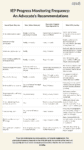
Here are some general recommendations. These are not IDEA-mandated timelines, and I would never recommend copying one of these into an IEP without considering the individual child. They are starting points for a conversation with the IEP team, based on almost two decades’ worth of advocacy experience.
| Area of Need or Situation | Data I’d Want Collected | Progress Reporting I Might Request | What I’d Want to See |
|---|---|---|---|
| Mild/stable academic needs | Weekly or biweekly, depending on the skill | Concurrent with report cards may be sufficient | Current performance compared with baseline and annual goal |
| Moderate reading discrepancy | Weekly or biweekly | Every 4–6 weeks | Skill-specific data such as accuracy, fluency, decoding or comprehension |
| Severe reading discrepancy | Weekly | Every 2–4 weeks | Objective measures showing whether the student is responding to the reading intervention |
| Math or writing significantly below grade level | Weekly or biweekly | Every 4–6 weeks | Data tied directly to the skill identified in the IEP goal, not just classroom grades |
| Speech/language with steady progress | During therapy or regularly as appropriate to the goal | Concurrent with report cards may be sufficient | Performance compared with baseline, including prompting or independence when relevant |
| Executive functioning | Weekly or biweekly | Every 4–6 weeks, or with report cards if progress is stable | Assignment completion, initiation, organization, prompts needed or another measurable target |
| Moderate behavior concerns | Daily or whenever the target behavior occurs | Every 2–4 weeks | Frequency, duration and/or intensity, depending on the behavior |
| Severe aggression, self-injury or elopement | Daily/event-based | Weekly or every 2 weeks | Frequency, duration, intensity and other measures identified by the IEP or BIP |
| School refusal/significant attendance concerns | Daily | Weekly or every 2 weeks while concerns are significant | Attendance, late arrivals, early dismissals, class attendance and data relevant to the student’s goal |
| Emotional regulation | Daily or several times per week | Every 2–4 weeks | Frequency or duration of dysregulation, support needed and successful use of strategies |
| New intervention or major IEP change | Frequently enough to evaluate the intervention | Every 2–4 weeks initially | Data showing whether the new intervention or service is producing improvement |
| Stable goals with consistent progress | At the frequency necessary to measure the goal | Concurrent with report cards is often reasonable | Clear data demonstrating continued progress toward the annual goal |
Again, these are professional recommendations, not federal requirements. The appropriate frequency depends on the child, the goal, the severity of the need and how quickly the team needs information to determine whether the intervention is working.
Your IEP Progress Report Should Actually Tell You Something
Parents tend to focus on whether the progress report arrived, but I also want you to look closely at what is on it.
You can receive an IEP progress report exactly when the IEP says you should receive one and still get a lousy progress report.
Comments such as “making progress,” “progressing toward goal” or “continue working on this skill” don’t give parents much useful information by themselves. Your child’s IEP is required to explain how progress toward each annual goal will be measured, so the information you receive should connect back to that measurable goal.
If the goal says your child will increase reading fluency from 42 correct words per minute to 80 correct words per minute, I want numbers that allow me to compare current performance with the baseline and the annual target. If the goal addresses the frequency of a behavior, I want frequency data. If the team is measuring independence, I want to know how independently the student is performing the skill and how much prompting is still required.
“Jacob is trying really hard” may be completely true, and I’m glad Jacob is trying really hard. It still doesn’t tell me whether Jacob is making measurable progress toward his IEP goal.
You Can Ask the IEP Team for More Frequent Reporting
If you believe your child’s situation warrants more frequent progress reports, bring it to the IEP team rather than relying on an informal request to “keep me updated.”
Explain why the current reporting schedule may not provide enough information soon enough to make decisions. For a child with a severe reading discrepancy, for example, I might write:
“My concern is that because of the severity of her reading deficit, receiving progress information only every nine weeks may not provide the team with enough information to determine promptly whether she is responding to the current reading intervention. I am requesting that the team discuss providing summarized progress-monitoring data every four weeks.”
That gives the team something specific to discuss and, more importantly, connects the request to the child’s individual needs rather than simply asking for “more communication.”
And yes, I would put the IEP change request in writing. You knew I was going to say that. And follow up with a PWN.
There isn’t one correct progress-reporting schedule for every child with an IEP. For some students, receiving progress reports concurrent with report cards is completely appropriate. For another student, monthly information may make more sense, while a child with intensive academic needs or significant behavioral concerns may require much more frequent data collection and reporting.
Look at the goal, the baseline, what is actually being measured and how quickly the team needs to know if the current approach isn’t working. If your child could lose weeks or months of valuable instructional time before anyone recognizes a lack of progress, then the frequency of progress reporting deserves another discussion with the IEP team.