
In a School Refusal Crisis? What to Do Right Now.
You’re in a school refusal crisis. Either you’re being called daily to come get your child, or their absences are now well into the double digits. Every morning is a struggle, you’re missing work and you don’t know what to do.
First, deep breaths (sorry if that sounds rudimentary). But it’s true. I understand the urgency associated with these situations, really I do. My own child has experienced short bouts of refusing to go to school. And, due to his many health issues, he has missed extended periods of school.
I am all too familiar with calling clients, canceling meetings because I have to stay with him, and the dwindling paycheck because of missing work. Before I was a self-employed advocate, my employer once had “the talk” with me about how much time I was missing from work (all from caring for K). I know that feeling in the pit of your stomach. I, too, have lost sleep wondering what laws am I protected under, with a disabled child.
But, since then, I’ve also worked with thousands of families–many dealing with these same issues. And I’ve gotten to see what works and what doesn’t. I want to say this, and I’ll say it gently: There are no quick fixes when it comes to school refusal. This crisis didn’t happen overnight, and it won’t be fixed overnight.
That may be hard to hear, but it’s the truth. Accepting this, and having a plan, is what works. Forcing a child to “just go to school” when that already isn’t happening, generally is not successful. If you’re new to school refusal, start here.
Quick Answer: What to Do in a School Refusal Crisis
When you are in a school refusal crisis, the priority is not fixing everything at once. It is stabilizing the situation so it does not continue to escalate.
The first step is to reduce pressure. If a child is in distress—refusing to leave the house, having panic responses, or shutting down—pushing harder to force attendance often makes the situation worse. This does not mean ignoring attendance, but it does mean recognizing that something is not working and needs to change.
Next, notify the school in writing. Let them know what is happening and that your child is unable to attend due to significant difficulty. This creates a record and shifts the conversation from attendance enforcement to problem-solving.
At the same time, begin documenting what you are seeing. Note patterns, triggers, and how your child is responding. This does not need to be complicated, but it will become important when discussing supports and next steps.
The goal in the first few days is not a full return to school. It is creating space to understand what is happening and to begin building a plan that addresses it.
What Crisis Actually Looks Like
School refusal is often described in simple terms, but in practice, it can look very different.
For some families, it involves intense emotional responses—panic attacks, crying, or physical symptoms like headaches or stomachaches when it is time to go to school. For others, it may look like complete shutdown, where the child refuses to get out of bed or leave the house.
Absences can add up quickly. What starts as a few missed days can turn into weeks or longer, especially if the underlying issue is not addressed. As time passes, returning to school can feel increasingly difficult for the student.
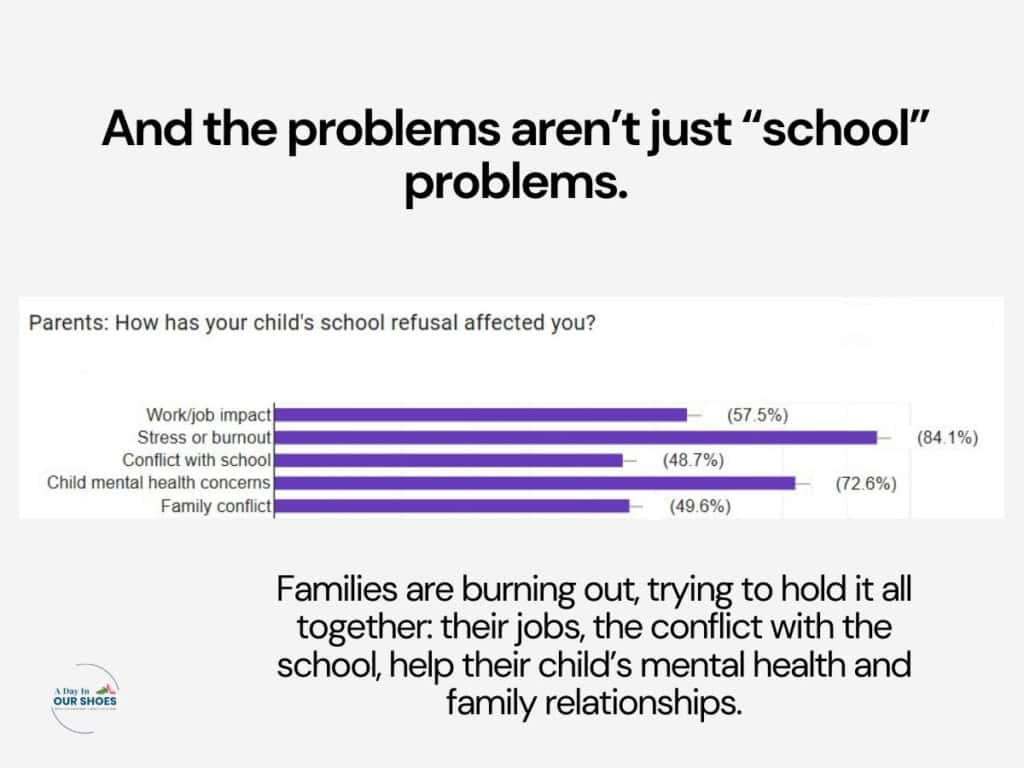
The impact extends beyond the student. Families often describe significant stress, changes to work schedules, and ongoing conflict related to school attendance. It becomes a daily challenge, not just an isolated issue.
Recognizing this as a crisis is important. It signals that the situation requires a different approach than typical attendance concerns. A recent survey of my readers tells us that school refusal effects extend well beyond school.
What to Ask for (Even If You Don’t Know Where to Start)
When you are in the middle of a crisis, it is common to feel unsure about what to request. Starting with a few key areas can help guide the process.
Request a meeting with the school team. If your child has an IEP or 504 plan, ask for a formal meeting. If not, request a team meeting to discuss concerns and next steps. The goal is to bring everyone together to address the situation.
Ask for evaluations if the cause is not clear. This may include psychological, behavioral, or other assessments depending on what you are seeing. Identifying the underlying issue is essential for determining appropriate supports.
Request temporary supports to stabilize the situation. This might include a shortened day, flexible arrival, access to a safe space, or reduced workload. These supports are not necessarily permanent, but they can help create a starting point. Yes, your child will need a reintegration plan for missing a lot of school, but right now the goal is to stabilize the situation.
You can also ask about alternative options if needed, such as homebound instruction or hybrid approaches, depending on your child’s situation.
If you are not sure how to phrase these requests, focus on describing what is happening and how it is impacting your child’s ability to attend and participate. That connection helps guide the conversation toward solutions.
When IEP Meetings Turn Into “Let’s Wait and See”
In a crisis, a common response from a team is to suggest waiting—waiting to see if things improve, waiting to collect more data, waiting for the student to return before making changes.
That approach can make sense in situations that are stable. It does not work well in a crisis.
If a student is not attending or is in significant distress, waiting often means the problem continues to grow. Absences increase, anxiety builds, and returning becomes more difficult.
From an advocacy standpoint, this is where it is important to push for action tied to the current level of need. That might mean asking:
- What is the plan for the next 5–10 school days?
- What supports can be put in place immediately?
- What will we do if attendance does not improve?
These questions shift the conversation from long-term uncertainty to short-term action.
If They Say “We Need Data First”
You may also hear that the team needs more data before making decisions.
Data is important—but in school refusal situations, there is already meaningful data available. Patterns of absence, difficulty entering the building, and the student’s response to school demands are all forms of data.
The challenge is that some of this data is not collected in traditional ways. It may come from parent reports, attendance records, or observations outside of the classroom.
In these situations, it can help to reframe what counts as data:
- “We have consistent attendance data showing…”
- “We have a pattern of difficulty with…”
- “We have repeated attempts that have not been successful…”
This makes it clear that the issue is not a lack of information, but how that information is being used.
What Schools Should Be Doing During Crisis
During a school refusal crisis, the school’s role is to respond as a team and begin identifying what supports are needed.
This typically involves gathering information, including attendance patterns, observations, and any available data. The goal is to understand what is happening, not just that attendance has decreased.
The team should also be considering adjustments. This may include changes to schedule, supports, or expectations based on the student’s needs. These adjustments should be monitored and revised as needed.
Communication is an important part of this process. Families should be informed about what is being considered and how decisions are being made. Regular follow-up helps ensure that the plan is working or can be adjusted if needed.
In practice, responses can vary depending on the school and available resources. However, the focus should remain on identifying barriers and creating a plan to address them.
When the Plan Exists but Nothing Changes
Another pattern that comes up is having a plan on paper, but little change in practice.
You may have:
- accommodations listed
- supports discussed
- a general reintegration plan
But attendance is not improving, and the situation remains the same. At that point, the question is no longer “What is the plan?” but “Is the plan working?”
If the answer is no, it is appropriate to ask for adjustments:
- What part of the plan is not effective?
- What needs to be changed based on the student’s response?
- What has been tried, and what are we doing next?
Plans should evolve as more information becomes available. When they do not, progress tends to stall.
When the Team Doesn’t Feel the Urgency
One of the most frustrating parts of a school refusal crisis is when it feels urgent at home—but not at school.
From the school’s perspective, the situation may look like an attendance issue that can be addressed over time. From the family’s perspective, it is often a daily crisis. That difference in urgency can slow down response, even when the situation requires immediate attention.
In these situations, it helps to make the impact more visible and concrete. Instead of general statements like “this isn’t working,” document and communicate specific details:
- how many days have been missed
- what is happening each morning
- how the situation is affecting your child’s ability to function
Framing the issue in terms of access to education can also shift the conversation. For example:
- “My child is currently unable to access their education due to…”
- “This is impacting their ability to attend and participate in school…”
This connects the situation to the school’s responsibility, rather than presenting it as a temporary attendance concern.
It is also reasonable to request timely action. If the situation is escalating, ask for a meeting within a specific timeframe and follow up if you do not receive a response. Putting requests in writing helps reinforce the need for action and creates a record of communication.
Sometimes, teams move more quickly when the issue is clearly defined and documented. While you cannot control the pace of the school’s response, you can make the urgency—and the impact—difficult to overlook.
Stabilizing First, Fixing Later
One of the most common challenges in school refusal is trying to solve everything at once. When a student has missed significant time, there may be pressure to address attendance, academics, and long-term planning immediately.
A more effective approach is to focus on stabilization first.
This means identifying what the student can currently tolerate and building from there. It may involve starting with very small steps—such as brief periods in the building or limited participation—and gradually increasing over time.
Addressing underlying needs, such as anxiety or skill deficits, is part of this process, but it often takes time. Expecting immediate resolution can lead to frustration and setbacks.
Once the situation is more stable, longer-term planning can begin. This may include academic recovery, adjustments to the IEP, or additional supports. Focusing on stabilization first helps create a foundation for progress, rather than trying to resolve everything at once.
And, try to get really creative with what you can do. When K was refusing, we learned that it wasn’t school–it was the van. There was another student on the van who did not like K and was quite unkind to him. The short term solution was that I drove my son to and from school for a few weeks until they created a new van route so the boys were not on the same van.
While it felt urgent in the moment, I had to take a deep breath and realize that they didn’t just have a van driver sitting around doing nothing–one had to be hired. Same with the aide. All of this took some reflection and patience from everyone on the team, because we thought he didn’t want to go to school. The fact was, he didn’t want to ride the van with a specific student.
Think very specifically, and engage your child to their maximum extent possible, about what they need to return to school and feel safe. That may help chip away at the issues and solve them piece by piece in a crisis.
Crisis Requires a Different Pace
School systems are often designed to move at a steady, procedural pace. Crisis situations do not follow that timeline.
Part of advocacy in these moments is recognizing that mismatch and adjusting expectations accordingly. This may mean more frequent communication, more direct requests, and a focus on immediate next steps rather than long-term planning alone.
The goal is not to escalate unnecessarily, but to ensure that the response matches the level of need. When a student is in crisis, the process should reflect that reality.