
School Refusal Laws: What Parents Need to Know
I recently had a conversation with a family and was guiding them on their school refusal issues with their child. Their situation had progressed to the point where they found themselves in truancy court.
And, get this–the judge gave the student (who was not attending school due to severe anxiety issues) community service hours to perform, for their delinquency. I wish I was kidding. That is perfectly legal for both the school (reporting them for truancy) and the judge to do. I’ve run across many teams with a “just get them to school” attitude toward school refusal. So what are your rights, and what are the laws?
If you’re new to school refusal, start here.
Laws That Can Apply to School Refusal
- IDEA (Individuals with Disabilities Education Act)
- If your child has an IEP, the school must provide a Free Appropriate Public Education (FAPE)
- School refusal tied to disability (anxiety, autism, etc.) = the team should be addressing it through:
- evaluations
- behavior plans (BIP)
- appropriate placement/services
- Chronic absenteeism can trigger a reevaluation or IEP meeting
- Section 504 of the Rehabilitation Act
- Covers students with disabilities who don’t have IEPs
- Requires equal access to education
- Can include accommodations like:
- modified schedule
- reduced day (short-term, not forever!)
- check-ins, counseling supports
- If school refusal is disability-related, the school must accommodate—not just punish
- ADA (Americans with Disabilities Act)
- Similar to 504, but broader civil rights law
- Prohibits discrimination based on disability
- Applies to public schools and reinforces access and accommodations
- State Truancy Laws
- Each state defines:
- how many absences = truancy
- when courts get involved
- Yes, this is where things can escalate to:
- truancy letters
- hearings
- fines and/or jail time (yes, really, in some states)
- BUT, schools should not ignore disability-related causes before going this route
- Each state defines:
- Child Find (under IDEA)
- Schools are legally required to identify and evaluate students who may have disabilities
- Repeated absences + school refusal = red flag
- If they suspect disability and do nothing? That’s a problem.
- FERPA (Family Educational Rights and Privacy Act)
- Gives you access to attendance records, emails, documentation
- Important when you’re building your paper trail (you know I’m going to say it…)
- State Compulsory Education Laws
- Require kids to attend school (with some exceptions)
- This is what schools rely on when they push attendance
- But again, this does NOT override disability rights
I am not an attorney. I’m a special education advocate. This content is provided for informational purposes only and is not legal advice.
What Happens Legally with School Refusal?
When a child stops attending school, it is often treated as a truancy issue, but that is not always appropriate. Truancy laws generally apply to willful absence. If a student is unable to attend due to a disability, anxiety, or unmet needs, the situation should be addressed through supports and services, not punishment.
Schools can initiate truancy procedures, including attendance letters or referrals, but they are also required to consider whether a disability is impacting attendance. If there is reason to suspect a disability, the school has an obligation to evaluate and provide appropriate supports.
Documentation is one of the most important protections for families. Written communication, records of absences, and any medical or evaluation information help establish that the issue is not simply refusal, but a matter requiring intervention.
In short, the legal outcome depends on how the situation is identified. If it is treated as truancy, the focus is enforcement. If it is recognized as disability-related, the focus should shift to support.
School Refusal vs Truancy: Why This Matters Legally
The distinction between school refusal and truancy is central to how a situation is handled.
Truancy typically refers to unexcused absences where a student is considered capable of attending but chooses not to. In these cases, schools may follow attendance policies that include warning letters, meetings, or legal action.
School refusal, on the other hand, is often connected to underlying factors such as anxiety, medical needs, or skill deficits. The student may want to attend but is unable to do so consistently due to those challenges.
When these two are treated the same, problems arise. Labeling a student as truant can shift the focus toward compliance and discipline, rather than identifying and addressing the cause of the absences. This can delay evaluations, limit access to services, and increase conflict between families and schools.
Clear communication matters. When discussing attendance concerns, it can be helpful to frame the issue in terms of access and need. For example, instead of focusing on missed days alone, describe how the student’s condition is affecting their ability to attend and participate in school.
This distinction does not eliminate attendance requirements, but it changes how the situation should be approached and what supports may be required.
Can You Get in Trouble If Your Child Won’t Go?
This is one of the most common concerns families have, and the answer depends on how the situation is being handled.
Schools may begin with attendance notifications or truancy letters when absences reach a certain threshold. If absences continue, the situation can escalate to meetings with school officials or, in some cases, referral to a truancy officer or court system.
However, escalation is not automatic or inevitable. When absences are connected to a disability or medical issue, schools are expected to consider those factors before moving forward with enforcement.
This is where communication and documentation become important. Responding to attendance notices in writing, explaining the circumstances, and requesting support or evaluation can help shift the focus from enforcement to problem-solving.
For example, a response might include:
- A statement that the absences are related to a suspected or identified disability
- A request for an IEP meeting or evaluation
- A request to discuss supports and accommodations
Taking these steps does not guarantee that a school will not pursue attendance procedures, but it establishes that the situation is being addressed and that there are underlying factors that need consideration.
What Schools Are Legally Required to Do for School Refusal
When school refusal occurs, there is often confusion about what schools are actually required to do. This can be exacerbated when your child is experiencing a crisis in regards to attending school. Either the number of days missed is growing, or they have just begun refusing to go to school altogether when they were previously at least going partial days.
While laws do not specifically use the term “school refusal,” there are clear obligations that apply when a student is unable to attend due to suspected or identified needs.
First, schools have a Child Find obligation. This means that if there is reason to suspect a disability—such as anxiety, emotional distress, or other factors impacting attendance—the school must consider whether an evaluation is needed. They cannot wait for the situation to resolve on its own if there are clear signs that a student is struggling to access education.
Second, schools are required to evaluate in all areas of suspected need. If attendance issues may be related to anxiety, executive functioning, sensory needs, or other factors, evaluations should reflect those areas—not just behavior or academics.
Third, if a student is eligible, schools must provide a Free Appropriate Public Education (FAPE). This includes developing and implementing an IEP that allows the student to access and make progress in their education. If the current plan is not working—such as when a student cannot attend consistently—the team is required to revisit and adjust it. FAPE and attendance don’t always match up neatly.
Schools are also responsible for implementing agreed-upon supports and services. An IEP or 504 plan is not just a document; it must be followed in practice. If supports are not being implemented, or are not effective, that needs to be addressed.
Finally, schools must consider placement and program changes when necessary. If a student cannot access their education in the current setting, the team may need to consider alternatives, such as schedule adjustments, different environments, or other options that better meet the student’s needs.
These responsibilities do not replace attendance requirements, but they do shape how attendance issues should be addressed. When a student is unable to attend, the response should include evaluation, support, and adjustment, not just enforcement.
What If There’s No IEP or 504 Plan?
A common assumption is that if a child does not already have an IEP or 504 plan, the school has fewer responsibilities. That is not accurate.
If a student is experiencing significant difficulty attending school, the school still has a legal obligation to respond, especially if there is reason to suspect a disability.
This goes back to Child Find. Schools are required to identify and evaluate students who may need special education or related services. That obligation does not depend on a parent using specific language or already having a diagnosis. If the school is aware that a student is unable to attend or is experiencing significant distress related to school, that can be enough to trigger the need to consider an evaluation.
In practical terms, this means the school should not simply continue with attendance procedures without also considering:
- whether an evaluation is appropriate
- whether supports can be put in place
- whether the current expectations are realistic for that student
This is where many families get stuck. Without an existing plan, the situation may be treated entirely as an attendance issue. But if there is an underlying need, the school still has a responsibility to explore that.
For parents, this often means making the concern explicit in writing:
- describing what is happening
- connecting it to suspected needs (anxiety, medical, learning, etc.)
- requesting an evaluation
Once that request is made, the school is required to respond—typically by agreeing to evaluate or providing written notice explaining why they are declining.
Even without an IEP or 504 in place, the obligation to identify and support students who cannot access their education still applies.
What Schools May Not Tell You About Truancy and Special Education
In many situations, schools will continue to move forward with attendance procedures while also knowing that a student may need additional support. These two tracks—truancy and special education—can run at the same time.
What is often not explained clearly is that initiating truancy does not remove the school’s responsibility to evaluate and provide services. If there is reason to suspect a disability, the obligation to identify and support that student still applies.
This is where things can get confusing for families. You may receive attendance letters or warnings, while at the same time trying to request help. It can feel like you are being pushed in one direction while asking for something entirely different.
From an advocacy standpoint, it is important to keep the focus on access to education. When responding to attendance concerns, consistently bring the conversation back to:
- what is preventing the student from attending
- what supports have been tried
- what evaluations or changes are needed
Both things can be happening at once, but they should not be treated as unrelated.
If They Say “We Don’t See This at School”
This comes up often, especially with anxiety-related school refusal.
A team may say:
“We’re not seeing these behaviors here.”
And technically, they may be correct, because the student is not there.
Advocacy Tip: I acknowledge that, but also push back. The phrasing I use is, “I believe you when you tell me that you are not seeing this at school. I have to believe that if you were seeing what I see, you would let me know. But we are seeing this at home, and the conversation cannot end here. It has to be addressed.”
Lack of behavior in the building does not mean lack of need. In fact, inability to attend is, in itself, important data. If a student can consistently attend, participate, and function in the school environment, that tells you one thing. If they cannot enter the building or sustain attendance, that tells you something else.
From an advocacy perspective, this is where outside information becomes important. This can include:
- parent observations
- medical or mental health input
- patterns of attendance and avoidance
The key is connecting that information back to education: How is this impacting the student’s ability to access school?
A student does not need to demonstrate difficulty inside the classroom if the barrier is getting into the classroom in the first place.
When School Refusal Becomes a FAPE Issue
Under IDEA, students with disabilities are entitled to a Free Appropriate Public Education (FAPE). This includes not only access to instruction, but access in a way that allows the student to benefit from that instruction.
When a student is missing significant amounts of school due to unmet needs, it raises questions about whether FAPE is being provided. If the current program is not allowing the student to attend and participate, adjustments may be necessary.
Missed instruction is not just an attendance issue, it can be an access issue. If a student cannot access their education due to anxiety, lack of supports, or an inappropriate placement, the school may need to consider changes.
This could include:
- Adjusting accommodations
- Providing additional services
- Modifying the schedule
- Considering alternative placements
The key question is whether the current program is appropriate given the student’s needs. If it is not, then the issue is not simply attendance, but whether the student is receiving an appropriate education.
One More Reality: “We’ve Done All We Can”
Another common point families reach is being told that the school has tried everything available. Sometimes this reflects real limitations—staffing, programs, or resources. But it can also reflect the limits of what has been considered, not what is possible.
Special education is based on individual need, not what is typically offered. If a student is not able to access their education, the conversation should not stop at what is currently in place. However, a recent survey to my email list tells us that student need is not always what drives these decisions.
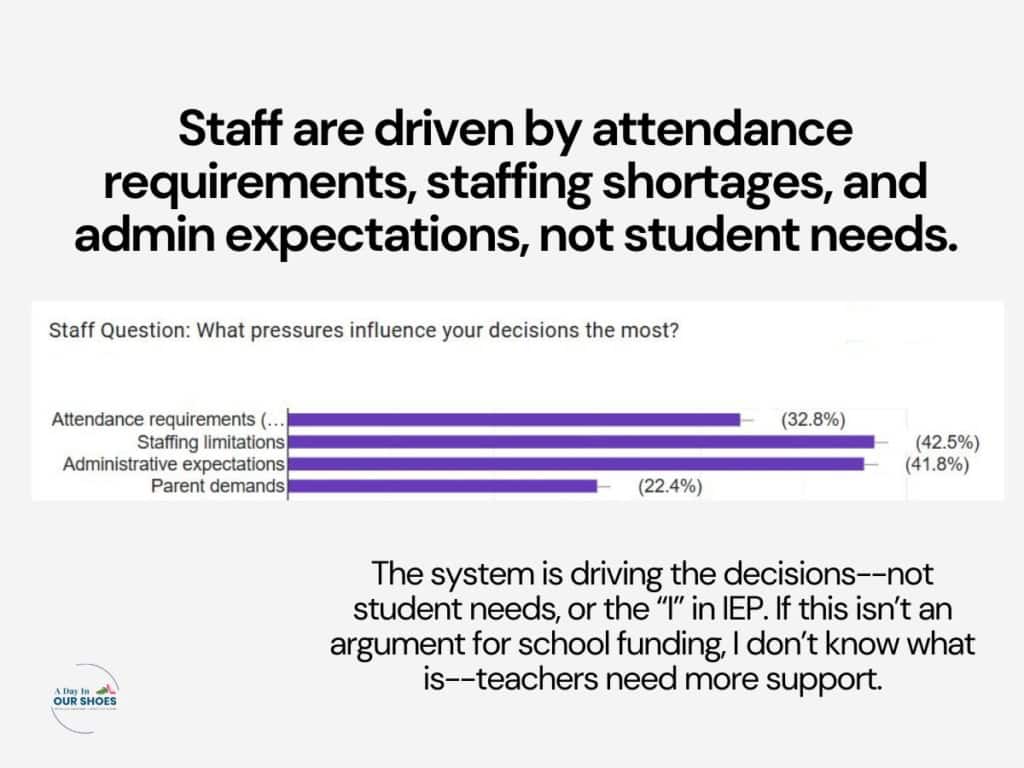
This does not mean every request will be agreed to. But it does mean the discussion should stay open to:
- adjusting the schedule
- trying different supports
- considering alternative options when appropriate
When progress is not being made, it is reasonable to ask not just what has been tried, but whether those approaches matched the student’s needs.
What to Do Right Now (Step-by-Step)
When a child is refusing school, it can feel urgent and overwhelming. Having a clear process can help.
Start by putting everything in writing. Document concerns about attendance, describe what is happening, and connect it to any known or suspected needs. Written communication creates a record and ensures that concerns are formally acknowledged.
Next, request a meeting. This may be an IEP meeting or a team meeting, depending on whether the student already has a plan in place. The goal is to bring the team together to discuss what is happening and what supports are needed.
If the underlying cause is not clear, request evaluations. This could include psychological, behavioral, or other assessments depending on the situation. Identifying the cause is an important step in determining appropriate supports.
During this process, focus on solutions. Ask what changes can be made to help the student attend and participate. This may include accommodations, interventions, or adjustments to the schedule.
Follow up after meetings and requests. If actions are agreed upon, confirm them in writing. If there are delays or disagreements, continue to document and request clarification.
Common Mistakes That Hurt Your Case
One of the most common mistakes is relying on phone calls or informal conversations. While these can be helpful for communication, they do not create a record. Important requests and concerns should be documented in writing.
Another issue is waiting too long to act. When absences begin to increase, it is easier to address the situation early than after it has escalated. Early documentation and requests can help prevent misunderstandings later.
It is also common for families to be told to “just get the child to school.” While attendance is important, this advice does not address the underlying issue. Accepting this as the only response can delay more appropriate supports.
Avoiding these pitfalls can help ensure that the situation is addressed in a way that considers both legal requirements and the student’s needs.
What This Means for Your Situation
When a child refuses school, it is easy for the situation to shift quickly into an attendance or truancy issue. But the legal outcome often depends on how the problem is framed and addressed early on.
If the focus stays on attendance alone, the response is likely to be enforcement. If the situation is clearly connected to a disability or unmet need, the responsibility shifts toward evaluation, support, and access to education. That distinction matters, both for the services a student receives and how the situation progresses.
The most important steps for families are to document concerns, communicate in writing, and request appropriate support. These actions help ensure that the situation is recognized as more than just missed days, and that decisions are based on the student’s needs.
School refusal is not just a legal issue, it is an educational one. When handled appropriately, the process can move from enforcement to problem-solving, with a focus on helping the student return to school in a way that is both realistic and sustainable.