Earth Day Reading Comprehension: 9 Printable Passages and Worksheets
Earth Day activities don’t all have to involve planting something, collecting trash, or constructing a craft out of 14 items you were supposed to remember to save from the recycling bin.
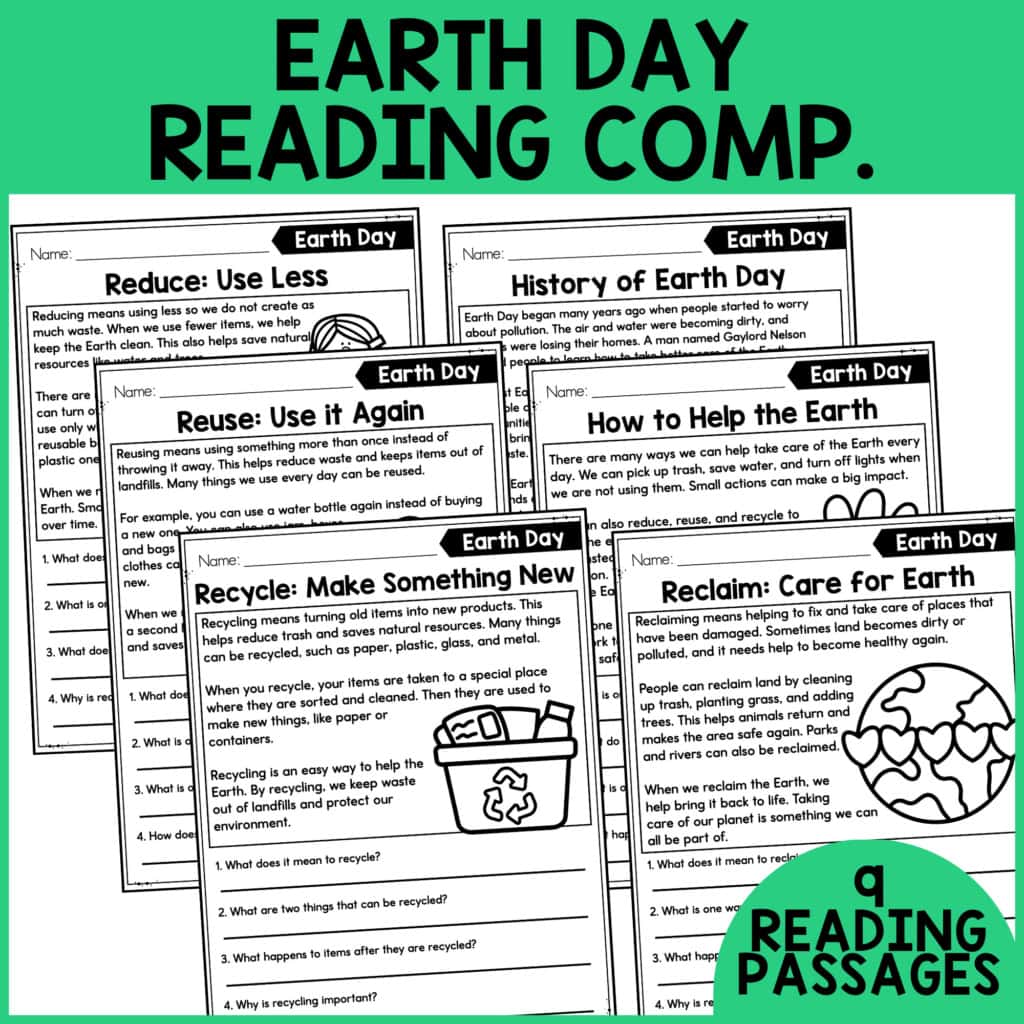
These Earth Day reading comprehension worksheets give students a way to learn about Earth Day while also practicing reading informational text and answering questions about what they’ve read. The printable includes 9 Earth Day reading passages, and each passage has four comprehension questions.
If you are using these worksheets in conjunction with Earth Day, don’t miss:
Earth Day Reading
I like seasonal reading activities when the seasonal part gives kids something meaningful to read about.
And Earth Day gives us plenty.
The passages introduce students to what Earth Day is, when it is celebrated, some of its history, and different ways people can care for the environment. Students also read separate passages about reducing, reusing, recycling, reclaiming land, planting trees, and everyday ways to help the Earth.
So you’re getting reading practice without the entire lesson being, “It’s April. Here is a picture of the planet.”
What’s Included in the Earth Day Reading Comprehension Worksheets
The printable includes nine passages:
- What is Earth Day?
- What is Earth Day?, with a focus on April 22 and Earth Day activities
- History of Earth Day
- Reduce: Use Less
- Reuse: Use it Again
- Recycle: Make Something New
- Reclaim: Care for Earth
- Plant a Tree
- How to Help the Earth
Each worksheet includes a short passage followed by four written comprehension questions.
The questions ask students to locate information, explain ideas from the text, identify examples, and answer basic why/how questions.
Download the Earth Day Reading Comprehension Worksheets
This printable includes 9 Earth Day reading comprehension worksheets with short informational passages, illustrations and four comprehension questions on each page.
Use them for Earth Day reading lessons, literacy centers, small groups, homeschool, special education, intervention, or informational text practice throughout April.
Download the Earth Day Reading Comprehension Worksheets.
Don’t Make the Writing the Reading Test
This is especially important for students with IEPs.
These worksheets provide space for students to write their answers, but that doesn’t mean handwriting has to be part of the reading comprehension task.
If you’re trying to determine whether a student understood the passage, requiring several written responses may create an unnecessary barrier for a student who has dysgraphia, motor difficulties, or other writing needs.
Depending on the student’s accommodations and instructional goals, they may be able to answer orally, dictate to a scribe, type, use speech-to-text, use AAC, point to information in the passage, or respond another way.
Reading comprehension and handwriting are different skills. We don’t have to turn every worksheet into a two-for-one assessment.
Use One Earth Day Passage at a Time
You certainly don’t need to hand students nine worksheets and declare it Earth Day Reading Comprehension Week. Use the passages individually.
You might start with What is Earth Day? to introduce the topic. Then use the History of Earth Day passage when discussing why the observance began. The packet says the first Earth Day was celebrated in 1970 and identifies Gaylord Nelson in its history passage.
The reduce, reuse, recycle and reclaim passages can then be used separately as you introduce those concepts.
This makes the packet useful across several lessons instead of treating Earth Day as something you have to squeeze into 45 minutes on April 22.
Reduce, Reuse, Recycle and Reclaim
Most kids have heard “reduce, reuse, recycle.” Actually explaining the difference between them is another story.
These Earth Day reading passages give each concept its own page.
- The Reduce passage focuses on using less and creating less waste.
- Reuse discusses using items more than once.
- Recycle explains turning old materials into new products.
- Reclaim discusses helping damaged or polluted land become healthy again.
After reading, students could sort examples into the different categories or come up with their own examples. That gives you an easy extension activity without needing another worksheet.
Earth Day Reading Passages and Vocabulary
There’s quite a bit of environmental vocabulary packed into these nine passages.
Students encounter words and concepts including pollution, natural resources, waste, landfills, recycle, reduce, reuse, reclaim, erosion and environment.
For students with language, reading, or processing difficulties, I wouldn’t introduce every term at once.
Preview the vocabulary needed for that day’s passage. Pair unfamiliar words with pictures or examples. Keep the definitions available while students read instead of expecting them to memorize everything first.
Before Students Answer the Questions
These worksheets can also be used to teach students how to go back to the text.
Read a question first. Then ask: Where could we find that information in the passage?
Have the student underline, highlight, point to, or otherwise identify the part of the text that helped them answer.
That’s a much more useful reading habit than teaching kids that comprehension means reading something once and then desperately trying to remember every sentence.
Earth Day Activities Beyond the Worksheet
The passages can easily lead into discussion or other classroom activities.
After reading Plant a Tree, students could discuss what trees provide and how trees affect air, animals and soil. The passage specifically discusses oxygen, animal habitats, shade, air, erosion and soil.
After How to Help the Earth, students could create a class list of realistic actions they can take at home or school.
And after reading about reduce, reuse and recycle, students can look around the classroom and find real examples (or do the Earth Day Scavenger Hunt).