Peter Max Art for Kids: Free Pop Art Inspired Printable PDF Craft
Peter Max is known for bold color, cosmic imagery, stars, planets and psychedelic artwork that became closely associated with the 1960s and 1970s.
That’s what makes his work so much fun to explore with kids. You can look at his use of bright colors, repeated shapes, faces and space imagery, then ask kids to create something of their own using some of those same ideas.
A Pop Art Project With Choices
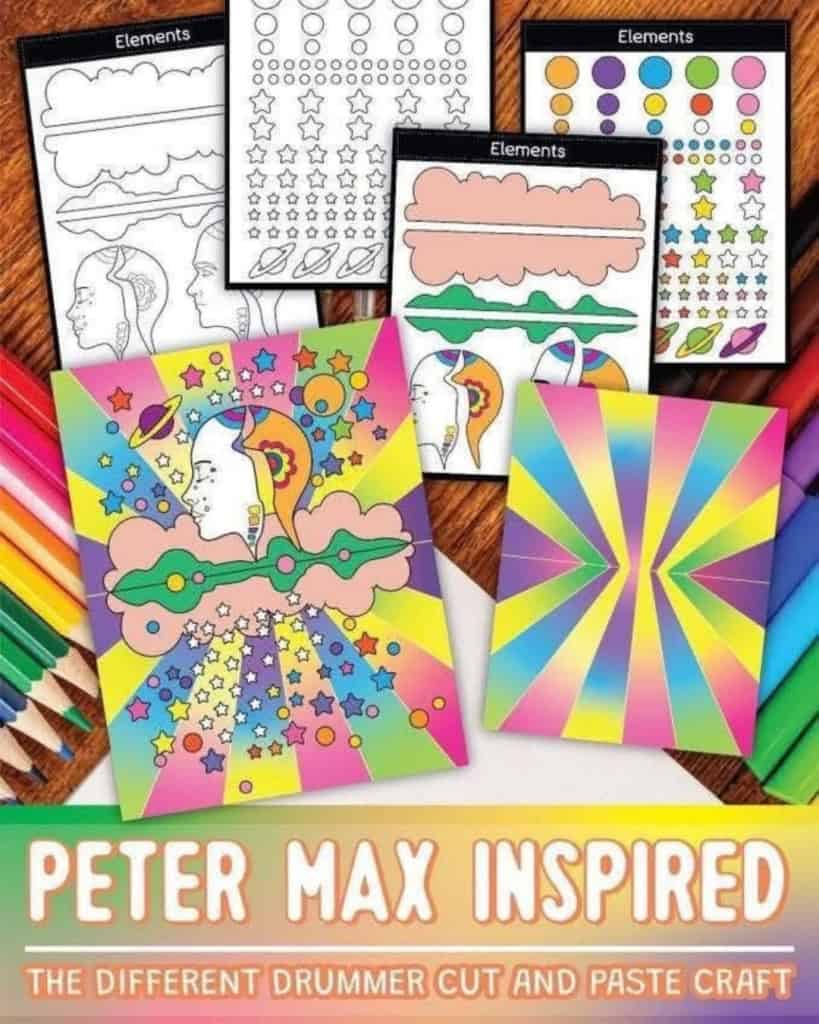
The printable includes several pages of design elements.
Students can work with stylized faces, cloud-like shapes, abstract forms, circles, stars and planets. Some elements are provided as black-and-white outlines while others are provided in bright colors. There’s also a colorful radiating background that can become the base of the finished artwork.
The final page shows one possible arrangement, with a face in the center surrounded by stars, circles, planets and layered abstract shapes.
I’d use that page as an example, not a template students are expected to reproduce. There’s much more value in asking, “What are you going to do with these pieces?”
Download the Printable Pop Art Project
The printable includes colorful backgrounds, black-and-white and colored design elements, and a completed example that can be used for inspiration.
Print the pages you want, let students select and arrange their elements, and give them room to make the composition their own.
Download the Printable Pop Art Project
Teach Composition Without Making It Complicated
This is an easy opportunity to introduce some basic art concepts without turning an elementary art project into Art History 401.
Before students glue anything, have them move the pieces around.
- What happens when the face is in the center?
- What happens when it’s off to one side?
- What if some of the stars overlap another shape?
- Which pieces should look closer? Which should look farther away?
Students can experiment with color, shape, repetition, placement, balance, layering and contrast simply by rearranging the printable pieces.
And because nothing is glued yet, changing your mind costs exactly zero dollars.
That’s a nice life lesson too.
Black-and-White or Full Color
The packet includes both outlined and colored design elements.
The black-and-white pieces give students more control over the finished artwork. They can choose their own color combinations, add patterns, draw inside the shapes, or alter the elements before adding them to the collage.
The colored pieces can reduce the amount of coloring required and make the activity more accessible for students who want to focus on arranging and composing the artwork.
You could also combine the two.
There is absolutely no art police coming to check.
Make the Art Project More Open-Ended
One thing I’d avoid is showing students the finished example first and saying, “Make this.”
If possible, give them the elements before showing the example.
Ask students to select a background and several elements, then experiment with different arrangements.
You could even require only one thing: Use at least three different types of elements in your composition.
After that, let them make some decisions.
That turns the printable into an art-making tool instead of a cut-and-paste exercise.
Adapting the Art Project for Students With Disabilities
Cutting out dozens of tiny stars is not a requirement for appreciating or creating art.
Some students may need pre-cut pieces, larger elements, adapted scissors, fewer choices at one time, or assistance attaching pieces.
Students can also direct another person where to place an element or choose between different arrangements.
If the instructional goal is creating a composition using color, shape and placement, then that’s what we should be looking at.
Fine motor ability doesn’t need to become the admission ticket to the art lesson.
Extend the Pop Art Lesson
After students create their artwork, have them look at each other’s compositions.
Not to decide which one is “best.”
Instead, ask what they notice.
Which colors stand out? Where does your eye go first? Which shapes repeat? How did someone use overlapping? How did two students use the same printable elements completely differently?
That’s where this project gets interesting.
The pieces may start out the same. The artwork doesn’t have to.