CBI on an IEP: What It Is and How to Get It for Your Child.
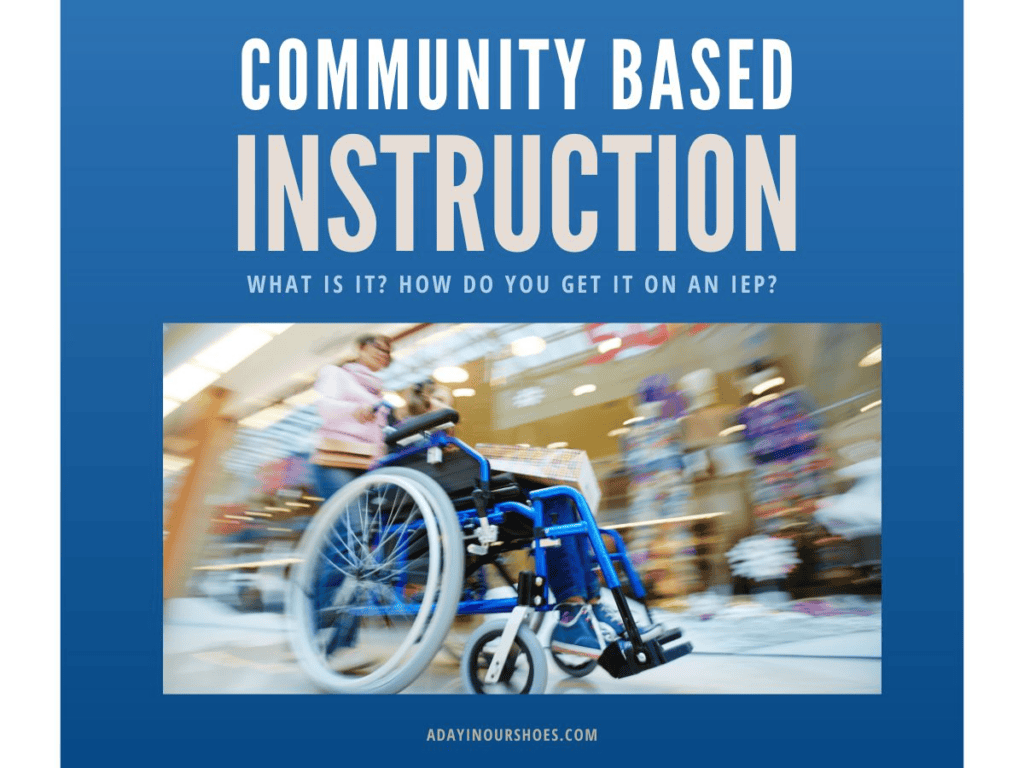
Since my son has had community based instruction on his IEP for over a decade, I can always spot the CBI trips when I am out in my local community. To the untrained eye, it looks like just a bunch of kids out at the grocery store or local restaurant.
But, if you look closer, you’ll probably see CBI teachers and therapists with clipboards. And, they are often prompting students as they move throughout the venue. My son’s school has a heavy focus on community based instruction and it is one of the main reasons I wanted that placement for him.
What is CBI?
CBI stands for community-based instruction. It’s another one of those special education acronyms you may hear at IEP meetings.
CBI is a data-driven, guided outing that occurs in a natural setting where the student can work toward an IEP goal. Community based instruction most often happens in placements where the student is in a life skills program. However, if your child is not ready to graduate at 18 and still needs some assistance, I have seen a lot of CBI take place from ages 18-21.
While you typically will see community based instruction happening at transition age or older, there is NOTHING in IDEA that says that this is the only time it can happen. My son has been doing it since kindergarten, as have all the other kids at his school.
It also doesn’t say anywhere that community based instruction is only for life skills students. If your child is in mostly gen ed programs, yes, getting pulled out for CBI outings will be a challenge. It’s also a thought hurdle for the IEP team to overcome, as they typically only ever have life skills students do community based instruction.
You’re going to have to decide if you want to push this issue, or do it after school on your own time.
IDEA addresses this as part of a student’s transition plan. If your child needs CBI, transition is the latest time that you should be adding it to the IEP. My son has been receiving it since kindergarten, although he is in a life skills type program, one of those “CBI Kids” if you will. Again, most districts think of CBI meaning in school as only for lower-functioning students, or those on a non-diploma path. There is nothing in IDEA that supports this–any student can get CBI instruction in their education.
Transition services under IDEA are supposed to help prepare students with disabilities for life after high school. That can include college, job training, employment, independent living, and participating in the community.
These services should be individualized to the student’s strengths, needs, interests, and preferences, not just whatever program the district already has.
Transition planning can include:
- instruction and job training
- related services
- community experiences (like CBI)
- employment and independent living goals
- daily living skills
- vocational assessments, when appropriate
In other words, transition services are supposed to help students build real-world skills for real-world life. Not just complete worksheets about “career readiness” while never leaving the classroom.
CBI Teacher
A CBI teacher is usually a special education teacher who helps students with disabilities learn functional, real-world skills in community settings instead of only inside a classroom. Their job is to connect classroom learning to actual adult life, because eventually our kids have to function in the real world, not just circle answers on laminated task cards forever.
A CBI teacher may work on skills related to employment, independent living, transportation, communication, safety, social interaction, and community participation. They often take students into the community for hands-on instruction at places like grocery stores, restaurants, libraries, job sites, banks, or public transportation systems.
The role of a CBI teacher can look very different depending on the students’ needs. Some students may be learning basic safety and daily living skills, while others are practicing vocational tasks or preparing for supported employment. Ideally, the instruction is individualized and tied directly to the student’s transition goals and IEP needs, not just random field trips with a worksheet attached to make it look official.
A good CBI teacher should also be collecting data on student progress, collaborating with related service providers, and helping students generalize skills across different environments. Because the goal is independence and functional success, not just “performed skill once when prompted by three adults.”
Instruction and Community Experience
A natural setting is a setting within the disabled students’ own community. It is a neighborhood setting. It’s a place that the student will frequent as an adult to live a more independent life.
A laundromat is a natural setting because this is a setting where the student is likely to frequent as an adult to live an independent life. Other examples of natural settings are the library, the bank, the post office, and the grocery store.
What is not a natural setting: a washer and dryer in a life skills classroom. That may be a starting point, as far as putting the clothes in. But the student should still experience having strangers there with him/her, choosing which washer and dryer to use vs which ones are occupied, how to get quarters or pay, and so on.
A life skills classroom can talk about meal planning and choosing items to eat. But being able to go into a grocery store with $25 and come out with enough items to prepare a dinner are entirely different skills from meal planning.
Your child may need explicit instruction to learn these skills, and that’s ok.
CBI in Special Education
“Community-Based Instruction” (CBI) is a very commonly used and widely accepted special education term, particularly in transition programming and life skills education. You will hear it used by schools, transition coordinators, advocates, vocational programs, and state agencies all the time.
But, it is not specifically defined in IDEA the way terms like “transition services” or “related services” are.
Instead, CBI falls under the broader IDEA requirements for:
- transition services
- community experiences
- independent living skills
- functional skill development
- vocational education
- postsecondary preparation
So while “CBI” itself is not a legally defined IDEA term, the concepts and services behind it absolutely are supported under federal law.
That’s why some districts may call it different things:
- community instruction
- community outings
- vocational training
- travel training
- functional life skills instruction
- transition programming
- community experiences
Same idea, different label. Because special education loves nothing more than taking one thing and giving it ten different names depending on the district or state.
Recreation is Included in CBI.
One misconception I hear all the time is that Community-Based Instruction has to look “academic” or job-related every second of the day. As if the only acceptable CBI outing is silently stocking soup cans at a grocery store while carrying a clipboard.
But recreation and leisure skills absolutely matter. In fact, they’re specifically connected to independent living and community participation, which are both part of transition planning under IDEA.
Many students with IEPs struggle with generalization and abstract learning. They may be able to practice a skill in a classroom but not know how to use that same skill in the real world. That’s exactly why CBI exists. Students need opportunities to practice skills in actual community settings, not just talk about them from a desk.
And yes, that can include bowling, going to an arcade, eating at a restaurant, attending a community event, or even fishing.
Think about all the skills involved in a simple bowling outing:
- checking in and communicating with staff
- waiting appropriately
- handling money or payment
- reading signs and schedules
- taking turns and social interaction
- managing emotions if things don’t go as planned
- following safety expectations
- navigating a noisy, overstimulating environment
- solving problems independently
Some students may need direct instruction for every single one of those tasks. A student may not know their shoe size, how to ask for help, how to order food, or how to regulate themselves in a busy environment. Those are functional life skills.
And honestly? Recreation matters because quality of life matters. Adults without disabilities spend time bowling, fishing, going to concerts, eating out, and participating in hobbies and community activities. We don’t suddenly stop needing leisure skills because we have an IEP.
So when someone rolls their eyes and says, “Must be nice to go bowling during the school day,” remember: there is often far more instruction happening on those outings than people realize.
How to Get CBI on your IEP
Like most things in special education, you usually do not get Community-Based Instruction just because it sounds like a good idea. You get it by showing that your child needs it in order to make meaningful progress toward their transition and functional goals.
That means the conversation should always come back to data, needs, and skills—not “Well, other students don’t get to leave the building.” Because IDEA is about individualized programming, not fairness according to whoever is annoyed about the school van schedule.
Start by looking at your child’s present levels, transition assessments, evaluations, and transition goals. Where are the gaps? Does your child struggle with communication in public settings? Safety awareness? Purchasing items? Using transportation? Independent problem-solving? Social interaction? Job skills? Self-advocacy? Those are all areas where CBI may be appropriate.
Then connect those needs to real-world environments. If the goal is independent living or employment, ask yourself: can this skill realistically be mastered only inside a classroom? Often, the answer is no.
You should also ask the team:
- What transition services are being provided right now?
- How are community participation and independent living skills being taught?
- How is the district helping the student generalize these skills across settings?
- What data is being collected?
- How are transition goals being practiced in natural environments?
And remember, “we don’t do that here” is not a valid reason to deny a needed service. Neither is “we don’t have staff” or “we only offer that to students in another classroom.” If the data supports the need for Community-Based Instruction, then the team should be discussing how to provide it.
Parents can also request transition assessments, vocational evaluations, travel training assessments, or adaptive behavior evaluations if more data is needed to support CBI services. Sometimes schools resist CBI because they view it as extra work, liability, or scheduling headaches. And honestly? It probably is. But inconvenience to the district is not the legal standard for denying an IEP service.
Most importantly, be specific in the IEP. If CBI is appropriate, the IEP should clearly outline:
- what skills will be worked on
- where instruction will occur
- how often it will happen
- who is responsible
- how progress will be measured
Because “student may participate in community outings as appropriate” is the kind of vague wording that magically disappears the second someone has to actually plan a trip.
CBI and Data Collection
Just like with any classroom lesson or IEP goal, there is a component of data collection. Baselines should have already been developed.
There should be a pre-test to determine the trip goals, data collection during the trip, and post-assessment data. There should be an assessment of the student and his needs to determine where would be an appropriate setting.
What is the difference between CBI and a Field trip?
Community-Based Instruction differs from the traditional field trip in that instruction is cumulative. The same skills are instructed and assessed from week to week. The emphasis is on the acquisition and application of functional and age-appropriate skills in the natural setting.
Field trips are NOT Community-Based Instruction and are NOT a legitimate substitute for systematic instruction in functional, age-appropriate skills in natural settings. Because they tend to be episodic, one-time activities, student needs for consistency, repeated practice, and systematic generalization are difficult to address in the context of a field trip.
Students with developmental disabilities should participate in field trips with grade-level age-peers in the context of an inclusion activity depending on their placement.
Presumably, if this is the case, specific IEP goals relating to socialization, communication, behavior and academic skills are addressed. However, activities of this sort do NOT constitute, nor are they a substitute for, Community-Based Instruction.
Goals for CBI Trips
I have a large list of life skills goals and CBI IEP goals in the IEP Transition Goal Bank.
A good CBI trip should be tied to meaningful, functional IEP goals, not just “getting out of the building” because everyone needed a break from fluorescent lighting and cafeteria pizza.
The goals being worked on during Community-Based Instruction should reflect the student’s individual transition needs and real-life skills. That might include communication skills, social interaction, self-advocacy, safety awareness, money skills, executive functioning, vocational skills, travel training, or independent living skills. For one student, a trip to a grocery store might focus on reading a shopping list, budgeting, asking for help, and navigating a public space appropriately. For another student, the same trip could focus on sensory regulation, following multi-step directions, or practicing job-related tasks like stocking shelves or interacting with customers.
CBI goals should also connect back to what the student actually wants and needs for adult life. If a student’s transition plan says they want employment, independent living, or community participation after graduation, then the CBI activities should help build those skills in real environments. Because honestly, “student will complete worksheet about community jobs with 80% accuracy” is not the same thing as learning how to safely cross a parking lot, order food, use public transportation, or interact with coworkers.
And importantly, the skills practiced during CBI should be measurable and observable. Schools should be collecting data on how the student performs these tasks in natural settings, not just assuming exposure equals progress. Sitting in a coffee shop once a month is not magically transition programming. Sorry to that clipboard.
Progress Monitoring and Community Based Instruction
Community environments should be visited repeatedly so that the students can learn and then practice target skills. Community based instruction is not just exposing students to different environments; its purpose is to master target goals and skills.
In order to assess, create a target goal, work on the target goal, and provide maintenance of the mastered skills then students need to go to the same place multiple times.
CBI Community Based Instruction
Lastly, here is a great handout. It’s for the state of PA, but it’s a great list of discussion items for IEP teams when considering Community Based Instruction for a student.
Transition Planning & Independent Living
- Developing a Meaningful IEP Transition Plan (Beyond “Food, Filth, and Flowers”)
- Transition Assessments for Students with Blindness or Severe Disabilities
- IEP Re-Evaluations for Ages 18–21: What Really Happens (and Why It Matters)
- IEP Vision Statement Examples (Samples and free workbook)
- What IEP Parents Need to Know About Community-Based Instruction (CBI)
- What Is Age of Majority and How Does It Affect the IEP Process?
- Indicator 13: What to Know and Compliance Checklist