Women’s History Month Printables: 12 Free PDF Research Worksheets
Women’s History Month deserves more than a fill-in-the-blank worksheet about Susan B. Anthony and a quick craft project that may or may not survive the ride home in a backpack.
Women’s History Month is a good time to introduce kids to women whose work has influenced science, sports, art, literature, medicine, politics and other parts of history.
But I’d rather have kids actually learn something about these women than color a picture, write “She was important,” and call it history.
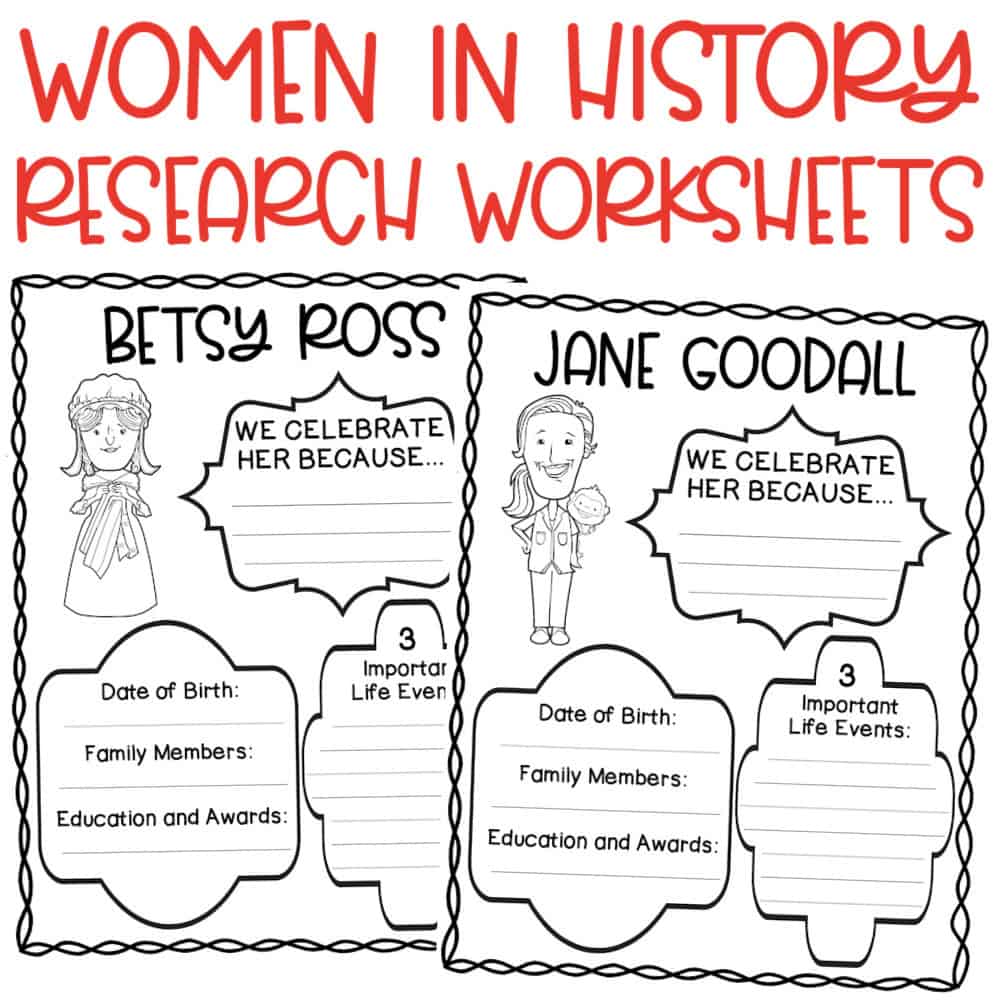
These free Women’s History Month printables give students a simple framework for researching 12 well-known women. Each worksheet focuses on one woman and asks students to find information about her life, family, education, accomplishments and important life events.
They’re easy to use for a Women’s History Month research project, biography unit, independent work, homeschool lesson or classroom display.
- Black History Month Coloring Pages
- US Presidents History Worksheets
- 50 States and Capitals Worksheets
What Is Women’s History Month?
Women’s History Month is observed in the United States during March and recognizes women’s contributions to American history. What eventually became Women’s History Month began as a Women’s History Week celebration in California in 1978. Congress designated March 1987 as Women’s History Month, and presidents have issued annual proclamations recognizing the month since 1995.
Of course, women’s history doesn’t need to disappear when March ends.
These worksheets can be used throughout the year whenever you’re studying one of the women included in the set, working on biography research, or connecting a person to another subject.
What’s Included in the Women’s History Month Printables?
The free PDF contains 12 Women’s History Month worksheets, with one research page for each woman.
The women included are Anne Frank, Althea Gibson, Ann Bancroft, Betsy Ross, Billie Jean King, Clara Barton, Frida Kahlo, Florence Nightingale, Hillary Clinton, Jane Goodall, Louisa May Alcott and Marie Curie.
That’s a pretty broad range of subjects.
Students can research women connected to science, medicine, exploration, sports, art, literature, public service and history rather than learning about 12 people who all did roughly the same thing.
Download the Free Women’s History Month Printables
This free printable set includes 12 Women’s History Month research worksheets featuring women from science, sports, medicine, art, literature, exploration, politics and history. Each page gives students a framework for researching the woman’s life and explaining why she is remembered.
Use the worksheets individually, assign different women for a class research project, or create a Women’s History Month classroom display.
Turn the Worksheets Into a Women’s History Month Research Project
The worksheets do not contain biographies for students to copy, and that’s on purpose.
Each page gives students categories to investigate. Students research why the woman is celebrated, her date of birth, family members, education and awards, and three important events from her life.
That makes the printable more useful as a research organizer than a fact sheet.
Students can use books, biographies, library databases or reliable websites to locate the information they need.
For a larger project, assign each student a different woman. When the research is finished, students can present what they learned to the class.
Now 12 worksheets become 12 mini-biographies without requiring every student to research every person.
Don’t Make Women’s History a List of Dates
There’s nothing wrong with learning when someone was born.
But that’s probably not the most important thing a student can learn about Marie Curie or Jane Goodall.
The most useful prompt on these worksheets may be: “We celebrate her because…”
Ask students to identify what the woman did, what changed because of her work, what barriers she encountered, or why people still learn about her today.
A student who knows why Althea Gibson is historically significant has learned considerably more than a student who successfully copied her birth date onto the correct line.
Compare Women Across Different Fields
You don’t have to use these Women’s History Month worksheets one at a time.
Comparing two people can make the research much more interesting.
Students might compare Billie Jean King and Althea Gibson as athletes, Marie Curie and Jane Goodall as scientists, or Frida Kahlo and Louisa May Alcott as women whose creative work became internationally recognized.
They can look for similarities and differences:
- What obstacles did they face?
- What did they accomplish?
- When did they live?
- How did their work affect other people?
- How were opportunities for women different during their lifetimes?
Now the activity moves beyond collecting five facts from Google and declaring the research project complete.
Help Students Choose Reliable Research Sources
Because these pages require outside research, this is also an easy opportunity to talk about sources.
Students shouldn’t assume the first search result is automatically correct.
For younger students, provide two or three approved sources instead of sending them into the entire internet. Older students can compare sources and see whether the information agrees.
The National Women’s History Museum has biographies and educational materials about women in history, including resources specifically for Women’s History Month.
Libraries, museums, archives and reputable biographies are also good places to begin.
Research skills are part of the lesson here. “I found it online” is not actually a citation. Despite what middle schoolers everywhere would like us to believe.
Adapt the Research for Different Learners
These pages require quite a bit from a student.
They have to locate information, understand it, decide what’s important and then write that information in relatively small spaces.
For some students, that’s several barriers piled on top of one another.
You can introduce one research category at a time, provide selected sources, highlight where information can be found, offer choices, allow speech-to-text or AAC, have students dictate responses, or complete portions of the worksheet together.
You could also assign just the “We celebrate her because…” section and three important life events rather than requiring every box.
If the goal is understanding a person’s historical significance, handwriting doesn’t need to become the deciding factor.
Women’s History Doesn’t Have to Stay in the History Lesson
One thing I like about this particular set is that the women don’t all fit neatly into one subject.
- Studying Marie Curie can connect to science.
- Jane Goodall can lead into animal behavior and conservation.
- Billie Jean King and Althea Gibson can connect sports with social history.
- Frida Kahlo gives you an art connection.
- Louisa May Alcott connects naturally with literature.
- Clara Barton and Florence Nightingale can lead into conversations about nursing, medicine and humanitarian work.
And that’s a useful reminder for kids too.
History isn’t a separate little box full of dates and dead people. Science has history. Art has history. Sports have history. Medicine has history.
Women are part of all of it.
Make a Women’s History Month Classroom Display
These worksheets also lend themselves to a simple classroom display.
Have students research different women and complete their pages. When everyone is finished, display the completed biography sheets together.
You can organize them by field, chronologically, or simply create a Women in History wall.
Students could also add a second page with a portrait, quote, timeline or one fact they found particularly interesting.
That gives the research an audience beyond the teacher’s grading pile.
And I’m always in favor of a worksheet having somewhere more exciting to go than directly from desk to recycling bin.
Use These Women’s History Printables All Year
Yes, they’re called Women’s History Month printables because that’s when many parents and teachers are searching for them.
But nothing about Marie Curie’s life becomes less relevant on April 1.
Use individual worksheets whenever these women connect with something you’re already teaching.
The Anne Frank page can accompany a historical or literature study. The Jane Goodall worksheet can go with a science unit. The Billie Jean King page can fit a discussion about sports history.
March is a good reminder to teach women’s history.