
Weather Worksheets: Math, Literacy and Vocabulary Activities
Weather is one of those topics that shows up everywhere in elementary school.
Science lessons. Morning meeting. Calendar time. Seasonal units. And approximately 4,000 conversations about whether it’s cold enough to require a coat at recess.
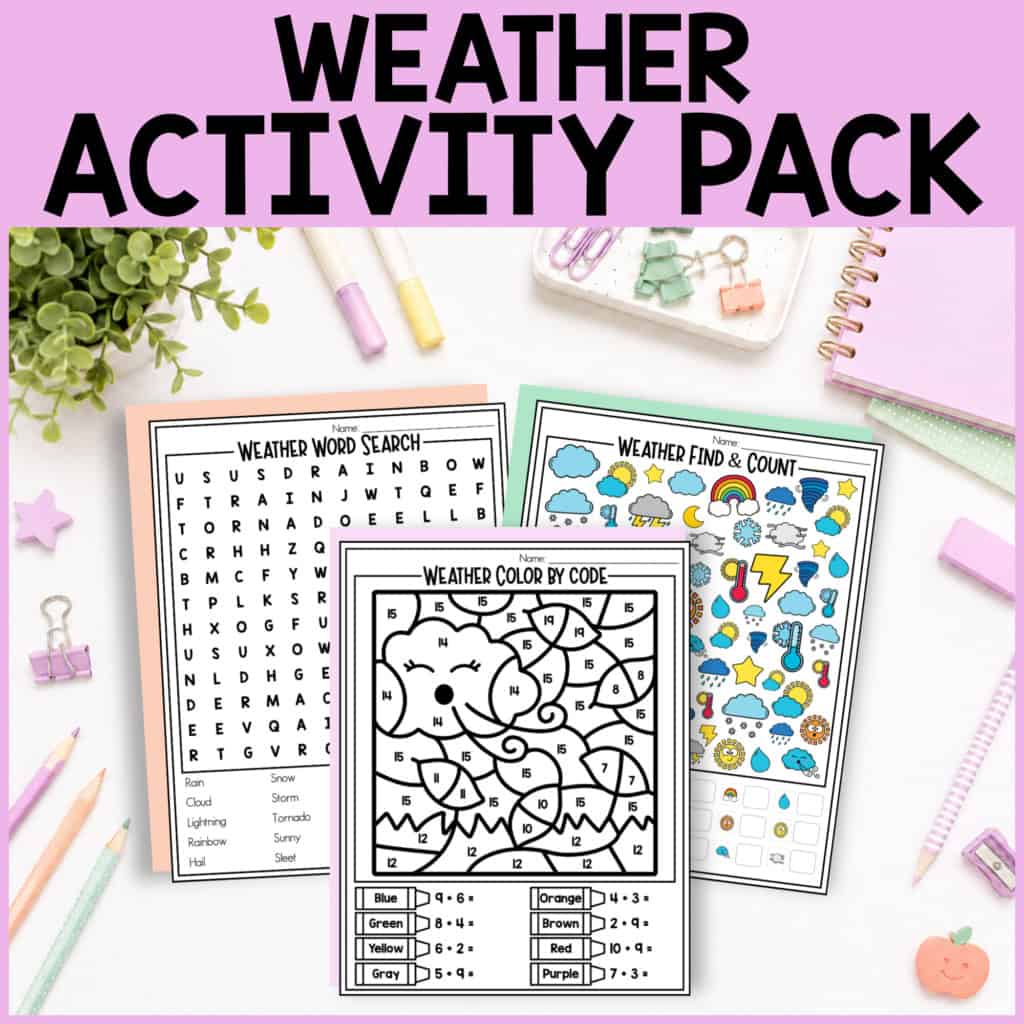
These weather worksheets for kids give you a few more ways to use the theme for math and literacy practice.
The printable set includes 7 different student activities, including weather vocabulary puzzles, counting, subtraction, addition, a maze, and word work. Answer keys are also included.
These aren’t meant to be a complete weather science unit. They’re supplemental activities you can pull out during a weather unit, use for centers, morning work, independent practice, homeschool, or keep around for one of those days when your carefully planned schedule has gone completely sideways.
- Types of Clouds Worksheets
- Natural Disasters for Kids (PDF activity)
- School/Child Care Emergency Plan PDF (not a kids’ activity, adult resource for storms and emergencies)
What’s Included in the Weather Worksheets?
There are seven different activities in the printable set, so students aren’t doing the same worksheet seven times with slightly different clip art.
The Weather Find and Count page asks students to search a busy picture for different weather symbols and record how many they find. The page includes clouds, lightning, rain, rainbows, snowflakes, suns, thermometers, tornadoes and other weather pictures.
There’s also a weather word search and weather word scramble using vocabulary such as rain, cloud, lightning, rainbow, hail, snow, storm, tornado, sleet, fog, wind, thunder and hurricane.
Students also get a weather-themed crossword puzzle with clues describing different weather words.
Download the Weather Worksheets for Kids
This printable set includes 7 weather activities plus answer keys. Students can practice counting, addition, subtraction, vocabulary, spelling, word work and problem solving with a weather theme.
Use the worksheets individually or add them to your weather unit, math and literacy centers, morning work, homeschool lessons, independent practice or early-finisher activities.
Weather Math Activities
Two of the pages combine the weather theme with elementary math practice.
The Weather Maze Escape has students travel through a maze and solve subtraction problems along the way. The problems shown are 20−16, 15−5, 18−3 and 12−4.
The Weather Color by Code combines addition facts with coloring. Students solve equations such as 9+6, 8+4, 6+2 and 10+9 to determine which colors belong in the picture.
These make more sense as supplemental math practice than as instruction.
In other words, I’d use them after a child has learned the math skill, not as the method for teaching addition or subtraction for the first time.
Weather Vocabulary Activities
Weather comes with a surprising amount of vocabulary.
Rain and sun are easy enough. Then we start tossing around words like sleet, hail, thunder, lightning, tornado, and hurricane and expecting kids to know that these things are not interchangeable.
The word search, word scramble and crossword give students repeated exposure to weather-related words.
Before using those pages, I’d make sure students actually understand the vocabulary.
Finding HURRICANE hidden in a word search does not mean a student understands what a hurricane is.
You can introduce the words with photos, videos, books or your regular weather science materials first. Then use these worksheets for additional practice with the vocabulary.
Use the Weather Worksheets for Literacy Practice
There’s also a simple word-building page that asks: How many words can you make with the word weather?
Students can rearrange the letters to create smaller words.
The answer page gives examples including hear, here, hate, heat, rate, tree, wear, heater, reheat, tear, and ate, while noting that answers will vary.
I like activities like this because there isn’t one single list every student has to reproduce.
You can also adapt the expectations.
One student might find five words. Another might find 15. Older or more advanced students can be challenged to find longer words or sort their words by number of letters.
Easy Ways to Use These Weather Printables
You don’t have to print all seven activities and hand them to every student as a packet.
Actually, please don’t feel obligated to do that.
Pick the worksheet that matches what you’re already teaching.
Put the vocabulary activities in a literacy center during a weather unit. Use the subtraction maze or color-by-code for independent math practice. Put the find-and-count page in a morning-work folder.
You could also place several different activities in centers and let students rotate through them.
The theme ties everything together without requiring every activity to teach the exact same skill.
Weather Worksheets and Special Education
Because these worksheets cover several different skills, don’t assume that a student who can complete one page independently should automatically be able to complete all of them.
The find-and-count page, for example, has a very busy visual field.
For a student who has difficulty with visual scanning, you could cover portions of the page and reveal one section at a time.
Students who have difficulty writing can point, circle, dictate or use another appropriate response method.
The crossword and word puzzles may also require more language support than the math pages.
Again, decide what skill you’re trying to practice.
If the goal is weather vocabulary, don’t let handwriting become the reason a student can’t demonstrate that they know the answer.
Use These With a Weather Science Unit
These printables are weather-themed, but they don’t replace actual weather instruction.
Pair them with lessons about clouds, precipitation, storms, temperature, seasons or weather observation.
You could also have students keep a daily weather chart and compare what they observe outside with some of the vocabulary in these activities.
- Is it cloudy?
- Windy?
- Sunny?
- Did it rain?
- What kinds of clouds can they see?
Now the vocabulary isn’t just something they found diagonally in a word search. It’s connected to something they can actually observe.
Weather Activities Don’t Have to Stay in Science
That’s probably the biggest advantage of this set.
You’re using the same familiar theme across several subjects.
A child can encounter the word thunder during science, find it in the word search during literacy, and use weather pictures during math practice.
That repeated exposure can be particularly helpful for students who need more opportunities to learn and use new vocabulary.