
Shoe Tying Solutions for Kids with Autism, ADHD, Dyspraxia and Fine Motor Delays.
I hear it often. Does your disabled child know how to tie their shoes? And are they past the age of when they should be able to tie their shoes? It’s a pretty common problem.
After all, if your child struggles with fine motor coordination, sequencing, and other issues that are elements of shoe-tying, it only makes sense that tying their shoes would be a challenge for them too.
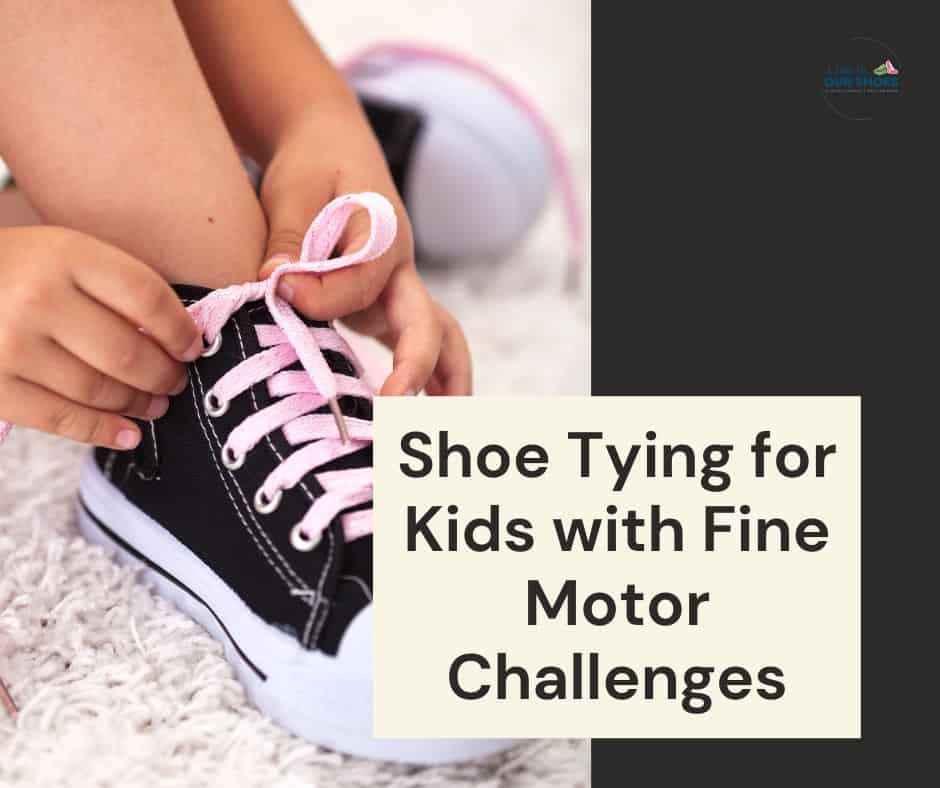
Every child develops at their own pace. While many children learn to tie their shoes between ages 5 and 7, plenty of children need more time. If your child is 8, 9, 10, or older and still can’t tie their shoes, you’re not alone.
For many disabled children, shoe tying isn’t simply something they “haven’t practiced enough.” It’s actually one of the more complicated fine motor tasks children are expected to master.
Shoe tying requires:
- Fine motor coordination
- Bilateral coordination (using both hands together)
- Motor planning
- Hand strength
- Finger dexterity
- Visual-motor integration
- Sequencing
- Attention
If even one of those skills is difficult, shoe tying becomes frustrating. And unfortunately, it’s one of those childhood skills people love to judge.
I’ve heard parents worry that teachers, grandparents, or even strangers assume their child is “lazy” simply because they still wear Velcro shoes. Thankfully, there are now many other age appropriate options like Crocs, Uggs, slides and more.
The reality is that many autistic children, children with ADHD, dyspraxia, cerebral palsy, Down syndrome, developmental delays, or other disabilities simply need more support, or a different approach.
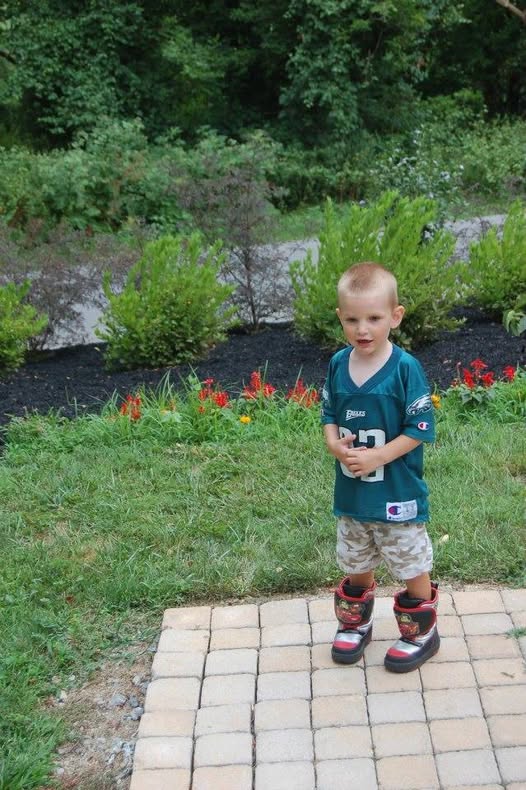
When my one son was a toddler, he had these light-up Cars boots that he wore everywhere, even in July. We joke about it now, but the fact is–he was too young to know how to tie his shoes, and the boots were a pull on boot. He could do it himself and he wanted that independence.
The good news? Shoe tying is a skill that can often be broken into smaller, teachable steps. Even if your child does not learn shoe tying very quickly (or ever) I’ll also list some solutions that allow them greater independence (and no, no light up Cars boots).
Is Shoe Tying a Fine Motor Skill?
Yes. Shoe tying is considered a fine motor skill, but it’s actually much more complex than many people realize.
When people think about fine motor skills, they often picture handwriting, coloring, or using scissors. Shoe tying involves those same small hand muscles—but it also requires your child to coordinate several different skills at the same time.
To successfully tie a pair of shoes, a child needs:
- Fine motor control to grasp and manipulate the laces
- Hand strength and finger dexterity
- Bilateral coordination (using both hands together while each hand does something different)
- Motor planning to remember and perform the steps in the correct order
- Visual-motor integration to coordinate what they see with how their hands move
- Executive functioning skills like attention, working memory, sequencing, and self-monitoring
That’s a lot for one everyday task!
Why do occupational therapists work on shoe tying?
Occupational therapists (OTs) don’t work on shoe tying simply because every child “should” know how to tie their shoes.
They work on it because shoe tying is a meaningful activity of daily living (ADL) that helps children become more independent.
While practicing shoe tying, an OT is often addressing much bigger skills, such as:
- Improving hand strength
- Developing finger isolation and dexterity
- Increasing bilateral coordination
- Building motor planning skills
- Improving visual perception and visual-motor integration
- Teaching sequencing and problem-solving
If a child is struggling with these underlying skills, simply telling them to “practice more” usually isn’t enough. The underlying skill deficits often need to be addressed first.
Why bilateral coordination matters
One of the biggest challenges with shoe tying is bilateral coordination.
This means using both sides of the body together in a coordinated way. With shoe tying, each hand has a different job. One hand stabilizes the loop while the other wraps the lace around it. Both hands have to work together, but they aren’t doing the same thing.
Children with developmental coordination disorder (dyspraxia), cerebral palsy, autism, or other motor differences may find this especially challenging.
If your child struggles with activities like cutting with scissors, buttoning clothes, opening food containers, or zipping a jacket, bilateral coordination may also be affecting their ability to tie shoes.
Executive Functioning is Required to Tie Shoes
Many parents are surprised to learn that shoe tying isn’t just about hand skills.
It’s also about executive functioning.
A child has to:
- Remember multiple steps in order
- Stay focused long enough to complete the task
- Shift from one step to the next
- Notice when something went wrong and correct it
- Keep trying even when it’s frustrating
For children with ADHD, autism, or executive functioning challenges, these cognitive demands can make shoe tying feel overwhelming, even if their hand skills are developing well.
How shoe tying relates to IEP goals
If your child has an IEP, shoe tying may be addressed as part of adaptive skills, fine motor goals, or occupational therapy services.
Rather than writing a goal that simply says, “The student will tie shoes,” the IEP team should identify the underlying skills your child needs to develop. For example, goals might focus on improving bilateral coordination, hand strength, sequencing, or independence with dressing tasks.
Remember that the ultimate goal isn’t to master one specific type of shoelace. The goal is independence. For some students, that may mean learning to tie traditional laces. For others, adaptive options like elastic laces or alternative shoe closures may be the most appropriate way to increase independence.
Parents sometimes feel pressure because shoe tying has become one of those childhood milestones that people use to judge whether a child is “on track.” But for many disabled children, shoe tying is not simply a matter of trying harder. It’s a complex functional skill that depends on many different developmental abilities, and it’s perfectly appropriate to teach it one small step at a time, or to use adaptive solutions when that’s what helps your child be the most independent.
Is this the only OT skill they lack? If your child cannot tie their shoes, ask yourself what other fine motor skills they might be struggling with things like buttons, zippers, and handwriting. If they are not currently receiving Occupational Therapy for this, you can ask for an evaluation.
You can do it through the school and the IEP process or you may just choose to pursue this privately and pay out of pocket or with insurance. But I have seen tying shoes and other fine motor skills listed at OT goals in an IEP.
Should I add a shoe-tying goal to my IEP? Years ago, I said, “It’s a necessary skill, so yes, add it.” But as I stated above, now there are many more options available. Heck, even Skechers is now advertising shoes that you don’t even have to bend over to put on. That said, it is a social skill that can lead to exclusion and bullying if not mastered. Also, mastering this skill can lead to proficiency in other skills such as fine motor and sequencing.
As a special education advocate, my answer is YES that this can/should be on the IEP if it is an identified area of need and a priority for the parent.
Shoe Tying Task Analysis
A task analysis breaks one big skill into smaller, teachable steps. And shoe tying definitely needs one. Adults tend to say, “Just make a loop and wrap the other lace around it,” as if that clears everything up. It does not.
For a child who struggles with fine motor skills, motor planning, working memory, or bilateral coordination, shoe tying can feel like 14 separate jobs happening at once.
Here is a simple shoe tying task analysis using the one-loop method:
- Place one lace in each hand.
- Pull both laces up and away from the shoe.
- Cross one lace over the other.
- Tuck the top lace under the crossed laces.
- Pull both laces in opposite directions until the knot is tight.
- Make a loop with one lace.
- Pinch the bottom of the loop with one hand.
- Hold the other lace with the opposite hand.
- Wrap the loose lace around the loop.
- Keep holding the first loop in place.
- Push a small section of the loose lace through the opening behind the loop.
- Grasp the new loop.
- Hold one loop in each hand.
- Pull both loops in opposite directions.
- Adjust the loops until the bow is tight and even.
Some children can learn several of these steps at once. Others may need each step taught separately.
You can teach shoe tying through forward chaining, which means the child learns the first step and the adult finishes the rest. Once the first step is mastered, the child learns the first two steps, then the first three, and so on.
You can also use backward chaining. With this method, the adult completes most of the task and the child finishes the last step. Once the child can do that successfully, they learn the final two steps, then the final three.
Backward chaining often works well because the child gets to complete the task and experience success right away. And sometimes that little win is what keeps everyone from throwing the shoe across the room.
It may also help to:
- Use two different colored laces
- Practice with a shoe placed on a table
- Use thicker or stiffer laces
- Teach the same method every time
- Pair each step with the same short verbal cue
- Use pictures or a visual checklist
- Practice for a few minutes at a time
Adaptive Alternatives to Traditional Shoelaces
If shoe tying is an occupational therapy goal or an IEP objective, your child can still use accommodations while they continue practicing. The goal is independence, not frustration.
For some children, adaptive shoelaces or alternative closures aren’t a temporary solution. They’re the best long-term solution. Just like some people wear glasses instead of squinting, there’s nothing wrong with using adaptive tools that make everyday life easier.
All of these options can be considered low tech assistive technology. Here are a few options to consider.
Elastic Laces
Elastic laces turn most lace-up shoes into slip-on shoes. Once they’re installed and adjusted, your child can simply slide their shoes on and off without tying them every time.
Many elastic lace systems include a locking mechanism that keeps the laces snug while eliminating the need to tie a bow.
Lace Locks
Lace locks replace the traditional knot with a small locking device. Your child tightens the laces and secures them with the lock instead of tying loops.
Some require squeezing or pinching the lock, while others use magnetic or push-button systems that may be easier for children with limited hand strength.
Hickies No-Tie Laces
Hickies are individual elastic bands that replace standard shoelaces. They stretch enough for shoes to slip on and off while still providing a secure fit.
They’re especially popular with children who dislike loose laces or become frustrated with tying shoes.
Adaptive Shoes
Many shoe companies now offer adaptive footwear with closures designed for people with disabilities. Options include:
- Extra-wide openings
- Wraparound zippers
- Magnetic closures
- Velcro fasteners
- Hands-free slip-on designs
Nike’s FlyEase line helped bring attention to adaptive footwear, but many brands now offer similar styles at a variety of price points.
Shoes Without Traditional Laces
Sometimes the simplest solution is choosing shoes that don’t require tying. Today’s options include:
- Slip-on sneakers
- Velcro athletic shoes
- Hands-free shoes
- Loafers and casual slip-ons
Thankfully, adaptive footwear has come a long way. You no longer have to choose between function and style.
Practice Tools That Can Help
If your child is still learning, practicing away from their own feet can make the process much less overwhelming.
Some ideas include:
- Lacing boards
- Shoe tying practice toys
- Two-colored shoelaces
- Thick or stiff practice laces
- A single shoe placed on a table instead of on their foot
Many occupational therapists recommend mastering the movements first before asking a child to bend over and perform them while wearing the shoe.
Videos and Different Teaching Methods
There isn’t one “right” way to tie a shoe. Some children learn the traditional one-loop method, while others do better with the bunny ears method or another technique. Watching several demonstrations can also help because every instructor explains the process a little differently.
If one method isn’t working, don’t assume your child can’t learn. Sometimes they simply need a different explanation, different visuals, or a different sequence of steps.
Last week I made a post on my Facebook page about the phrase “being so dumb that you can’t even tie your shoes.” A person’s worth isn’t measured by whether they can tie their shoes. That doesn’t mean we stop teaching the skill, it means we stop treating it as a moral achievement.
Shoe tying is one of those childhood milestones that often comes with a lot of unnecessary pressure.
The truth is, it isn’t “just tying a knot.” It’s a complex skill that combines fine motor coordination, bilateral coordination, motor planning, visual-motor integration, sequencing, and executive functioning. For many children with disabilities, mastering all of those skills takes extra time—and that’s perfectly okay.
Whether your child learns by practicing one step at a time, works with an occupational therapist, uses adaptive shoelaces, or chooses shoes that don’t require tying at all, the goal remains the same: independence.
Celebrate progress, not perfection. If your child receives special education services, remember that difficulties with shoe tying may point to underlying skills that can be addressed through occupational therapy or functional IEP goals. Talk with your child’s IEP team or occupational therapist if you think additional support is needed.
And if today’s lesson ends with tangled laces and a little frustration? That’s okay, too. Tomorrow is another chance to practice. Sometimes learning happens one loop at a time.