
The Easiest Way to Read and Understand Your Child’s IEP.
If you’ve ever opened your child’s IEP and immediately felt overwhelmed, you’re not alone. Some IEPs are 15 pages. Others are 50. I’ve seen them well over 100 pages.
And what do most parents do? They start on page one and try to read every single word. Then somewhere around page 7, your eyes glaze over, you’re wondering what FAPE means for the fifteenth time, and you still don’t know if the IEP is actually appropriate for your child.
There is a better and much easier way.
As a special education advocate, I almost never read an IEP from beginning to end the first time I see it. Instead, I pick one concern (from the parent) and follow it throughout the document.
That method tells me far more than reading every page in order.
If your child is struggling with reading, behavior, writing, executive functioning, speech, math, anxiety, or anything else, you should be able to follow that concern from the beginning of the IEP to the end.
If you can’t, you’ve probably found the first issue that needs attention.
Video Explaining How to Read an IEP
In this short training, I walk you through exactly how I review an IEP and explain why this approach helps parents find missing pieces much faster than reading the document from cover to cover.
Download the Free IEP Review Worksheet
I created this worksheet so you can review your own child’s IEP while you watch the video. Instead of taking notes on random pages, you’ll organize everything around one specific skill or area of need.
The worksheet walks you through identifying the issue, locating the relevant evaluations and Present Levels, reviewing the goal and baseline, checking supports and services, and comparing everything to the progress monitoring reports.
Print it out and keep it with your IEP binder. You’ll use it again and again.
Start with One Issue
One of the biggest mistakes parents make is trying to decide whether an entire IEP is “good.”
That’s too big of a question, especially when you’re trying to sort through 75 pages of clunky language and acronyms and percentages you don’t understand.
Your starting point: What are the biggest concerns I have about my child right now? Pick a few priority items for you right now, and put them down on the worksheet or just notebook paper.
Maybe it’s:
- Reading comprehension
- Decoding
- Writing
- Math calculation
- Executive functioning
- Emotional regulation
- Social skills
- Behavior
- Speech and language
Now you’re going to become a detective. Your job is to see whether the IEP consistently addresses that need.
Look at the IEP Evaluations
Every service, accommodation, and goal should begin with data.
The evaluations answer questions like:
- What disability-related need exists?
- What assessments were used?
- What do the scores tell us?
- What recommendations were made?
If the evaluation identifies a significant weakness, that’s where your trail begins.
If you’re thinking, “The evaluator said my child struggles with written expression,” make a note of it. Now keep following it.
If your child has not been evaluated for this item, then you may wish to request IEP evaluations.
Check the IEP Present Levels
The Present Levels should describe how that difficulty affects your child today. This is where the IEP tells the story. The evaluations assess the skill, the present levels of the IEP tell how that skill deficit affects their day.
If your child has difficulty reading, the Present Levels should explain things like:
- Current performance
- Strengths
- Areas of need
- How the disability affects access to the curriculum
The evaluation identifies the need. The Present Levels explain how it shows up at school. If those two sections don’t match, that’s a red flag.
Find the IEP Goal for this Skill
Now ask yourself: Is there an IEP goal that addresses the need? This sounds obvious, but it gets missed more often than you’d think.
Sometimes the evaluation identifies a need, and then the IEP Present Levels mention it.
Then…Nothing, no annual goal.
Or maybe there’s a goal, but it measures something completely different but kinda sorta related, and the IEP team has that that is the goal.
The goal should directly address the skill deficit you identified. It should also include a baseline so you know where your child is starting. Without a baseline, it’s difficult to know whether meaningful progress is happening.
Look for IEP Supports and Services
Now ask: How is the school going to help my child reach that IEP goal?
Look for:
- Specially designed instruction
- Related services
- Accommodations
- Supports
- Frequency and duration
If the IEP expects improvement but doesn’t provide instruction or support, ask how the school expects your child to make progress.
Review IEP Progress Monitoring
Finally, compare everything with the progress reports.
Ask yourself:
- Is the school collecting data?
- Does the data actually measure the goal?
- Is progress being reported clearly?
- Is my child making meaningful progress?
If progress monitoring doesn’t connect back to the goal (or the goal doesn’t connect back to the original concern) you’ve identified another area to discuss with your IEP team.
What You’re Looking For
When you follow one concern through the IEP, you’re looking for consistency.
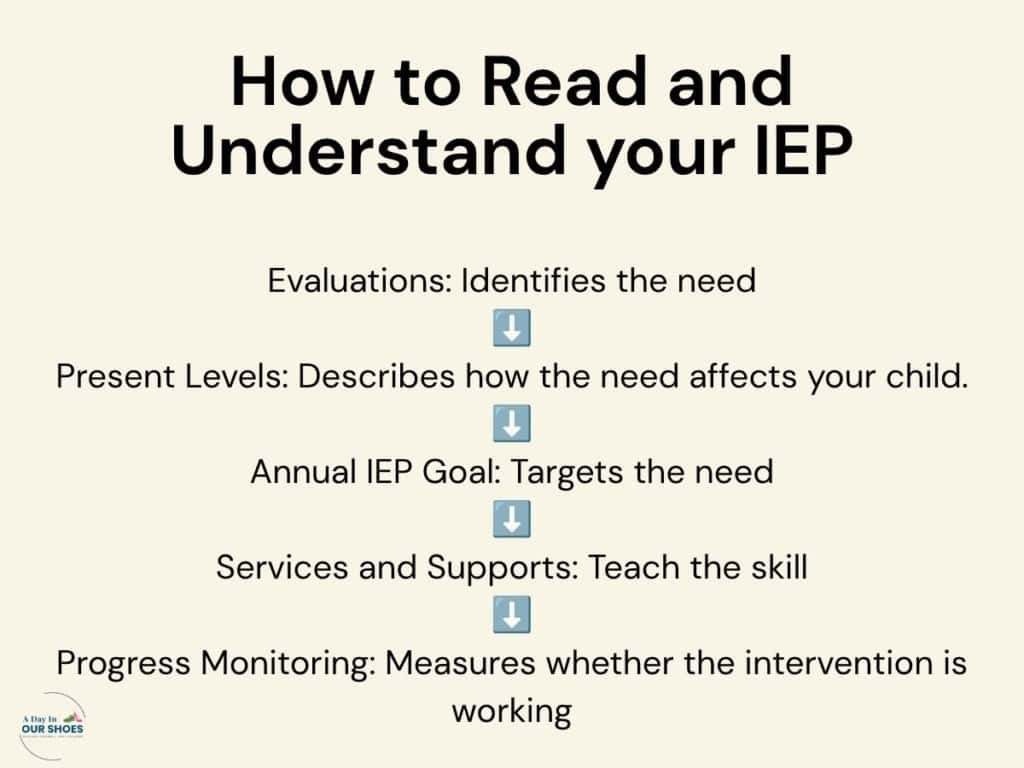
It should look something like this:
Evaluation ➜ identifies the need
⬇️
Present Levels ➜ describes how the need affects your child
⬇️
Annual Goal ➜ targets the need
⬇️
Services and Supports ➜ teach the skill
⬇️
Progress Monitoring ➜ measures whether the intervention is working
When one of those pieces is missing, the chain breaks.
Common Red Flags
As you review your child’s IEP, watch for these common problems:
- An evaluation identifies a need, but there is no goal.
- A goal exists, but no services support it.
- Accommodations don’t actually address the disability.
- Present Levels are outdated or don’t reflect current performance.
- Progress reports don’t measure the goal.
- Goals aren’t based on current data.
You Don’t Have to Read the Whole IEP First
Eventually, yes, you’ll want to review the entire document.
But if you don’t know where to start, don’t start with page one. Most parents tune out by page five because they don’t understand it.
Start with one concern, and then follow it through every section of the IEP.
It’s faster and less overwhelming. And it’s exactly how an experienced special education advocate reviews an IEP.
If this method helps you, download the free worksheet, watch the video, and keep both with your IEP binder so you can use them every time your child’s IEP is updated.