Free ABC Matching Worksheets: Cut and Paste Alphabet Letter Matching
Learning to recognize the letters of the alphabet takes practice, and that practice doesn’t always have to mean tracing the same letter over and over again.
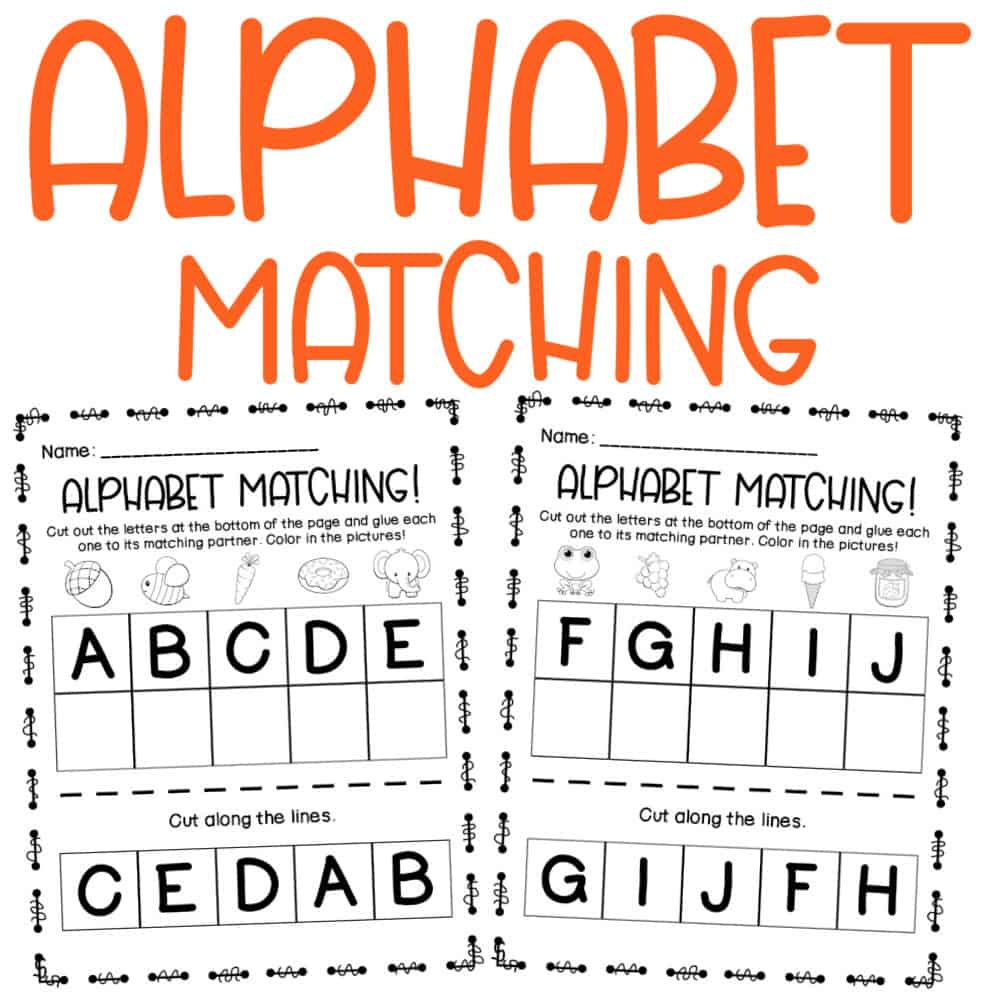
These free ABC matching worksheets give kids a different way to work on letter recognition. Instead of tracing or writing the letters, students cut out the letters at the bottom of each page, find the matching alphabet letter above, and glue it into the correct space.
It’s a pretty simple activity, which is kind of the point. The student has one job: find the matching letter.
Other Alphabet Activities (all free PDFs):
Download the Free ABC Matching Worksheets
This free printable includes six pages of ABC matching worksheets covering the alphabet from A through Z. Students cut out the scrambled letters and glue each one underneath its matching letter. Each page also includes pictures that can be colored and used for additional vocabulary or beginning-sound practice.
Use the entire set or print only the alphabet match worksheet you need.
Download the free Alphabet Matching Worksheets below.
Alphabet Matching Worksheets A-Z
The printable includes the entire alphabet from A through Z. Most pages contain five letters at a time, with the final page used for Z. The letters to be cut out are deliberately placed in a different order from the letters students need to match.
For example, the first alphabet matching worksheet shows A, B, C, D and E. At the bottom of the page, those same letters appear as C, E, D, A and B.
Students have to identify each letter rather than simply cutting and gluing them back in the same sequence. And yes, that’s a small difference. But if we’re trying to determine whether a child actually recognizes B, I’d rather not give away the answer by putting another B directly underneath it.
What Does Letter Matching Work On?
Before kids can read words, they have to recognize individual letters consistently. Matching letters is one way to practice that skill without requiring the student to write them independently.
These worksheets can be used to work on letter recognition, visual discrimination and matching alphabet letters. Because students are also cutting and gluing, there’s a fine motor component built into the activity.
The pictures at the top of the pages can also be colored, and they correspond with the letters on the page. On the first page, for example, you’ll find an acorn, bee, carrot, donut and elephant above A-E.
You can leave it at that, or use those pictures to add some beginning-sound practice. Ask the student to name each picture and listen for its first sound.
ABC Matching Is Not the Same as Writing the Alphabet
One reason I like having different kinds of alphabet activities available is that they don’t all measure the same thing.
A child might recognize the letter M immediately but still have difficulty writing an M. Another child may be able to sing the alphabet and recite A through Z but struggle to identify individual letters when they’re presented out of order.
An ABC matching printable lets a child show that they recognize two letters as the same without also requiring handwriting. That can be particularly useful when you’re trying to figure out what a child actually knows.
If handwriting or fine motor skills are difficult, you can also modify the activity. Cut the letters out ahead of time and have the student place the matching letters instead of gluing them. Laminate the pages and use Velcro dots. Have the student point to the match.
The goal is letter matching. Cutting should not be the thing that prevents a student from demonstrating that skill.
How to Use These Letter Matching Worksheets
You don’t have to give a student the entire alphabet at once.
If they’re learning A-E, start with the first page. The next letter matching worksheet covers F-J, followed by K-O, P-T and U-Y, with Z on the final page.
That makes it easy to use the worksheets alongside whatever alphabet sequence you’re already teaching.
Teachers can use them for literacy centers, small-group instruction, independent work or extra practice. Parents can use them at home, and they’re easy to add to homeschool lessons.
You can also come back to the same alphabet letter matching worksheets later to see whether the student can complete them with less prompting or support.
What Age Are Alphabet Matching Worksheets For?
These worksheets are probably most appropriate for preschool, Pre-K and kindergarten students who are learning to recognize the alphabet.
But I’m not a fan of attaching a hard age limit to foundational skills, particularly for disabled students.
If an older student is still working on alphabet recognition or matching letters, then that’s the skill that needs instruction. Use materials that match the student’s instructional needs.
You may decide that the graphics aren’t appropriate for a particular older student, and that’s worth considering. But needing to learn letter recognition doesn’t suddenly disappear because a child reaches a certain grade.
More Letter Matching Activities
Once a student understands the concept, you can practice alphabet matching without a worksheet too.
Use magnetic letters and have students find pairs. Print two sets of alphabet cards and play a matching game. Hide letters around the room and have students find the matching alphabet letter. You can also begin matching uppercase letters to lowercase letters once the student is ready for that next step.
The important part is giving students opportunities to recognize letters in different formats and contexts, not simply memorize where they appear on one worksheet.