
Outer Space Dot to Dot Printables | 8 Free Connect the Dots PDFs
Space is one of those themes that works for almost everything. Science? Obviously. Reading? Sure. Math? Yep. And apparently it can also convince kids that counting to 61 is considerably more interesting if an astronaut is involved.
These free space dot to dot printables give kids practice with number recognition and number order while they complete astronauts, rockets, planets, UFOs and other outer space pictures.
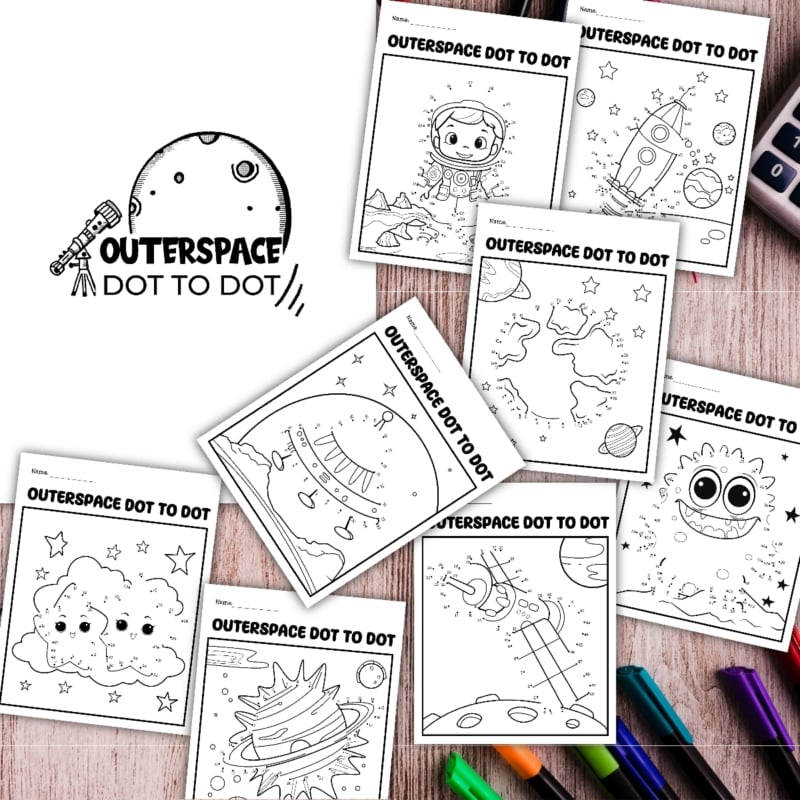
There are 8 free printable space dot to dot worksheets in the set. The puzzles aren’t all the same difficulty either. Some have shorter number sequences while the more detailed pictures go up to 50, 60 and 61.
So you can choose a page based on the numbers a child is currently working on rather than handing everyone the same worksheet and hoping for the best.
- 9 Planets Coloring Pages PDF
- Solar Eclipse PDF Worksheets for Kids
- Free Solar System Worksheets (PDF)
- Solar Eclipse Activity (free PDF for a fold-out activity)
What’s Included in the Space Dot to Dot Printables?
This free printable PDF includes eight black-and-white outer space connect the dots pictures.
Kids will find astronauts, a rocket, planets, a UFO and several fun outer space characters and scenes. After connecting the numbered dots, they can color the completed pictures.
The number sequences vary from page to page. The UFO activity goes to 25, one of the planet-themed pages goes to 35, and the more detailed space pictures include numbers through 50, 60 and 61.
That gives you more options than a set where every single dot-to-dot stops at the same number.
Download the Free Space Dot to Dot Printables
This free PDF includes 8 space dot to dot printables featuring astronauts, a rocket, planets, a UFO and other fun outer space pictures. The worksheets include different number ranges, with puzzles extending as high as 61.
Use them for kindergarten and elementary math practice, homeschool, special education, early finishers, space-themed activities or alongside an outer space or solar system unit.
Print the pages that match the numbers your child or student is currently practicing.
Why Use Dot to Dot Worksheets?
Connect-the-dots activities can be a simple way to practice number recognition and number sequencing.
A child isn’t just reciting numbers from memory. They have to identify the current number, determine what comes next, locate that number somewhere on the page and continue the sequence.
You can get a little more information about what a student knows by watching how they complete the activity.
- Do they immediately know what number comes next?
- Can they recognize the number when they find it?
- Do they lose their place when scanning the page?
- Can they resume the sequence after stopping?
That’s more useful information than simply knowing whether the finished rocket looks like a rocket.
Space Connect the Dots for Different Skill Levels
One reason I like having several space connect the dots in the same set is that you don’t have to treat them as interchangeable.
A student who is working comfortably with numbers through 25 can start with the shorter UFO puzzle. Another student may be ready for a page that continues through 50 or 60.
Choose the worksheet based on the skill you’re working on.
This is especially important in special education classrooms, intervention groups and mixed-ability classrooms. Grade level doesn’t tell you which number sequence an individual student needs to practice.
Pick the skill. Then pick the worksheet.
Use the Space Dot to Dot Worksheets for Number Recognition
If you’re using these for math practice, don’t feel like the activity has to end when the picture is finished.
Have the student say each number as they connect the dots. Or pause periodically and ask: What number comes next?
You can also have students find a specific number without connecting anything. Ask them to locate 17, 24 or 32, for example.
For students who need additional support, use a number line or number chart alongside the printable. They can find their current number on the chart, identify what comes next and then search for that number on the worksheet.
The support isn’t “cheating.” It’s support. That’s why we put it there.
Outer Space Connect the Dots and Fine Motor Skills
Yes, dot-to-dot activities involve pencil control. But I wouldn’t automatically turn these into a fine motor assessment.
If your goal is number sequencing, that’s what you should be paying attention to.
A student may know that 28 comes after 27 and still have difficulty drawing a neat line between the two dots.
Students who need motor support can use a thicker writing tool, work on an enlarged copy, point to the numbers while someone else draws the lines, or use whatever adaptations are appropriate for them.
If you’re specifically working on pencil control, that’s different. Just be clear about which skill you’re actually measuring.
Add These to a Space or Solar System Unit
These printables also make an easy addition to an outer space or solar system theme.
The pages feature rockets, astronauts, stars, planets, a UFO and other space imagery.
You could use a solar system dot to dot after a science lesson, put the worksheets in a space-themed math center, or keep a few available for early finishers during a planets unit.
I wouldn’t use these to actually teach the solar system. They don’t teach the names or order of the planets.
They’re number activities with a space theme.
And that’s fine. Every printable doesn’t need to teach seven subjects simultaneously.
Easy Ways to Extend the Space Theme
After students complete a picture, you can extend the activity without printing another worksheet.
Have them color the picture and add details to the scene. They might draw stars, another planet, a moon, an alien, or even another spacecraft.
You could also have students write a sentence or short story about the picture they completed.
For younger students or students with language needs, ask questions instead:
- Where is the astronaut going?
- What do you think is on that planet?
- What might the astronaut see?
- What would you take with you into space?
Now the same printable can lead into conversation, vocabulary or writing without pretending the dot-to-dot itself magically teaches creative writing.
Free Printable Space Dot to Dot Activities at Home
These don’t have to be classroom worksheets.
If you have a kid who is currently in the everything must involve space phase, print a few for home.
They can work well for quiet time, homeschool, travel, rainy days or something to put on the table when you need an activity that doesn’t involve setting up 14 containers of craft supplies.
Print the pages your child can reasonably complete. You don’t have to give them all eight at once.
Using Connect the Dots With Students Who Need More Support
For students with disabilities, the easiest way to adapt these worksheets is to separate the skills involved.
- If finding the next number is difficult, provide a number line.
- If visually scanning a busy page is difficult, help the student locate a smaller area to search.
- If drawing lines is difficult, adapt the writing tool or response method.
- If a page with 60 dots is overwhelming, use one with a shorter number sequence.
And if a student understands the number sequence but can’t physically connect the dots independently, don’t confuse the motor difficulty with not understanding numbers.
We can accommodate one skill without lowering expectations for the other.
More Ways to Practice Numbers
Dot-to-dot worksheets are one option for practicing number order, but they shouldn’t be the only one.
Students can also put number cards in order, find missing numbers on a number line, build sequences with magnetic numbers, count objects, play number games or match numerals with quantities.
That’s particularly helpful if a student can complete a familiar worksheet format from memory but has trouble applying the same skill somewhere else.
We want the kid to understand number order, not simply become extremely proficient at dot-to-dots.
Though if they happen to enjoy them, great. We finally found a worksheet nobody has to argue about.