Behavior Goals for an IEP: 101 Examples incl. Adaptive Behavior Goals (+ PDF)
I can’t believe I haven’t tackled this topic before. Well, ok, I can. It’s an IEP subject area that is incredibly complex. It also is one that affects our kids day-to-day the most, and in my opinion, is usually handled the worst.
Helping child improve their behavior, through an IEP or another mechanism, has really changed a lot over the past decade. Now we know that behavior IEP goals are not enough. The team must take a whole 360-degree view of the child, their disability and their environment.

Behavior goals may be needed due to autism–but autism doesn’t cause bad behavior, if that makes sense. It’s usually unsupported sensory needs, slow processing issues or other things causing the behavior, which is secondary to the autism if that makes sense.
Behaviors can also present like an emotionally disturbed child. But again, the behavior is usually secondary to another issue. But, behavior IEP goals can be a starting point. If you’re having trouble defining what it is that a child is struggling with, sometimes reading over goals describing desirable behavior can help get you there.
Please note: There’s a lot of overlap when it comes to various areas of need that a child has. If you are looking for Social Emotional goals, I have a list of those too. If you don’t find what you need here, you made find it there. Or, check the IEP Goal Bank.
- IEP Goals for Perseveration and Perseverating Behaviors
- 10 Effective Replacement Behaviors and Strategies for Hitting and Aggression (Classroom and Home)
- Why Most FBAs and Behavior Plans Fail
How do you Decide on Behavior Goals?
Can you have Behavior Goals without an FBA? The short answer is yes. However, doing an FBA first is the best practice. And, how do you know that you need behavior goals if you have not done any evaluations regarding behavior?
You would need the FBA to drive the Behavior Plan within the IEP. That being said, if my child’s behaviors were minimal, and adequately addressed in the IEP without an FBA, I’m not sure that would be a battle I would fight. Every situation is different.
The main thing to remember is: All behavior tells you something. What is the child trying to say?
This behavior IEP goals and objectives bank has a lot of lists. So grab a cup of something and poke around for a while. Behavior is a complex topic, and you cannot talk about behavior goals without also talking about FBAs, discipline, manifestation hearings, and so on.
As I say, “knowledge base I wish I didn’t have to have” but I do. But let’s not put the cart before the horse.
Can you have a Behavior Plan without an IEP?
Again, the short answer is yes. You can have a behavior plan without an IEP, and you can even have a behavior only IEP. I have seen it done (though I did not question the validity of doing it this way as it was not my client). For some kids, their only area of need might be behavior.
Therefore it kinda sorta makes sense that they only need a behavior plan and not a full-blown IEP. However, I think this is a horrible practice. If a child has behaviors significant enough to warrant a behavior plan, then they should have an IEP though the law does not require it.
Because it is my opinion, and Ross Greene’s too, that most behaviors are caused by lagging skills. Having an IEP also offers legal and disciplinary protections that should be considered.
How to Write a Behavior Goal for an IEP
In behavior, there’s a whole lot of talk about “making good choices.” Just make sure that the child has the skill set before the expectation is set.
It’s very easy to lay out expectations of what you wish a child to do. Classroom behavior goals are never going to happen if the foundation isn’t there.
If a child lacks a skill, it is never going to happen. This goes back to your FBA. Make sure that as behaviors are listed, they are defined as either “will of the child” or “lack of skill set.”
There is a huge difference, but both can result in being expelled from school. Two of my favorite experts for behavior are Ross Greene and Peter Gerhardt. Both address teaching skills, not just reward and punish.
Behavior Goals for an IEP
I didn’t need to reinvent the wheel. There are lots of great sites to pull from. I have included some goals that I wasn’t that crazy about. If the IEP goal you need isn’t on this list, make sure you check out the IEP Goal Bank.
Some had wording like “will act mad the right way.” You know what’s wrong with that one, right? Who says what is the right way to be mad? Does the child even know this? And how to do it?
For numbers, use the figure that is in the child’s baselines and work up from there. I have removed wording such as “calm body” and “quiet hands.”
If a child needs to stim, script, flap, or rock while doing a task, what is the harm in that?
IEP Behavior Goals by Category
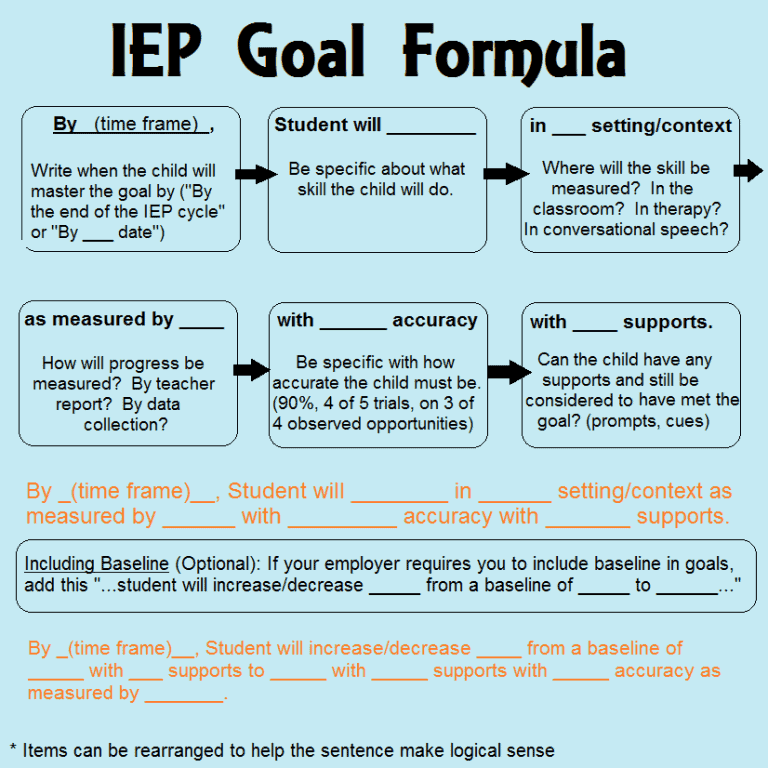
When writing IEP goals, every goal should follow a clear, measurable structure. The formula below helps teams stay consistent while still personalizing each goal to the student. Each goal includes a time frame, the specific skill the student will demonstrate, the setting or context where the skill will be measured, how progress will be assessed, the required level of accuracy, and any supports the student may use.
By _____(time frame)_____, Student will_____ in_____ setting/context as measured by_____ with_____ accuracy with _____supports.
If a baseline is required, it can be added to show where the student is starting and how much growth is expected. Using this structure ensures the goal is meaningful, measurable, and easy for any teacher or parent to understand.
Including Baseline (Optional): If your employer requires you to include baseline in goals, add this “…student will increase/decrease _____ from a baseline of _____ to ______.”
Adaptive Behavior Goals
An adaptive behavior IEP goal focuses on everyday functional skills that help a student navigate school and life independently—like following routines, managing personal care, or using coping strategies. In contrast, a regular behavior goal may target classroom-specific behaviors such as staying on task or reducing disruptions. Adaptive goals support overall independence, not just compliance.
- Conflict Management: By (2-month period), student will manage peer or classroom conflicts independently in naturally occurring classroom situations as measured by observations and performance assessments with 4 out of 5 accuracy with no teacher support.
- Self-Regulation with Checklist: By (2-month period), student will use a self-monitoring checklist to demonstrate self-regulation skills in weekly instructional sessions as measured by teacher observation with 90% accuracy with minimal prompts.
- Task Initiation: By (2-month period), student will initiate writing tasks within 1 minute of assignment presentation in classroom writing activities as measured by observation and performance assessments with 80% accuracy across 20 opportunities with standard classroom supports.
- Rule-Following with Token System: By (2-month period), student will follow classroom rules using a five-piece token board system in half-hour academic sessions as measured by token data with 80% accuracy across 4 of 5 sessions with visual supports.
- Break Requesting: By (2-month period), student will request a break appropriately and return to task independently in academic and non-preferred activities as measured by observation and performance data with 8 out of 10 accuracy with access to their communication method.
On-Task IEP Goals
I have another whole list of Work Completion IEP Goals and Examples (Task Completion).
You Need IEP Data. You Also Need to Teach.
Progress monitoring matters. But it has to be simple enough to actually use in a real classroom.
Get teacher-created, simple, ready-to-use tools that help you track IEP goals, and document student progress, without drowning in more paperwork. Save time, stay compliant.
- Task Initiation (2-minute window): By (2-month period), student will begin assigned tasks within 2 minutes when given a visual or verbal prompt in classroom instructional settings as measured by teacher observation and data collection with 4 out of 5 accuracy with prompting supports.
- On-Task Behavior (15 minutes): By (2-month period), student will remain on task during independent work for at least 15 consecutive minutes in classroom work periods as measured by time-on-task data and teacher observation with 4 out of 5 accuracy with standard classroom supports.
- Classwork Completion: By (2-month period), student will complete and turn in assigned classwork in weekly instructional settings as measured by collected assignments and teacher records with 4 out of 5 accuracy with minimal adult prompts.
- Checklist Use for Multi-Step Tasks: By (2-month period), student will follow a daily task checklist to complete multi-step assignments in academic settings as measured by teacher data with 80% accuracy with no more than one adult prompt.
- Sustained Attention During Non-Preferred Tasks: By (2-month period), student will use a self-selected strategy (e.g., timer, break card) to stay on task and complete non-preferred assignments in classroom settings as measured by observation with 4 out of 5 accuracy with access to preferred strategies.
- Homework Recording and Submission: By (2-month period), student will accurately record homework in their planner and submit homework on time in daily school routines as measured by teacher records with 4 out of 5 accuracy with organizational supports.
- Help-Seeking Behavior: By (2-month period), student will ask for help appropriately when unsure how to begin or complete a task in classroom activities as measured by observation with 80% accuracy with routine teacher modeling.
- Task Initiation + On-Task Behavior Combo: By (2-month period), student will begin tasks within 1 minute and remain on task for at least 10 minutes independently in classroom activities as measured by staff data with 8 out of 10 accuracy with no more than two prompts.
- Attending to Non-Preferred Activities: By (2-month period), student will attend to non-preferred small-group or independent activities for 20 minutes in instructional settings as measured by staff documentation with 3 out of 4 accuracy with no more than one verbal cue.
- On-Task Behavior with Fidget: By (2-month period), student will demonstrate on-task behavior for 75% of intervals during a 10-minute period in general education settings as measured by observational data with 4 out of 5 accuracy with access to an appropriate fidget and one reminder.
- Group Instruction Attention (10 minutes): By (2-month period), student will attend to tasks during large and small group instruction for at least 10 minutes across classroom settings as measured by teacher-charted data with 4 out of 5 accuracy with no more than one teacher prompt.
- On-Task Behavior with Movement Breaks: By (2-month period), student will attend to classroom tasks for an average of 75% of intervals during a 20-minute class period in instructional settings as measured by staff observation with standard movement break supports.
- Task Initiation with Self-Regulation Strategies: By (2-month period), student will initiate tasks—including non-preferred ones—within 2 minutes of direction across environments as measured by staff data with 80% accuracy with access to self-regulation strategies and a self-monitoring checklist.
- Sustained Focus with Strategies: By (2-month period), student will remain focused on tasks for at least 10 minutes without adult prompting across settings as measured by observation and data tracking with 80% accuracy with access to self-regulation strategies and a checklist.
- Small Group Task Completion: By (2-month period), student will complete assigned tasks and ask for help appropriately in small-group instructional settings as measured by teacher observation with 80% accuracy across 5 consecutive trials with standard classroom supports.
- Non-Preferred Task Completion with Timer: By (2-month period), student will begin non-preferred tasks within 1 minute and complete them within a designated time limit in structured classroom settings as measured by staff data with 8 out of 10 accuracy with access to self-regulation tools and a reward system.
Class Participation IEP Goals
- Group Participation (Hand-Raising and Relevant Responses): By (2-month period), student will raise their hand and contribute a relevant response or question during group instruction in classroom lessons as measured by teacher observation and participation logs with 4 out of 5 accuracy with standard classroom prompts.
- Group Discussion Engagement: By (2-month period), student will engage in group discussions by offering an idea or response in classroom group activities as measured by teacher observation with 80% accuracy with a verbal prompt or cue.
- Following Group Instructions and Engagement: By (2-month period), student will follow group instructions and remain engaged during class activities (e.g., tracking the speaker, turn-taking) in group instructional settings as measured by teacher data collection with 4 out of 5 accuracy with typical classroom supports.
- Participation in Routines and Transitions: By (2-month period), student will participate in class routines or transitions (e.g., lining up, classroom jobs, cleanup) in daily classroom routines as measured by observation with 80% accuracy with no more than one reminder.
- Appropriate Volume and Tone in Discussion: By (2-month period), student will use appropriate volume and tone when speaking during class discussions in group instructional settings as measured by teacher observations and checklists with 4 out of 5 accuracy with verbal modeling supports.
- Clarification / Help-Seeking: By (2-month period), student will ask for clarification or assistance appropriately (e.g., raising hand, help card) in academic settings as measured by teacher observation with 80% accuracy with access to communication supports.
- Partner / Small-Group Participation: By (2-month period), student will participate in partner or small-group work by taking turns, sharing materials, and staying on task in small-group instructional settings as measured by teacher observation and checklists with 4 out of 5 accuracy with standard instructional supports.
Coping Skills Behavior Goals
Here are sample Coping Skills Behavior IEP Goals, designed to support students in managing emotions, frustration, or anxiety in the school setting.
- Coping Strategy Use (Frustration Response): By (2-month period), student will identify and use an appropriate coping strategy in response to frustration in classroom settings as measured by teacher observation and behavior logs with 4 out of 5 accuracy with access to pre-taught strategies.
- Expressing Feelings / Needs: By (2-month period), student will verbally express feelings or needs using appropriate language when experiencing stress or anxiety in school environments as measured by teacher observation with 80% accuracy with verbal or visual cues.
- Initiating Self-Regulation Strategies: By (2-month period), student will initiate a self-regulation strategy to de-escalate when cued in instructional settings as measured by staff observation with 4 out of 5 accuracy with visual or verbal supports.
- Early Identification of Dysregulation / Break Requesting: By (2-month period), student will recognize early signs of emotional dysregulation and request a break or support before exhibiting disruptive behavior in classroom situations as measured by teacher observation with 80% accuracy with access to break-request tools.
- Using Personalized Coping Toolkit: By (2-month period), student will use a pre-taught coping strategy from a personalized toolkit in instructional settings as measured by staff observation with 4 out of 5 accuracy with no more than one prompt.
- Returning to Baseline: By (2-month period), student will stay in class during challenging academic or social situations and return to baseline behavior within 5 minutes as measured by behavior data with 80% accuracy with standard supports.
- Selecting Appropriate Coping Tools Independently: By (2-month period), student will select and use an appropriate coping tool or strategy independently when given choices in classroom settings as measured by observation and student self-report with 4 out of 5 accuracy with access to coping tools.
- Using Positive Self-Talk & Coping Strategies: By (2-month period), student will use positive self-talk and coping strategies to manage stressful tasks or work demands and engage calmly in the activity in classroom settings as measured by teacher documentation with 2 out of 3 accuracy with no more than one prompt.
- Identifying Feelings and Choosing Strategies (Counseling): By (2-month period), student will identify feelings and select an appropriate coping strategy during counseling sessions as measured by therapist records with 80% accuracy with instructional supports.
- Self-Regulation During Emotional Upset: By (2-month period), student will use a self-regulation strategy to avoid unexpected behaviors when frustrated, angry, or upset in classroom environments as measured by staff observation with 4 out of 5 accuracy with no more than one reminder.
- Returning to Expected Emotional State (Small Group): By (2-month period), student will use a self-regulation tool to return to an expected emotional state in small group settings as measured by staff data with 8 out of 10 accuracy with one adult reminder.
- Insight Into Emotional Regulation: By (2-month period), student will identify situations where a regulation tool would have been helpful and select an appropriate tool for each in counseling settings as measured by session data with 80% accuracy with guided practice.
- Problem Size and Response Selection: By (2-month period), student will determine the size of a problem and select an appropriate coping response before returning to task in classroom situations as measured by teacher-charted data with 4 out of 5 accuracy with strategy reminders.
- Coping Strategy Use + Task Return (Extended Duration): By (2-month period), student will use a coping strategy with one prompt during frustrating situations and return to the task for at least 10 minutes in classroom environments as measured by teacher data with 95% average success over 8 consecutive weeks with access to strategies.
- Independent Coping / Returning to Task: By (2-month period), student will independently use an appropriate strategy when presented with situations known to cause anxiety or frustration and return to task within 2 minutes across all settings as measured by staff documentation with 80% accuracy with access to coping tools.
Emotional Regulation
This is another category where I have an entire separate list devoted to: IEP Goals for Self-Regulation Skills or Emotional Regulation
- Identifying Emotional State: By (2-month period), student will identify their current emotional state using a visual scale in classroom settings as measured by teacher observation and student check-ins with 4 out of 5 accuracy with access to visual supports.
- Demonstrating Self-Regulation Strategies: By (2-month period), student will demonstrate appropriate self-regulation strategies to return to a calm state in instructional environments as measured by staff observation with 80% accuracy with visual or verbal cues.
- Recognizing Triggers and Using Strategies: By (2-month period), student will recognize personal triggers for dysregulation and use a pre-taught strategy to manage their response in school settings as measured by behavior logs and staff reports with 4 out of 5 accuracy with access to strategy tools.
- Calm Transitions: By (2-month period), student will transition between activities calmly and independently in daily school routines as measured by observation with 4 out of 5 accuracy with no more than one prompt.
- Managing Frustration Without Outbursts: By (2-month period), student will refrain from physical or verbal outbursts and use a coping skill during frustration or anger in classroom situations as measured by staff observation with 80% accuracy with access to coping strategies.
- Daily Self-Monitoring Participation: By (2-month period), student will participate in a daily self-monitoring routine and reflect on their behavior with adult support in school settings as measured by teacher data with 4 out of 5 accuracy with structured monitoring tools.
- Staying Engaged During Challenges: By (2-month period), student will use positive self-talk or other regulation strategies to remain engaged and avoid escape behaviors during academic or social challenges as measured by teacher or counselor observation with 80% accuracy with access to regulation strategies.
Self -Control IEP Goals
- Body and Voice Self-Control: By (2-month period), student will maintain appropriate personal space and use a classroom-appropriate voice level in classroom activities as measured by staff data collection with 80% accuracy during a 20-minute observation period with standard behavioral supports.
- Impulse Control When Speaking: By (2-month period), student will raise their hand and wait to be called on before speaking in class in instructional settings as measured by teacher observation and data tracking with 80% accuracy across 5 out of 5 trials with verbal modeling supports.
- Refraining From Interruptions: By (2-month period), student will refrain from interrupting peers or the teacher and wait for an appropriate time to speak during instructional activities as measured by staff documentation with 4 out of 5 accuracy with routine classroom prompts.
- Self-Control During Group or Partner Tasks: By (2-month period), student will use respectful language and tone, stay seated, and keep hands to self during group or partner tasks as measured by teacher observation with 4 out of 5 accuracy with structured expectations.
- Following Directions the First Time: By (2-month period), student will follow adult directions the first time given in classroom settings as measured by staff observation with 80% accuracy with no more than one prompt.
- Regulation During Frustration or Excitement: By (2-month period), student will refrain from shouting or physical outbursts and use a taught strategy to stay regulated during emotional situations as measured by staff observation with 4 out of 5 accuracy with access to regulation tools.
- Safe Hallway Transitions: By (2-month period), student will walk safely in hallways and transition areas without touching walls, materials, or peers as measured by staff data with 4 out of 5 accuracy with visual and verbal reminders.
- Controlling Impulsive Physical Behaviors: By (2-month period), student will control impulsive physical behaviors in group settings in school environments as measured by teacher observation and behavior logs with 80% accuracy with access to social expectations supports.
Self-Monitoring IEP Goals
- Daily Self-Monitoring Completion: By (2-month period), student will complete a daily self-monitoring checklist related to behavior or task completion in school routines as measured by completed checklists and teacher review with 90% accuracy in 4 out of 5 school days with structured monitoring supports.
- Assessing Classroom Expectations: By (2-month period), student will independently assess whether classroom expectations were followed using a visual or written checklist in instructional settings as measured by teacher and student comparison logs with 4 out of 5 accuracy with access to a checklist.
- Emotional State & Performance Rating: By (2-month period), student will rate their emotional state and performance at the beginning, middle, and end of sessions in instructional or counseling contexts as measured by self-monitoring forms with 4 out of 5 accuracy with visual rating tools.
- Tracking Target Behavior: By (2-month period), student will track one target behavior using a self-monitoring chart in classroom environments as measured by teacher data with 80% accuracy across the period with access to goal-tracking tools.
- Comparing Self-Monitoring to Teacher Ratings: By (2-month period), student will compare their self-monitoring scores to teacher ratings and reflect on differences in classroom check-ins as measured by comparison logs with 4 out of 5 accuracy with guided reflection supports.
- Scheduled Self-Monitoring Check-Ins: By (2-month period), student will independently check in at scheduled times and record behavior accurately using a self-monitoring system in school routines as measured by staff data with 80% accuracy over 4 consecutive weeks with access to monitoring tools.
- Weekly Goal Setting and Reflection: By (2-month period), student will identify one behavior to improve each week and set a personal goal using a daily log in school settings as measured by student logs with 80% participation over 6 weeks with adult support for goal setting.
- Behavior Reflection in Sessions: By (2-month period), student will verbally reflect on behavior and identify a successful or unsuccessful strategy during weekly counseling or check-in sessions as measured by staff notes or journal entries with 4 out of 5 accuracy with guided prompts.
- Identifying Expected vs. Unexpected Behavior: By (2-month period), student will identify expected and unexpected behaviors and rate their own behavior using a self-monitoring tool in classroom situations as measured by comparison data with at least 80% agreement with teacher ratings with access to visuals.
- Anxiety Level Self-Rating: By (2-month period), student will identify their level of anxiety using a visual self-rating tool in instructional or counseling settings as measured by comparison to teacher observations with 80% accuracy with access to the self-rating tool.
IEP Goals for Addressing Aggression
- Using Replacement Behaviors: By (2-month period), student will use a pre-taught replacement behavior instead of aggression during frustration or anger in classroom and school environments as measured by staff documentation with 4 out of 5 accuracy with access to coping strategies.
- Identifying Feelings and Requesting Support: By (2-month period), student will verbally identify feelings and request support or a break before resorting to physical behaviors in triggering situations as measured by staff observation with 80% accuracy with visual or verbal prompts.
- Using Calm-Down Routine or Space: By (2-month period), student will use a designated calm-down routine or space to regulate emotions and avoid aggressive behavior in school settings as measured by behavior logs and staff observation with 4 out of 5 accuracy with access to the calm-down area.
- Responding to Peer Conflict Without Aggression: By (2-month period), student will respond to conflict or frustration using respectful words or coping strategies without physical aggression during peer interactions as measured by staff observation with 80% accuracy across a 4-week period with structured social supports.
- Daily Behavior Check-Ins: By (2-month period), student will participate in daily check-ins with a staff member to reflect on behavior and identify triggers or coping strategies in school routines as measured by check-in logs with 90% participation over 4 weeks with adult support.
- Post-Incident Reflection: By (2-month period), student will complete a behavior reflection form or verbal debrief after incidents or difficult situations in classroom or school environments as measured by staff documentation with 4 out of 5 accuracy with guided reflection supports.
- Walking Away or Seeking Help Instead of Retaliation: By (2-month period), student will walk away or seek adult help when provoked or upset instead of engaging in physical retaliation in school settings as measured by teacher observation and incident reports with 4 out of 5 accuracy with access to adult support.
Anxiety IEP Goals
I have a separate list of IEP goals for Anxiety.
- Identifying Anxiety Level and Choosing Strategies: By (2-month period), student will identify their level of anxiety using a visual scale and select an appropriate coping strategy in classroom settings as measured by teacher observation and student check-ins with 4 out of 5 accuracy with access to visual supports.
- Using Coping Strategies During Anxiety-Provoking Tasks: By (2-month period), student will use a pre-taught coping strategy to remain engaged during anxiety-provoking tasks or situations in instructional environments as measured by staff observation with 80% accuracy with access to coping tools.
- Advocating for Needs During Anxiety: By (2-month period), student will advocate for their needs appropriately during moments of elevated anxiety in school settings as measured by staff documentation and student self-report with 4 out of 5 accuracy with communication supports.
- Reflection During Check-Ins: By (2-month period), student will participate in daily or weekly check-ins to reflect on anxious thoughts or situations and review coping strategies used in counseling or classroom routines as measured by check-in logs with 90% consistency over 6 weeks with adult support.
- Remaining in Class During Anxiety-Inducing Activities: By (2-month period), student will remain in the classroom and complete assigned academic tasks during anxiety-inducing activities in instructional settings as measured by teacher observation and performance data with 4 out of 5 accuracy with accommodations and supports.
IEP Goals for Negative Comments and Gestures
- Refraining From Negative Comments or Gestures: By (2-month period), student will refrain from making negative comments or gestures toward peers or staff in school-day intervals as measured by staff observation and behavior data with 80% accuracy over a 4-week period with standard behavioral supports.
- Using Replacement Strategies Instead of Negative Responses: By (2-month period), student will use an appropriate replacement strategy when frustrated or upset instead of making negative verbal or nonverbal responses in school settings as measured by staff observation with 4 out of 5 accuracy with access to coping tools.
- Respectful Communication (Language, Tone, Body Language): By (2-month period), student will use neutral or positive language, tone, and body language during classroom interactions as measured by teacher checklists and observation data with 80% accuracy with teacher modeling supports.
- Self-Monitoring Negative Responses: By (2-month period), student will recognize and self-monitor negative comments or gestures using a visual checklist or point sheet in classroom and social settings as measured by teacher data with a 50% reduction from baseline over an 8-week period with structured monitoring tools.
- Choosing Appropriate Responses in Social Scenarios: By (2-month period), student will choose an appropriate response during social scenarios or real-time conflict instead of using sarcasm, threats, or gestures in school environments as measured by teacher or counselor observation with 4 out of 5 accuracy with access to social strategies.
IEP Goals for Non-Compliance/ Following Directions
Complementary Post: Ways to Increase a Child’s Ability to Follow Directions
- Complying With Directions Promptly: By (2-month period), student will comply with directions within 30 seconds and with no more than one prompt in classroom settings as measured by teacher observation and behavior data with 80% accuracy with standard supports.
- Following Multi-Step Directions: By (2-month period), student will follow 2–3 step directions accurately and independently across classroom settings as measured by staff documentation with 4 out of 5 accuracy with instructional supports.
- Beginning Non-Preferred Tasks Without Avoidance: By (2-month period), student will comply with directives to begin non-preferred tasks without arguing, refusing, or engaging in avoidance behaviors in school environments as measured by staff data with 4 out of 5 accuracy over a 6-week period with structured expectations.
- Responding to Redirection Appropriately: By (2-month period), student will respond appropriately to adult redirection by following the instruction without protest in school settings as measured by staff data with 80% accuracy with verbal or visual cues.
- Using Strategies Instead of Non-Compliance: By (2-month period), student will use a pre-taught strategy when frustrated or overwhelmed by a directive instead of displaying non-compliant behavior in classroom activities as measured by staff observation with 4 out of 5 accuracy with access to coping strategies.
- Compliance With Classroom Routines: By (2-month period), student will comply with classroom routines and expectations with no more than one reminder during daily school activities as measured by teacher observation with 4 out of 5 accuracy with visual and verbal supports.
- Transitioning as Directed: By (2-month period), student will transition between tasks or settings as directed using a visual or written schedule in school environments as measured by staff documentation with 80% accuracy across a 4-week period with access to schedule supports.
IEP Goals for Social/Emotional Problem Solving
- Collaborating With Peers During Group or Partner Work: By (2-month period), student will collaborate with peers by negotiating solutions, compromising, or asking clarifying questions during group or partner work as measured by teacher observation with 4 out of 5 accuracy over a 4-week period with structured group expectations.
- Identifying Problems, Emotions, and Solutions: By (2-month period), student will identify the problem, name their emotions, and generate at least two possible solutions when presented with real or hypothetical social conflict as measured by staff or counseling session data with 4 out of 5 accuracy with guided supports.
- Using a Structured Problem-Solving Process: By (2-month period), student will use a structured problem-solving process to respond to peer conflict or frustration in school settings as measured by teacher or counselor documentation with 4 out of 5 accuracy with access to problem-solving tools.
- Recognizing Escalation and Using Calming Strategies: By (2-month period), student will recognize when a problem is escalating and independently use a calming strategy to de-escalate during social interactions as measured by staff observation with 80% accuracy with access to calming strategies.
- Selecting Appropriate Responses to Peer Challenges: By (2-month period), student will select an appropriate response to peer-related challenges in classroom or social settings as measured by staff documentation with 4 out of 5 accuracy with access to social coping strategies.
- Matching Problem Size to Proportional Responses: By (2-month period), student will identify the size of a problem and match it to a proportional emotional and behavioral response during counseling or social skills sessions as measured by staff data with 80% accuracy across 5 trials with visual supports.
- Role-Play and Real-Life Social Problem-Solving: By (2-month period), student will participate in role-plays or real-life scenarios to practice social problem-solving and demonstrate appropriate responses as measured by staff observation and skill tracking with 4 out of 5 accuracy with structured session supports.
PDF List of IEP Behavior Goals
Here is the PDF printable list of behavior goals for an IEP, including adaptive behavior and staying in a designated area.
Can you have Behavior Goals without an FBA?
Yes, you can have behavior goals in an IEP without a Functional Behavior Assessment (FBA)—but it’s not always best practice.
Here’s a breakdown:
When Behavior Goals Might Be Added Without an FBA
- Mild or clearly defined behavior issues (e.g., calling out in class, staying seated)
- The IEP team already has ample data from observations, teacher reports, or previous plans
- The behaviors do not significantly interfere with learning or are not dangerous
- It’s the start of the process, and the team is trialing interventions before going deeper
When You Really Should Have an FBA First
- If the behaviors are intense, disruptive, aggressive, or self-injurious
- When behaviors are impeding the child’s learning or that of others
- If prior interventions or goals have not worked
- When the cause or trigger is unclear
- If you are considering a Behavior Intervention Plan (BIP)
Why an FBA Matters
An FBA helps you:
- Identify why the behavior is happening (the function)
- Avoid writing goals that target symptoms, not causes
- Ensure the interventions are individualized and effective
Can you have a Behavior Plan without an IEP?
Yes, you can have a Behavior Plan without an IEP, but context matters.
There are two common situations where this happens:
Behavior Plan Under a 504 Plan
- Students with a Section 504 Plan (not an IEP) can have a Behavior Intervention Plan (BIP) if their disability affects behavior.
- The plan may include:
- Positive behavior supports
- Environmental adjustments
- Adult responses to behaviors
- Strategies to prevent escalation
However, schools aren’t legally required to conduct a formal Functional Behavior Assessment (FBA) under Section 504, though they should if behavior is significantly impacting learning or access.
Informal Behavior Plan (No IEP or 504)
- Some schools write behavior plans for general education students without formal identification.
- These are often part of RTI/MTSS (Response to Intervention or Multi-Tiered System of Supports).
- They’re usually:
- Temporary
- Data-driven
- Designed to avoid or delay special education referral
But they don’t carry the legal protections of an IEP or 504 Plan. The school can change or stop the plan without parent consent.
If a student needs a BIP due to disability-related behavior, but doesn’t have an IEP or 504, it may be time to request a special education evaluation. A BIP alone isn’t a substitute for the protections of IDEA or Section 504.