IEP Goals for Severe and Profound Students: 30 Examples
Students with severe and profound disabilities may have significant needs across multiple areas, including communication, mobility, health, academics, self-care and daily living skills. Some students may also be medically fragile or require extensive adult support throughout the school day.
For these students, good IEP goals aren’t about lowering expectations. They’re about identifying meaningful skills, providing the supports necessary to access education, and measuring progress from the student’s individual starting point.
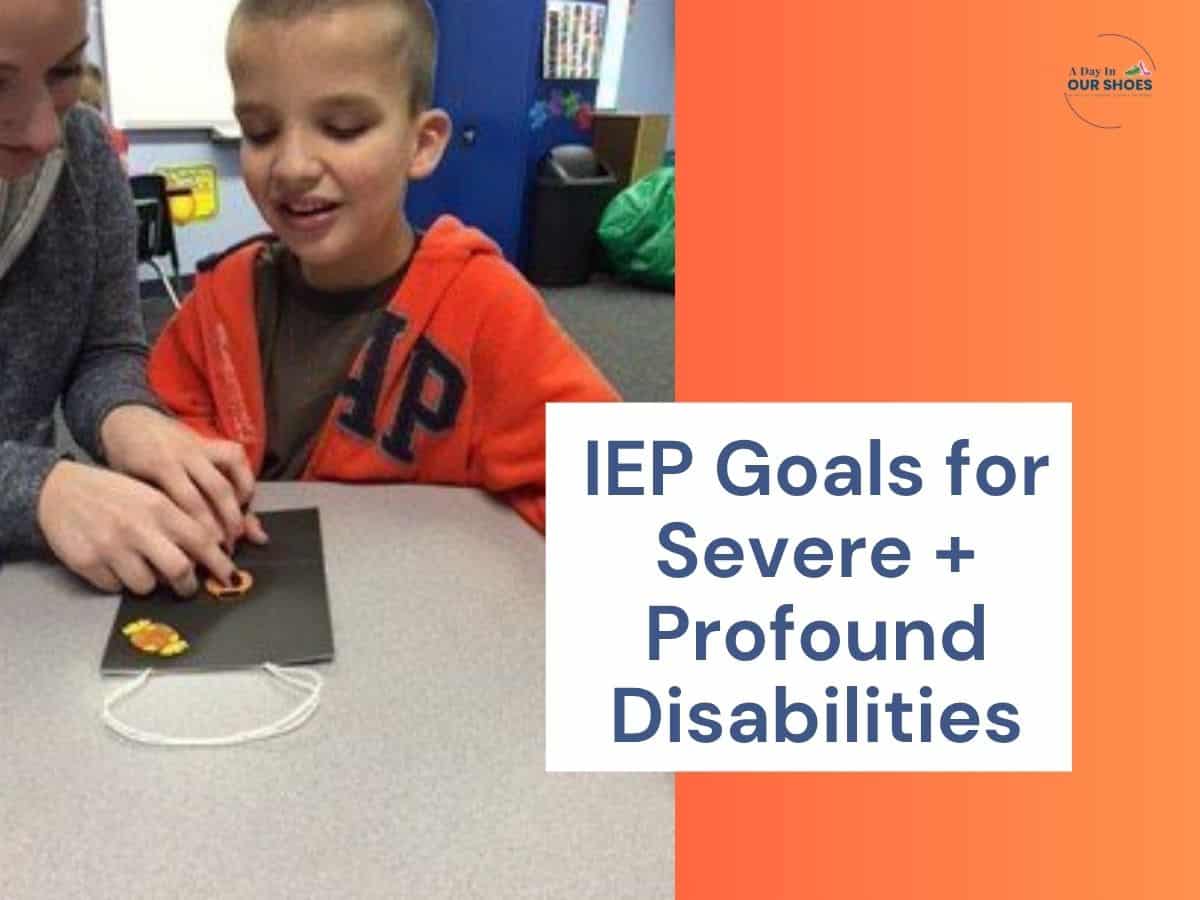
My own son has profound disabilities and requires extensive hands-on support in daily life. I don’t view words such as severe or profound as negative. For some students, including my son, they communicate the significance of their disabilities and support needs. I am aware that the title of this is IEP Goals for Severe and Profound Students, but I changed it to IEP Goals for Severe and Profound Disabilities on the graphic. I want to address the “no human is severe!” backlash I may get, and I agree. My son is not severe, but his disabilities are. Anyway…..
Those words alone don’t tell an IEP team what a student needs. That’s what comprehensive evaluations, accurate Present Levels and good data are for. If you’re looking for a broader list of IEP goals for low functioning students including functional academics, daily living, vocational and community skills, I have a separate list of those goals.
You Need IEP Data. You Also Need to Teach.
IEP progress monitoring has to get done, but it shouldn’t take hours. You need a system that’s simple enough to actually use in a real classroom.
Get teacher-created, ready-to-use tools that help you track IEP goals, document meaningful progress, and write progress reports faster, without adding more paperwork to your day. Save time, stay compliant.
Evaluating Students With Severe or Profound Disabilities
There isn’t one assessment that determines whether a student is “severe” or “profound.” An evaluation should identify the student’s individual strengths and needs across every area of suspected disability.
Depending on the student, that may include:
- cognitive and academic skills
- receptive and expressive communication
- AAC access and use
- adaptive and daily living skills
- fine and gross motor abilities
- mobility and positioning
- sensory needs
- social-emotional and behavioral needs
- assistive technology
- feeding and other school-related functional needs
- health and medical needs that affect access to education
A school team may use standardized assessments, adaptive behavior measures such as the Vineland, functional assessments, observations, interviews, work samples and other data. The specific assessments should be driven by the individual student’s suspected needs.
For students with significant disabilities, it’s particularly important that the evaluation doesn’t become an exercise in documenting everything the student cannot do. The team also needs enough information to determine how the student communicates, learns, participates, makes choices and accesses their environment.
I often say as an advocate: I want the child in front of me to match the child on paper.
IEP Eligibility for Students With Significant Disabilities
There isn’t an IEP eligibility category called “severe and profound.”
Depending on the individual student and evaluation results, eligibility might include Intellectual Disability, Autism, Multiple Disabilities or another IDEA disability category.
The eligibility category matters, but it shouldn’t become a substitute for identifying individual needs. Two students with the same disability classification may have dramatically different abilities, needs and IEPs.
That’s why the Present Levels section of the IEP is so important. It should provide an accurate picture of the student’s current functioning and give the team the baseline information necessary to develop measurable goals.
IEP Goals for Severe, Profound and Multiple Disabilities
IEP goals for students with severe or profound disabilities should come directly from their Present Levels and identified areas of need. The examples below are starting points, not goals to copy and paste into an IEP.
The appropriate criterion may also look very different from student to student. For one student, independence may be realistic. For another, meaningful progress may be moving from full physical assistance to partial assistance, intentionally activating a switch, making a selection with eye gaze, or independently communicating that they need help.
IEP Goals for Students With Multiple Disabilities
For a student with multiple disabilities, goals shouldn’t be developed separately for each diagnosis. Look at how the student’s needs interact. A student may need positioning in order to access AAC, AAC in order to participate in academics, or assistive technology in order to demonstrate what they know.
That means a strong IEP goal may involve more than one skill area. The important question is what the student needs to be able to access, participate in and make progress in their educational program.
See also: IEP Goals for Perseveration and Perseverating Behaviors
Communication and AAC Goals
Bigger lists to choose from: Functional Communication Goals and AAC Goals for an IEP
1. Requesting Needs: Using the student’s established communication method, [student] will communicate a basic need, such as help, food, drink, restroom, repositioning or a break, in 4 out of 5 opportunities across three consecutive data-collection periods.
2. Making Choices: When presented with two preferred or familiar options, [student] will indicate a choice using AAC, eye gaze, gestures, signs, vocalizations or another established response in 4 out of 5 opportunities.
3. Rejecting or Protesting: [Student] will communicate “no,” “stop,” “finished” or another established rejection response in 4 out of 5 naturally occurring opportunities.
4. Requesting Help: When assistance is needed, [student] will use their established communication system to request help in 4 out of 5 opportunities.
5. Communication Across Partners: [Student] will use their established communication method to communicate a need or preference with at least three different communication partners across two school environments.
Functional Academic and Literacy Goals
Students with significant disabilities are still students. Functional skills shouldn’t automatically replace access to academic instruction. See also: Basic Reading Skills IEP Goals
6. Functional Symbol Recognition: Given individually relevant environmental symbols or words, [student] will identify or match 10 symbols to the corresponding object, location or activity with 80% accuracy.
7. Literacy Participation: During an accessible literacy activity, [student] will demonstrate an established response to make a choice, answer a comprehension question, turn a page or activate adapted reading technology in 4 out of 5 opportunities.
8. Name Recognition: Given an array of names, photographs or symbols, [student] will identify their own name or personal identifier in 4 out of 5 opportunities.
9. Numeracy: Given quantities of 1–5 objects, [student] will match or identify the corresponding quantity or numeral with 80% accuracy across three data-collection periods.
10. Cause and Effect: Given an accessible switch, device or adapted activity, [student] will intentionally activate the device to produce a desired result in 4 out of 5 opportunities.
Daily Living and Adaptive Skills Goals
More to choose from: Independent Functioning and Independent Living IEP Goals (Life Skills)
11. Personal Care Participation: During an identified personal-care routine, [student] will actively participate in at least three steps of the routine at their documented level of assistance in 4 out of 5 opportunities.
12. Feeding Participation: Using necessary adaptive equipment and supports, [student] will participate in identified steps of their school feeding or mealtime routine at the level specified by the IEP team.
13. Dressing: During a familiar dressing routine, [student] will participate in identified steps, such as extending an arm, pulling clothing, fastening an adapted closure or selecting clothing, in 4 out of 5 opportunities.
14. Hygiene: Given visual, verbal, gestural or physical supports as documented in the IEP, [student] will complete identified steps of a hygiene routine with increased participation as measured by task-analysis data.
Mobility, Motor and Physical Access Goals
Related: Adaptive Phys Ed IEP Goals
15. Mobility: Using the student’s prescribed mobility equipment and supports, [student] will travel between two identified school locations at their documented level of assistance in 4 out of 5 opportunities.
16. Positioning Participation: Given appropriate positioning equipment, [student] will maintain an individually appropriate position necessary to access an educational activity for the duration determined by the student’s team.
17. Functional Reach: During classroom or daily-living activities, [student] will intentionally reach toward or activate a targeted object, switch or communication device in 4 out of 5 opportunities.
18. Accessing Materials: Using adaptive equipment as needed, [student] will independently initiate interaction with an educational material or activity in 4 out of 5 opportunities.
Social Participation and Self-Advocacy Goals
See also: IEP Goals for Self Advocacy Skills
19. Social Response: When a familiar peer or adult initiates an interaction, [student] will demonstrate an established response through AAC, eye gaze, gesture, vocalization, facial expression or another identified communication behavior in 4 out of 5 opportunities.
20. Initiating Interaction: Using their established communication method, [student] will initiate an interaction with a peer or adult for a functional or social purpose in 3 out of 5 opportunities.
21. Expressing Preferences: [Student] will indicate a preference regarding an activity, person, item or environment using their established communication method in 4 out of 5 opportunities.
22. Communicating Discomfort: [Student] will use an established communication response to indicate discomfort, pain, fatigue, positioning needs or a desire to stop an activity in 4 out of 5 observable opportunities.
Safety and Environmental Awareness Goals
See also: Safety Awareness IEP Goals
23. Responding to Safety Cues: Given an individually relevant safety cue such as “stop,” an alarm, a visual symbol or another established signal, [student] will demonstrate the taught response in 4 out of 5 opportunities.
24. Identifying Familiar Adults: Given photographs, symbols or people in the natural environment, [student] will identify familiar adults who can provide assistance in 4 out of 5 opportunities.
25. Emergency Communication: Using their established communication method, [student] will communicate a need for assistance during simulated or naturally occurring situations in 4 out of 5 opportunities.
Participation and School Routine Goals
26. Anticipating Routines: Given an object, visual, auditory or tactile cue associated with a familiar routine, [student] will demonstrate the established anticipatory response in 4 out of 5 opportunities.
27. Transitioning Between Activities: Given the student’s individualized supports, [student] will transition between two familiar school activities at their documented level of assistance in 4 out of 5 opportunities.
28. Active Participation: During an accessible classroom activity, [student] will demonstrate active participation through an established response such as reaching, eye gaze, AAC activation, vocalization or object manipulation in 4 out of 5 opportunities.
29. Choice Within Activities: During classroom activities, [student] will make at least two meaningful choices regarding materials, activities or participation using their established communication method.
30. Accessing Assistive Technology: Given appropriately positioned assistive technology, [student] will independently activate or access the device for its intended educational or communication purpose in 4 out of 5 opportunities.
IEP Goals for Medically Fragile Students
Being medically fragile doesn’t mean that a student’s IEP goals should be medical goals. The IEP should address how the student’s disability and health needs affect access to education, participation, communication and progress.
For example, a medically fragile student’s goals might address:
- communicating pain, discomfort, fatigue or a need for assistance
- accessing AAC from different positions or environments
- participating in instruction despite limited stamina
- using adapted materials or assistive technology
- increasing active participation in personal-care routines when appropriate
- making choices and exercising self-advocacy
- accessing instruction during absences or interruptions related to health needs
A student’s medical needs may also require accommodations, related services, nursing services, assistive technology or other supports that belong elsewhere in the IEP rather than being written as annual goals.
IEP Goals for Students With Intellectual and Developmental Disabilities
Students with intellectual and developmental disabilities may need goals across academics, communication, adaptive behavior, social participation, self-advocacy, daily living and transition skills.
The diagnosis itself doesn’t determine the goal. A student with an intellectual disability shouldn’t automatically receive goals for toileting, dressing, counting money or other commonly labeled “life skills.” Those goals should be included when evaluation data and Present Levels demonstrate that the student needs them.
Likewise, a student with significant cognitive disabilities shouldn’t be presumed incapable of academic learning simply because they also need substantial support with daily living skills.
What if a Student Isn’t Meeting Their IEP Goals?
Seeing essentially the same unmet IEP goal carried over year after year deserves a closer look.
It doesn’t automatically mean the student isn’t capable of progress. The team should look at the data and ask why the expected progress isn’t occurring.
Possibilities include inadequate or inappropriate specially designed instruction, insufficient services or supports, an inaccessible communication system, attendance or medical interruptions, a change in the student’s circumstances, an inappropriate goal or measurement method, or a baseline that wasn’t accurate in the first place.
An annual IEP goal generally describes progress the team reasonably expects the student to make during the IEP period with the services and supports in the IEP.
For a student with profound disabilities, progress may be incremental. Incremental does not mean insignificant.
Moving from a full physical prompt to a partial physical prompt is progress. Consistently communicating “no” is progress. Activating AAC without waiting for an adult prompt is progress. Participating in one additional step of a daily routine is progress.
The measurement needs to be meaningful for the individual student.
Severe and Profound IEP Goals Should Still Be Individualized
The most important thing about any of these sample goals is that they are examples.
A student’s diagnosis, disability category or functioning label doesn’t tell you what their annual goals should be. Their evaluations and Present Levels should.
And independence shouldn’t always be defined as performing a task completely alone. For some students with severe and profound disabilities, greater independence means having more control over what happens to them: communicating yes or no, making choices, directing another person, requesting help, accessing AAC, participating in personal care, or indicating when something is wrong.
Those are meaningful skills, too.
Looking for printable IEP goal ideas? My IEP Goal Bank includes goal examples organized by area of need, so you can find ideas that fit the student’s Present Levels rather than choosing goals based solely on a disability label.