50 Self Advocacy IEP Goals for Every Grade: Measurable Examples to Use Now
Every student should learn how to speak up for themselves—especially IEP students. If more of our kids knew how to ask for a sensory break or say, “I need help,” so many behavior issues could be avoided. The truth is, we won’t always be there to advocate for them. But we can teach them how to do it for themselves—and that starts with self-advocacy IEP goals.

In the context of IEPs, self-advocacy involves:
- Participating in decisions that affect one’s education
- Understanding one’s disability, including strengths and weaknesses
- Knowing what accommodations and modifications are available and how to request them
- Effectively communicating needs to teachers and peers
What this will look like in day to day practice will vary by the student’s abilities. Even students with a lot of needs can be taught to self advocate. For example, my son cannot speak. However, when he feels a seizure coming on, he often will sit on the ground (no matter where he is!) and refuse to budge. What initially was seen as non-compliance or task refusal is actually an important message he is communicating.
What is Self Advocacy?
Self-advocacy is the ability to understand your own needs and effectively communicate those needs to others. For students with disabilities, this skill becomes particularly important in academic, social, and eventually employment settings. Self Advocacy goes hand in hand with Self Determination, which is: “the process by which a person controls their own life.”
I can only imagine how exhausting, disheartening, and deflating it must be to be for some of our kids. People are always talking about you, your faults, your disabilities, your shortcomings, and your negative behaviors. Telling you what you need to do. And how often do we let them participate in the process? A child should participate in their IEP process from the earliest age possible that it is appropriate. While IDEA requires that students who are IEP transition age be invited to the IEP meeting, I see very few of them attend or give meaningful input. Certainly, that responsibility is on the parents.
It’s also essential that you and your child have a vision, and that the student has participated in developing the vision. I always say, “The IEP is the roadmap, the IEP Vision Statement is the destination. So how can you develop a roadmap if you don’t know where you’re going?” I have a free IEP Vision Statement workbook in that link. It’s designed to be a family activity, but certainly could be done with a student and their case manager or counselor.
Self Advocacy IEP Goal Example
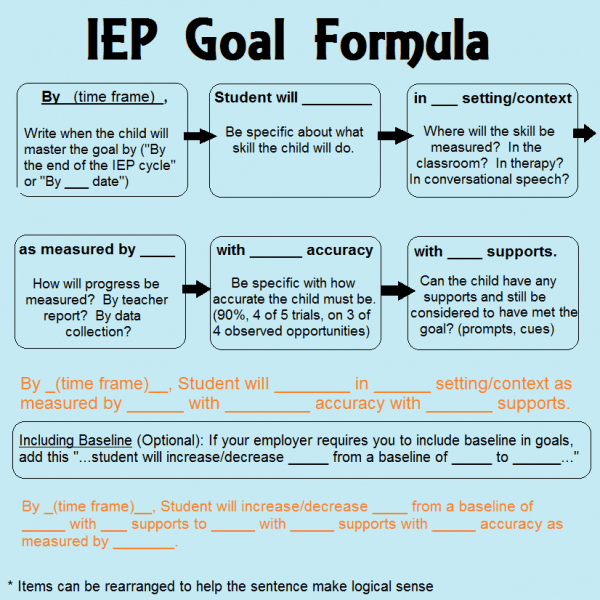
Both parents and educators can be intimidated by adding goals like these because they seem to be challenging to measure. Or at least that is the perception. It can be quite simple to measure; just add a quantity. I have a formula chart at the end of the post.
If a child has a behavior plan as part of their IEP, then it is absolutely necessary that they have self-advocacy goals. A student cannot stay on a behavior plan forever or have adults intervening and removing your antecedents when they can. A student needs to be able to self-identify their antecedents, predict them and have an action plan of acceptable coping skills. Set specific, attainable self-advocacy goals in the IEP.
When writing IEP goals, every goal should follow a clear, measurable structure. The formula below helps teams stay consistent while still personalizing each goal to the student. Each goal includes a time frame, the specific skill the student will demonstrate, the setting or context where the skill will be measured, how progress will be assessed, the required level of accuracy, and any supports the student may use.
By _____(time frame)_____, Student will_____ in_____ setting/context as measured by_____ with_____ accuracy with _____supports.
If a baseline is required, it can be added to show where the student is starting and how much growth is expected. Using this structure ensures the goal is meaningful, measurable, and easy for any teacher or parent to understand.

Including Baseline (Optional): If your employer requires you to include baseline in goals, add this “…student will increase/decrease _____ from a baseline of _____ to ______.”
Self Awareness IEP Goals
- Understanding IEP Goals: By ___, Student will explain two academic or behavioral goals from their IEP, including the purpose and strategies for each, during a discussion with staff as measured by teacher observation with 80% accuracy.
- Understanding Their Disability: By ___, Student will describe their learning disability (or other condition) and how it affects their learning in a structured conversation as measured by teacher rubric with 80% accuracy.
- Identifying Learning Needs: By ___, Student will communicate what supports, strategies, or conditions help them learn best during guided discussions as measured by teacher observation with 80% accuracy.
- Describing Personal Strengths: By ___, Student will identify and describe at least three personal strengths related to learning or behavior in a teacher-led activity as measured by student work samples with 80% accuracy.
- Identifying Behavior Antecedents: By ___, Student will list at least two antecedents or triggers to their own challenging behaviors using the prompt “I get upset when…” as measured by behavior reflections with 80% accuracy.
- Generating Replacement Behaviors: By ___, Student will identify at least two acceptable replacement behaviors or coping strategies they can use when triggered as measured by student self-reflection sheets with 80% accuracy.
- Understanding Community Resources: By ___, Student will research and compile a list of three community resources relevant to their educational or personal needs with descriptions and contact information as measured by teacher review with 100% accuracy.
- Describing Personal Strengths: By ___, Student will create a written or visual representation highlighting at least three personal strengths with supporting examples as measured by teacher review with 100% accuracy.
- Identifying Strengths and Difficulties: By ___, Student will identify one personal strength and one area of difficulty using visual prompts and adult support during structured classroom activities as measured by teacher observation with 75% accuracy.
- Identifying Feelings and Triggers: By ___, Student will name one feeling and explain its trigger during weekly check-ins as measured by teacher checklist with 80% accuracy.
- Understanding Accommodations: By ___, Student will identify and explain two accommodations listed in their IEP and when to use them in classroom activities as measured by teacher observation with 80% accuracy.
- Reflecting on Strengths and Challenges: By ___, Student will list one strength and one challenge related to their learning during structured reflection activities as measured by teacher review with 80% accuracy.
- Creating a Personal Learning Profile: By ___, Student will create a personal learning profile including three strengths, three challenges, and two learning strategies with no more than two prompts as measured by teacher rubric with 100% accuracy.
- Self-Assessing Use of Accommodations: By ___, Student will self-assess their weekly use of accommodations and explain whether they were effective as measured by teacher rubric with 80% accuracy.
- Describing Disability and Accommodations: By ___, Student will describe their disability, how it impacts learning, and name three accommodations they use in a written or verbal format as measured by teacher rubric with 90% accuracy.
- Identifying Strengths and Challenges for Transition: By ___, Student will identify three personal strengths and three challenges and explain how each may impact future education or employment goals as measured by teacher documentation with 100% accuracy.
IEP Goals for Personal Choices
Depending on the student and their challenges, you may have to change up these goals. Some students are impulsive and don’t think about choices before they make them–resulting in preventable mistakes, or not learning from their mistakes. Others may overthink a choice, and never come to a conclusion.
- Choosing Daily Menu Options: By ___, Student will select between the two available school-lunch options in 4 out of 5 trials as measured by teacher data with 80% accuracy.
- Selecting Elective Courses: By ___, Student will choose one elective class from a list of five options each semester as measured by scheduling records with 100% accuracy.
- Making Decisions Between Choices: By ___, Student will make a decision when presented with two or more choices in classroom activities as measured by teacher observation with 80% accuracy.
- Identifying Options and Choosing: By ___, Student will identify two available options in a given classroom scenario (such as tasks or tools) and make a choice aligned with their preferences as measured by teacher observation with 80% accuracy.
- Communicating and Explaining Choices: By ___, Student will verbally or nonverbally communicate their choice when presented with assignment or activity options and explain their reasoning in weekly opportunities as measured by teacher checklist with 75% accuracy.
- Making and Following Through on Personal Choices: By ___, Student will make a personal choice (such as selecting a break activity, choosing seating, or requesting a support) and follow through independently as measured by teacher observation with 80% accuracy.
- Evaluating Options and Selecting Based on Needs: By ___, Student will identify one potential consequence for each option in structured decision-making activities and select the option that best meets their learning needs with no more than one prompt as measured by teacher documentation with 80% accuracy.
- Reflecting on Personal Choices: By ___, Student will complete a weekly reflection describing one choice made, the reason for the choice, and whether it was successful as measured by a teacher rubric with 80% accuracy.
IEP Goals for IEP Meeting Participation
I am a huge advocate of students attending their IEP meetings, and participating in their IEP meetings. A student should participate in their IEP meeting, at the youngest age possible, to the maximum extent possible. What that will look like for each child is different.
- Co-Leading IEP Meetings: By ___, Student will co-lead their annual IEP meeting by contributing ideas and preferences for their educational goals in meetings as measured by meeting notes with 80% accuracy.
- Leading IEP Goal Development: By ___, Student will lead portions of the annual IEP meeting to help develop their goals in structured meeting activities as measured by staff observation with 80% accuracy.
- Participating in School Meetings: By ___, Student will participate in school meetings such as parent-teacher conferences or annual reviews and advocate for themselves with adult support as measured by teacher documentation with 80% accuracy.
- Sharing Strengths and Needs at IEP Meetings: By ___, Student will share one personal strength and one area of need during their IEP meeting with no more than one prompt as measured by meeting notes with 100% accuracy.
- Preparing a Self-Presentation for the IEP Meeting: By ___, Student will prepare a short written, verbal, or multimedia self-presentation for their IEP meeting including goals, accommodations, and future aspirations as measured by teacher checklist with 90% accuracy.
- Reviewing and Evaluating IEP Goals: By ___, Student will review their current IEP goals prior to the meeting and identify one goal they have met and one they would like to change with support in planning sessions as measured by teacher records with 75% accuracy.
- Practicing Self-Advocacy Through Role-Play: By ___, Student will role-play IEP meeting scenarios and express their preferences or concerns using appropriate communication skills in practice sessions as measured by teacher rubric with 80% accuracy.
- Asking Questions During IEP Planning: By ___, Student will ask at least one clarifying question or make one suggestion related to their services or goals during IEP planning meetings with no more than two prompts as measured by staff observation with 67% accuracy.
Requesting and Explaining Accommodations as an IEP Goal
- Requesting Curriculum Modifications With Support: By ___, Student will ask for a needed curriculum modification and negotiate the modification with adult cuing in classroom activities as measured by teacher observation with 80% accuracy.
- Understanding Their Disability and Learning Needs: By ___, Student will prepare and deliver a presentation explaining their learning disability (or relevant condition), its impact on learning, and effective strategies they use with teacher support as measured by a rubric with 90% accuracy.
- Communicating Effective Academic Strategies: By ___, Student will communicate academic strategies or compensation skills that work best for them during structured discussions as measured by teacher observation with 80% accuracy.
- Requesting Curriculum Modifications Independently: By ___, Student will ask for a needed curriculum modification independently during class activities as measured by teacher observation with 80% accuracy.
- Evaluating Learning Strategies: By ___, Student will evaluate the effectiveness of their learning strategies and modify them as needed during academic tasks as measured by teacher documentation with 80% accuracy.
- Assessing Strategy Use and Making Adjustments: By ___, Student will assess the effectiveness of their learning strategies and make appropriate adjustments during assignments as measured by teacher rubric with 80% accuracy.
- Explaining Needed Assistance: By ___, Student will explain the kind of help they need across weekly classroom situations as measured by teacher observation with 80% accuracy.
- Identifying Strategies for Learning Tasks: By ___, Student will identify a strategy for approaching a learning task during academic activities as measured by teacher observation with 80% accuracy.
- Identifying Effective Academic Strategies: By ___, Student will identify academic strategies or compensation skills that work best for them during structured reflection as measured by teacher documentation with 80% accuracy.
- Identifying Curriculum Modifications: By ___, Student will identify one or two curriculum modifications they need (such as extended time or directions written on the board) during classroom activities as measured by teacher observation with 80% accuracy.
- Communicating Environmental Needs: By ___, Student will explain one or two environmental needs (such as preferred seating or quiet workspace) and why they are needed during structured discussions as measured by teacher rubric with 80% accuracy.
- Identifying Personal Learning Strategies: By ___, Student will identify one or two learning strategies they use during academic tasks as measured by teacher observation with 80% accuracy.
- Understanding IEP Modifications: By ___, Student will identify specific curriculum modifications listed in their IEP and explain why they are needed during guided review activities as measured by teacher checklist with 80% accuracy.
- Understanding the IEP as a Legal Document: By ___, Student will explain that the IEP is a legal document and describe the types of information it contains during a teacher-led activity as measured by teacher documentation with 100% accuracy.
Problem Solving IEP Goals
- Generating Solutions to Problems: By ___, Student will define a challenging problem and generate at least two possible solutions in classroom activities as measured by teacher observation with 80% accuracy.
- Understanding Community Resources: By ___, Student will demonstrate knowledge of community resources by identifying and describing at least two relevant supports as measured by teacher review with 80% accuracy.
- Sharing Work and Accepting Help: By ___, Student will share their work and appropriately accept help from an adult during academic activities as measured by teacher observation with 80% accuracy.
- Requesting Appropriate Help: By ___, Student will identify when they need assistance, determine who is appropriate to ask, and request help during classroom tasks as measured by teacher observation with 80% accuracy.
- Problem-Solving Classroom Challenges: By ___, Student will identify a classroom-related problem and generate at least two solutions, selecting one to try with no more than one prompt as measured by teacher documentation with 80% accuracy.
- Using a Graphic Organizer for Problem-Solving: By ___, Student will describe a problem, brainstorm options, and evaluate the outcome using a graphic organizer during structured activities as measured by teacher review with 80% accuracy.
- Using Self-Advocacy Scripts for Conflict Resolution: By ___, Student will use a self-advocacy script or checklist to work through peer or academic conflicts and choose an appropriate strategy to resolve the issue as measured by teacher observation with 75% accuracy.
- Requesting Strategies or Help When Needed: By ___, Student will ask for help or request an appropriate strategy (such as a sensory break or alternate setting) in challenging social or academic situations as measured by teacher observation with 80% accuracy.
- Reflecting on Problem-Solving: By ___, Student will reflect weekly on a problem they encountered, describe how they handled it, and identify what they might do differently next time as measured by reflection logs with 90% accuracy.
Communication and Asking for Help IEP Goals
- Asking for Help at Appropriate Times: By ___, Student will ask for help at appropriate times during classroom activities as measured by teacher observation with 80% accuracy.
- Communicating Effective Academic Strategies: By ___, Student will compile a list of two academic strategies or compensation skills that work best for them with examples and explanations as measured by teacher review with 100% accuracy.
- Requesting Assistance When a Task Exceeds Ability: By ___, Student will raise their hand and request assistance from a teacher or peer when faced with a task beyond their abilities as measured by teacher observation with ___ accuracy.
- Identifying Need for Help Independently: By ___, Student will independently identify when they need help and request assistance from an appropriate adult or peer in various environments as measured by teacher documentation with ___ accuracy.
- Using a Predetermined Signal to Request Help: By ___, Student will use a predetermined signal such as raising a hand or verbal request when unsure how to complete a task as measured by teacher observation with ___ accuracy.
- Using Appropriate Communication to Request Assistance: By ___, Student will use appropriate language and communication skills to express their need for help or clarification during classroom activities as measured by teacher observation with ___ accuracy.
- Knowing When to Seek Help: By ___, Student will demonstrate understanding of when to seek help by asking relevant questions or seeking clarification in academic and social contexts as measured by teacher checklist with ___ accuracy.
- Using Multiple Communication Strategies to Request Help: By ___, Student will use verbal, written, and nonverbal strategies to request assistance across subjects as measured by teacher observation with ___ accuracy.
- Implementing a Personalized Help-Seeking Plan: By ___, Student will develop and implement a help-seeking plan identifying appropriate sources of assistance and using them effectively as measured by teacher review with ___ accuracy.
- Recognizing Situations Requiring Assistance: By ___, Student will independently recognize situations when assistance is needed and request help from an appropriate adult or peer as measured by teacher documentation with ___ accuracy.
- Increasing Frequency of Help Requests: By ___, Student will demonstrate increased self-awareness by proactively requesting help when encountering difficulty as measured by tracking logs with ___ accuracy.
- Practicing Help-Seeking Through Role-Play: By ___, Student will participate in role-playing and social skills exercises to practice asking for help in various situations as measured by teacher rubric with ___ accuracy.
- Using a Self-Monitoring Help-Seeking System: By ___, Student will develop and use a self-monitoring system to track successful instances of seeking help and reflect on strategies used as measured by teacher review with ___ accuracy.
- Using Visual Aids to Remind to Request Help: By ___, Student will use visual aids such as cue cards or posters to remind themselves to request help when needed as measured by teacher observation with ___ accuracy.
- Help-Seeking in Group Activities: By ___, Student will engage in cooperative learning and group projects by seeking assistance from peers or teachers as needed as measured by collaboration goals with ___ accuracy.
- Building Confidence in Asking for Help: By ___, Student will participate in social skills groups or counseling sessions to build assertiveness in asking for help as measured by counselor documentation with ___ accuracy.
- Seeking Help in Emotionally Challenging Situations: By ___, Student will identify and practice strategies for seeking help during emotionally challenging moments such as frustration or anxiety as measured by teacher observation with ___ accuracy.
- Initiating Conversations to Request Assistance: By ___, Student will initiate conversations with adults or peers to request help and communicate needs effectively as measured by teacher data with ___ accuracy.
- Using Phrases and Scripts to Request Help: By ___, Student will develop and practice a repertoire of phrases or scripts for asking for help across situations as measured by teacher rubric with ___ accuracy.
- Advocating for Help in Goal-Setting Meetings: By ___, Student will participate in goal-setting meetings by advocating for needed assistance and contributing ideas for strategies as measured by meeting notes with ___ accuracy.
- Using Technology Resources to Seek Help: By ___, Student will use technology tools such as assistive technology or online resources to seek help and access information independently as measured by teacher observation with ___ accuracy.
- Generalizing Help-Seeking Skills Across Settings: By ___, Student will apply help-seeking strategies in extracurricular, community, and social settings as measured by teacher or parent report with ___ accuracy.
- Demonstrating When and How to Ask for Help: By ___, Student will demonstrate that they know when and how to ask for help during academic tasks as measured by teacher observation with 80% accuracy.
Self Advocacy Goals for High School Students
- Identifying Strengths, Needs, and Learning Style: By ___, Student will demonstrate knowledge of their strengths, areas of need, and personal learning style and explain how these apply in school, community life, and career options as measured by teacher rubric with 80% accuracy.
- Identifying Supports Needed for Employment: By ___, Student will verbalize the supports they need to be a successful employee, including executive-function-related strategies, during structured activities as measured by teacher observation with 80% accuracy.
- Understanding Section 504 for Postsecondary Settings: By ___, Student will explain their understanding of the Rehabilitation Act Section 504 and how it applies to college settings as measured by teacher checklist with 80% accuracy.
- Selecting Elective Courses: By ___, Student will select one elective class from five available options each semester as measured by scheduling records with 100% accuracy.
- Participating in Postsecondary Planning: By ___, Student will participate in the development of a postsecondary plan by contributing ideas, preferences, and goals during planning sessions as measured by teacher documentation with 80% accuracy.
Self Advocacy Goals: Elementary
- Identifying Personal Strengths and Weaknesses: By ___, Student will create a list of three personal strengths and three areas for improvement in classroom activities as measured by teacher observation and self-assessment with 80% accuracy.
- Communicating Needs and Preferences: By ___, Student will raise their hand and express opinions or preferences at least twice per group activity as measured by teacher observation with 80% accuracy.
- Using a Communication Notebook: By ___, Student will write at least one weekly question or concern to the teacher in a communication notebook as measured by teacher review with 70% accuracy.
- Participating in IEP Goal Development: By ___, Student will articulate at least one personal academic or social-emotional goal during IEP meetings with support as measured by meeting notes with 100% accuracy.
- Suggesting New Accommodations: By ___, Student will review their current IEP accommodations and suggest at least one new accommodation each semester with guidance as measured by teacher documentation with 100% accuracy.
- Requesting Help for Academic Challenges: By ___, Student will ask the teacher for clarification or assistance at least three times per week when faced with difficult assignments as measured by teacher observation with 80% accuracy.
- Using Visual Cues to Request Help: By ___, Student will use a visual cue such as a colored card to signal a need for help during independent work with fading prompts as measured by teacher observation with 80% accuracy.
- Requesting Accommodations and Modifications: By ___, Student will independently request preferred seating or needed assistive technology during classroom activities as measured by teacher observation with 80% accuracy.
- Advocating for Testing Accommodations: By ___, Student will remind the teacher of approved testing accommodations during assessments as measured by teacher observation with 90% accuracy.
- Understanding Learning Style and Preferences: By ___, Student will complete a learning-style inventory and identify at least two preferred learning strategies in discussion with the teacher as measured by teacher rubric with 70% accuracy.
- Self-Monitoring Learning Preferences: By ___, Student will use a graphic organizer or checklist to monitor engagement and productivity during independent work and adjust their approach with guidance as measured by teacher review with 80% accuracy.
- Generating and Evaluating Solutions: By ___, Student will independently generate at least two solutions to a challenging situation and evaluate possible consequences during classroom tasks as measured by teacher observation with 80% accuracy.
- Practicing Assertive Communication and Conflict Resolution: By ___, Student will participate in role-playing or social-story activities to practice assertive communication and conflict resolution as measured by teacher rubric with 80% accuracy.
- Using Positive Self-Talk: By ___, Student will engage in daily self-affirmations or positive self-talk during classroom routines as measured by teacher observation with 80% accuracy.
- Building Confidence Through New Activities: By ___, Student will participate in extracurricular activities or projects outside their comfort zone to build self-confidence as measured by teacher documentation with 80% accuracy.
Components of a Strong Self-Advocacy Goal
Like all IEP goals, self-advocacy goals should be SMART:
- Specific
- Measurable
- Attainable
- Realistic
- Time-bound
They should also be tailored to a student’s age, grade level, and current skill set. Consider the following elements:
- How progress will be measured (teacher observation, self-report, work samples)
- The setting in which the skill will be demonstrated (classroom, IEP meeting, with peers)
- What tools or strategies the student will use (visual supports, scripts, checklists)
Use the IEP Goal Formula below to make an IEP goal measurable.
Self Advocacy Examples
Hope this helps and as always, ask in our forums if you have questions.
Student Self-Advocacy, Strengths, and Transition Planning
Self-Advocacy Skills and Goals
- Self-Advocacy IEP Goals (Measurable goals to build student voice)
- How to Teach Self-Advocacy Skills (Tools and strategies for all ages)
- How and Why to Talk to Your Child About Their Disability (Tips for building self-awareness)
- 6 Reasons Your Child Should Attend Their IEP Meeting (Encouraging participation and ownership)
Strengths, Identity, and Future Planning
- Student Strengths List (Ideas to include in Present Levels and goals)
- Free IEP Vision Statement Workbook (Helps students define their future)
- Why All Disabled Students Need Social Capital (The overlooked key to long-term success)
- Effective IEP Transition Planning (Beyond “food, filth, and flowers!”)

