Difference Between IEP vs. 504 Plan + What is the Same.
Quite often, parents in our online chat group will ask what is the difference between an IEP and a 504. A child is struggling, supports aren’t working, and parents are told that a 504 plan might be “enough,” even though they originally asked about an IEP.
While the two plans are frequently described as similar, the day-to-day impact can be very different. Some schools will try to push the family toward a 504 plan instead of an IEP; some will even suggest that the student get both an IEP and a 504.
So what is the correct information? How do you know what to do–do you keep pushing for an IEP, or take the 504 Plan? In this article, I am explaining and expanding upon the many differences between a 504 and an IEP and what is the same about the two.
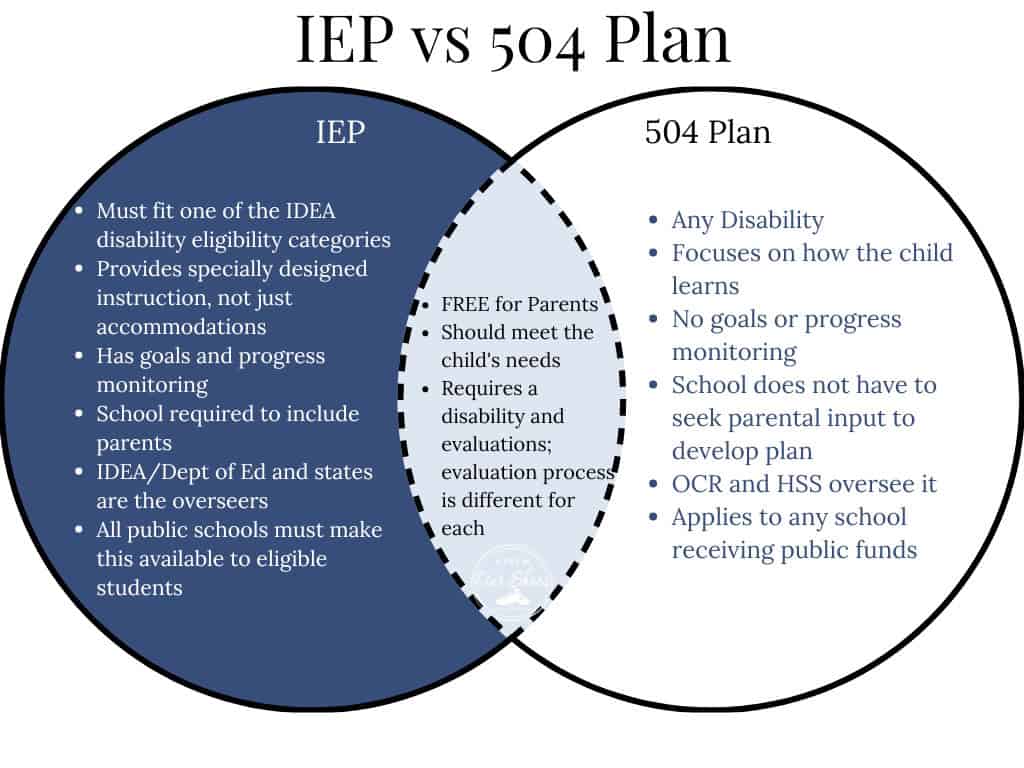
And, I hope to help you answer the question: Which is better, an IEP or 504? If you prefer to see the differences laid out visually, start with the IEP vs 504 chart below, then continue reading for real-world examples and explanations.
When you’re done here, scroll back up and read: I asked for an IEP and was offered 504/RTI.
What Is the Difference Between an IEP and a 504 Plan?
A 504 Education Plan was never intended to be an “IEP Lite.” Yet this is a trend that’s been going on for a while. IEPs and 504s are very different documents. And 504s were never intended to be an “IEP Lite.” They also were never intended to be a “pre-IEP” or a “Let’s try a 504 first.”
But that’s what is happening. If you feel you are being talked into this and your gut is telling you otherwise, push back. Request the IEP evaluations.
Avoiding the extensive evaluations, supports and related services that comes with an IEP is a cost-cutting measure.
IEP vs 504 Plan: What the Differences Look Like in Real Life
Here are some of the differences between an IEP (Individualized Education Program) and a 504 Plan.
| Category | IEP (Individualized Education Program) | 504 Plan |
|---|---|---|
| Purpose | Provides specialized instruction and related services | Provides accommodations to access general education |
| Law | IDEA (special education law) | Section 504 of the Rehabilitation Act (civil rights law) |
| Who Qualifies | Student needs specially designed instruction due to a disability | Student has a disability that substantially limits a major life activity |
| Instruction | Yes, goals, specially designed instruction, service minutes | No, instruction stays general education |
| Goals and Progress Monitoring | Required, with measurable annual goals | Not required |
| Services | Can include speech, OT, counseling, specialized reading programs | No related services (with rare exceptions) |
| Protections | Strong procedural safeguards and parent rights | Fewer procedural protections |
Difference Between IEP and 504
Here are 10 differences between IEPs and 504s.
- Eligibility: To qualify for an IEP, a student must have a disability that adversely affects their educational performance and requires specialized instruction. To qualify for a 504 plan, a student must have a disability that substantially limits one or more major life activities.
- Evaluation: An IEP requires a comprehensive evaluation by a team of professionals. A 504 plan requires an evaluation that looks at the student’s medical history, academic performance, and any other relevant information to determine if the student meets the eligibility criteria. It’s much less comprehensive than IEP evaluations.
- Goals: An IEP includes specific academic and functional goals for the student, while a 504 plan does not.
- Services: An IEP includes specialized instruction and related services, such as speech therapy or occupational therapy, while a 504 plan provides accommodations and modifications to address the student’s individual needs.
- Development: An IEP has the parent as a federally mandated IEP team member and other essential staff. A 504 plan can be developed or changed without parental input.
- Implementation: An IEP is a legally binding document that must be implemented by the school district. A 504 plan is also legally binding, however, there are fewer options for parents if it there are 504 plan violations.
- Review: IDEA requires than an IEP is reviewed and revised annually. There is no such mandate for a 504 plan. They are reviewed periodically, typically every three years or when there is a significant change in the student’s needs.
- Laws/Statutes: An IEP is covered under the Individuals with Disabilities Education Act (IDEA), while a 504 plan is covered under Section 504 of the Rehabilitation Act of 1973.
- Scope: An IEP covers all aspects of the student’s education, including academic, social, and emotional needs, while a 504 plan focuses on addressing the student’s disability-related educational needs and access.
- Disputes: Parents have the right to file a due process complaint and appeal an IEP decision. A 504 dispute has fewer options for parents.
The primary distinction lies in the level of services and individualization provided:
- Services: The IEP provides specialized educational services, such as individualized instruction, related services (e.g., speech therapy, occupational therapy), and sometimes even placement in a special education program. In contrast, a 504 plan focuses on accommodations and support within the general education setting.
- Individualization: An IEP is highly individualized, outlining specific goals, objectives, and measurable outcomes for the student’s education. It includes a detailed plan for the delivery of specialized services and progress monitoring. A 504 plan is generally less detailed and provides broader accommodations without specifying individualized goals or services.
504 Plan vs. IEP
Tell me if you’ve heard this one from your IEP team: “We have to move him to a 504.” Most importantly about 504s and IEPs, there are no “have-tos.” What I mean by that, is quite often, I hear that parents were told, “We have to move him to a 504.”
The reasons for this vary. I’ve heard everything from losing funding to having passing grades to not being able to get into college. Yes, if your child has either a 504/IEP now, they may very well need a 504 in college. That is a discussion for your child’s IEP transition planning, and should have no bearing on what the child receives now.
What affects what your child receives now, is what they need right now. If they need special education services, then they need an IEP. Sometimes until the day they graduate. They can then still get a 504 after graduation.
An IEP is special education. You cannot separate out the two. If your child has an IEP, they are receiving special education. If they are receiving special education, they must have an IEP. IEPs have goals, mandated IEP team members, a defined set of procedural safeguards or parents’ rights and more.
As far as disadvantages, I’d say the largest or most common one is the stress it puts on parents. The whole IEP process is quite cumbersome and overwhelming to parents and often quite adversarial with the school team. There is also a stigma to having an IEP, which is still very prevalent in our society, albeit fading, in my opinion. If a child needs special education and not just accommodations, then I would keep pushing for an IEP.
Which is Better: IEP or 504?
An Individualized Education Program (IEP) is a customized plan developed to meet the specific educational needs of a child with a disability. Governed by the Individuals with Disabilities Education Act (IDEA), an IEP outlines special education services, goals, accommodations, and supports to help the child succeed in school.
It provides legally enforceable services tailored to the child’s unique challenges, ensuring they receive a free and appropriate public education (FAPE).
However, as stated above, IEPs and 504s were never meant to be interchangeable, or stepping stones to each other.
Autism IEP vs 504
IEP example: A student with autism struggles with communication, transitions, and emotional regulation.
- Speech therapy for pragmatic language
- Social skills goals
- Behavioral supports and data tracking
- Modified instruction in certain subjects
504 example: A student with autism understands grade-level material but needs support to access it.
- Preferential seating
- Visual schedules
- Extended time
- Sensory breaks
Key difference: If the student needs instruction to build skills, an IEP is appropriate. If they already have the skills but need supports to access learning, a 504 may be enough.
ADHD
IEP example: A student with ADHD has significant executive functioning deficits affecting learning.
- Goals for organization, task initiation, or self-monitoring
- Direct instruction in executive functioning skills
- Possibly small-group instruction
504 example: A student with ADHD can do the work but struggles with attention and stamina.
- Extended time
- Reduced distractions
- Chunked assignments
- Movement breaks
Key difference: Needing accommodations alone points to a 504. Needing explicit instruction and goals points to an IEP.
Dyslexia IEP vs 504 plan
IEP example: A student with dyslexia requires structured literacy instruction.
- Specialized reading program
- Reading goals tied to decoding and fluency
- Progress monitoring data
504 example: A student with dyslexia can read but reads slowly and tires easily.
- Audiobooks
- Extended time
- Reduced reading load
Key difference: If the child needs a specialized reading program, that cannot happen under a 504, it requires an IEP. Dyslexia is the one that frustrates me the most, because as a long time advocate–I have now met hundreds of kids who cannot read. And instead of teaching them to read, they’re just getting accommodations.
Ask yourself:
- IEP: “My child needs to be taught differently.”
- 504: “My child needs the same instruction, with supports.”
How are an IEP and a 504 Plan the same?
Let’s break down what’s the same between a 504 Plan and an IEP:
- Both are Legally Backed: Yep, both of these plans are rooted in federal law. A 504 Plan comes from Section 504 of the Rehabilitation Act of 1973, while an IEP is mandated by the Individuals with Disabilities Education Act (IDEA).
- The Purpose? Same! Both plans are all about leveling the playing field—making sure that students with disabilities get the access, support, and accommodations they need to succeed in school.
- Eligibility Criteria: To get either plan, your child needs a documented disability that significantly impacts major life activities, like learning. But heads up—the bar is set a bit differently for each. An IEP has more specific criteria and requires that the disability affects your child’s educational performance and requires specialized instruction.
- Formal Documentation: Both involve a bunch of paperwork that outlines your child’s needs and accommodations. This includes evaluations, assessments, and input from the whole team: you, teachers, and specialists.
- Accommodations and Support: Whether it’s a 504 Plan or an IEP, both will tailor accommodations to your child’s needs. Some examples are a different classroom setup, large fonts, or extra time on tests.
- Review and Reevaluation: Both plans require regular check-ins to see how things are going, make sure the accommodations are working, and tweak anything that needs tweaking. Just know that the timelines for these reviews are different.
IEPs and 504 plans have a lot in common, but it’s the differences that will help you decide which one is right for your child.
Adversely Impacts vs Substantially Limits
When determining whether a child qualifies for an IEP under the Individuals with Disabilities Education Act (IDEA) or a 504 Plan under Section 504 of the Rehabilitation Act, two key phrases often guide the decision-making process: “adversely impacts” and “substantially limits.” Understanding these terms is essential because they highlight the different eligibility criteria for these two supports.
Under IDEA, a child qualifies for an IEP if their disability adversely impacts their educational performance and they require specialized instruction to make progress in the general curriculum. The term adversely impacts refers to the direct, measurable effect the disability has on a child’s ability to learn or participate in school activities. This might include significant struggles with reading, writing, or math due to a learning disability or behavioral challenges that disrupt classroom learning. The focus is on whether the child’s academic or functional performance is significantly impaired and whether specialized services are necessary to address these needs.
In contrast, Section 504 uses the broader standard of substantial limits. To qualify for a 504 Plan, a child must have a disability that substantially limits one or more major life activities, such as learning, concentrating, or walking. This standard is less restrictive than IDEA’s adversely impacts criteria. A child whose ADHD causes difficulty staying focused might qualify for a 504 Plan, even if their academic performance is not severely affected, because their ability to concentrate is substantially limited compared to their peers.
The implications of these phrases are significant in decision-making. If a child’s disability affects their ability to learn but does not require specialized instruction, they might qualify for accommodations under a 504 Plan rather than an IEP. Conversely, if the disability significantly disrupts academic progress and requires targeted teaching methods or interventions, an IEP is likely the appropriate path. Parents and school teams must carefully assess how the disability affects the child’s education to determine which plan provides the necessary support.
Accommodations vs Specially Designed Instruction
Two of the most common accommodations I see on 504 plans are extended time on tests and preferential seating (sitting near the teacher for better hearing and fewer distractions). As far as the specially designed instruction examples, the most common one I see is a specialized curriculum such as Lindamood Bell for reading.
So which is better? If your child needs specially designed instruction or special education, then they need an IEP. The importance of odd in adulthood cannot be understated, as these unique traits often lead to innovative thinking and problem-solving skills. Embracing differences can enhance personal and professional relationships, creating a more inclusive environment. By recognizing and fostering these characteristics early on, individuals are better prepared to navigate the complexities of adult life.
If they only need accommodations, then a 504 plan should suffice. And the bonus here is that the 504 process is much less cumbersome and stressful for parents, in my opinion.
Goals vs No Goals
An IEP has IEP goals and IEP progress monitoring. A 504 plan does not. Your only progress monitoring with a 504 plan is your grades and report cards, and your “eye test.” By eye test, I mean, what you see each day with your child as far as their progress and mental health.
Unsupported needs often result in deteriorating mental health, such as increased anxiety, low self-esteem, increased undesirable behaviors, and sometimes school refusal.
If your child has a 504 plan and you’re certain that it’s being followed, and your child’s mental health is starting to deteriorate or they’re refusing to go to school, chances are a 504 is not enough for them, and you may want to pursue more supports in the form of an IEP.
Parental Protections
Parents are mandated IEP team members per IDEA. And, your school team should be providing you with “meaningful parent participation” if your child has an IEP. There is no such mandate in Section 504. Best practice of course, is to keep the parent involved at every step but the school is under no obligation to do so.
However, it’s important to note, that just because your school may stink at putting together an meaningful 504 plan, that doesn’t mean the child needs an IEP. Honestly, if they stink at 504s, they stink at IEPs too. Not likely that they do one well, and not the other.
Both IEPs and 504 Plans provide parents with certain rights and protections, but the scope and detail of these protections differ due to the laws that govern each plan.
There is a due process for disputes regarding a 504 Plan, including if a school refuses to provide one. While the due process protections under Section 504 aren’t as formalized or extensive as those under IDEA (for IEPs), parents still have the right to challenge the school’s decisions, including the denial of a 504 Plan.
I have a whole separate article on what your next steps should be if you asked for an IEP and were offered a 504 plan (or RTI or MTSS) instead. Read that for your next steps. If things are not going well, you have much less recourse and fewer complaint or dispute resolution options. A 504 plan is a document for gen ed, it does not provide special education. A 504 Education Plan was never intended to be an “IEP Lite.” Yet this is a trend that’s been going on for a while. They also were never intended to be a “pre-IEP” or a “Let’s try a 504 first.”
If you feel you are being talked into this and your gut is telling you otherwise, push back. Request the IEP evaluations. Avoiding the extensive evaluations, supports and related services that comes with an IEP is a cost-cutting measure. As always, you are always welcome to join our message boards and ask your specific questions there.
Here’s that 504 booklet from the Office of Civil Rights.
And here is some helpful information from the Disability Rights Education and Defense Fund.