
Related Services in Special Education: What They Are, Who Gets Them, and Why It Matters.
So what are related services in special education, really? You’ve heard the term tossed around at IEP meetings, probably right before your brain started doing that thing where it quietly screams, “Why does this have to be so complicated?!” I get it.
Related services in special education are one of the biggest chunks of support available to students, and yet…most parents don’t even know what qualifies, who provides it, or how to ask for it. Let’s fix that.
The Official List (aka The Big IDEA Menu)
Here’s what the Individuals with Disabilities Education Act (IDEA) includes under the umbrella of related services:
- audiology
- counseling services
- early identification
- family training-counseling and home visits
- health services
- medical services
- nursing services
- nutrition services
- occupational therapy
- orientation and mobility services
- parent counseling and training
- physical therapy
- psychological services
- recreation and therapeutic recreation
- rehabilitative counseling services
- interpretation services
- school health services
- service coordination services
- social work services in schools
- speech pathology and speech-language pathology
- transportation and related costs
- assistive technology and services
Yep. That’s a big list. And no, it’s not even exhaustive. And yes, there are exceptions. And exceptions to the exceptions. (Because why make it simple?)
For example, implanting and maintaining a cochlear implant is specifically excluded. However, if the child needs an AT device, such as an FM system, to hear the teachers, and the FM system connects to the cochlear implants, then yes that is included.
Wait, What’s the Point of All This?
The purpose of related services is simple: to help your child actually benefit from their IEP. That means:
- Participating in the general ed curriculum
- Working toward IEP goals
- Taking part in school activities beyond academics
In other words, they exist so your kid isn’t just physically in the classroom, but actually learning, socializing, and growing like their peers.
How I Think About IEP Services (Stick With Me Here)
Imagine your IEP as two different kingdoms. (Yes, kingdoms.) One kingdom is Special Education, where teachers deliver specially designed instruction. Teacher → Student. You know the drill.
Then there’s Related Services. This is where all the other folks live: the OTs, SLPs, PTs, counselors, the bus driver who knows your kid’s behavior plan, etc. They’re not teaching math, but they’re crucial. They make sure your child can access what’s being taught.
Yes, the Entire School is Responsible.
No, your kid’s bus driver isn’t teaching them reading comprehension. But if your child has a seizure action plan or behavioral needs during transportation? Yup, they better know about it.
Even if your school contracts out the therapist, the district is still responsible for delivering services for special education students.
IDEA and Related Services
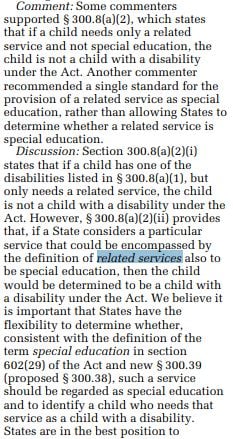
This is what IDEA says about Related Services.
Statute/Regs Main » Regulations » Part B » Subpart A » Section 300.34
300.34 Related services.(a) General. Related services means transportation and such developmental, corrective, and other supportive services as are required to assist a child with a disability to benefit from special education, and includes speech-language pathology and audiology services, interpreting services, psychological services, physical and occupational therapy, recreation, including therapeutic recreation, early identification and assessment of disabilities in children, counseling services, including rehabilitation counseling, orientation and mobility services, and medical services for diagnostic or evaluation purposes. Related services also include school health services and school nurse services, social work services in schools, and parent counseling and training.
(b) Exception; services that apply to children with surgically implanted devices, including cochlear implants.
(1) Related services do not include a medical device that is surgically implanted, the optimization of that device’s functioning (e.g., mapping), maintenance of that device, or the replacement of that device.
Eligibility for IEP Related Services
Like anything else, you have to demonstrate need. A child who receives a specialized reading program for dyslexia does not automatically qualify for Speech or OT.
A child can be eligible for only Special Education and not any of the Related Services. An example would be a student whose only areas of need are related to dyslexia, and the child only needs reading instruction.
And, working in reverse, a child can have a disability that only requires PT or OT or Speech, and not any special instruction in academics.
Make sure you check your state’s regulations regarding Related Services. I have all of them on a spreadsheet at the end of this post.
Eligibility: Who Gets What (and Why)
No, your child does not automatically qualify for all related services just because they have an IEP.
- A student with dyslexia may only need reading instruction (SDI), not OT or Speech.
- Another student may only need Speech, and not academic instruction.
The key? Documented need.
It always, always starts in the Present Levels of Performance section. If it’s not documented there, it’s going to be hard to justify.
What if my child only receives Related Services?
This is where it gets a little tricky, as it is left up to the states.
Who Provides Special Education Related Services?
You want to check your specific state regulations. But, per IDEA, yes, a para or aide can provide related services. Unless the IEP specifically states that the professionally licensed therapist is to deliver the services, they can designate the list of exercises to do with an Aide or Assistant if the state’s practicing guidelines permit it.
Your child’s IEP should also specify:
- when the service will begin
- how often it will be provided and for what amount of time (service hours)
- where it will be provided [§300.320(a)(7)]
This is why it is so important to go through your child’s IEP with a fine-toothed comb. I have seen soooo many Moms flip to related services. Everyone wants to know what their child is going to “get.”
But what often gets overlooked as far as Related Services in an IEP:
- Will services be group or individual?
- Will the services be push in or pull out?
- What are the arrangements for missed hours?
I have seen literally hundreds of IEP disputes over these issues. The parent assumes it is individual, when it is not. Or, there is nothing in place to make up absences (particularly if not the student’s fault) and parents are left scrambling trying to gain time.
Easy to Miss, Big Deal Later
Here’s where a lot of IEP teams get tripped up (and where I’ve seen hundreds of disputes):
- Individual vs Group? If the IEP doesn’t say, assume they’ll go group.
- Push-in or Pull-out? Different experiences entirely.
- Missed Services? What’s the plan if the therapist is absent or your kid is sick?
Pro tip: Ask now. Don’t wait until May when they’re “out of time.”
A Few Hidden Gems in IDEA
If you want to read all of IDEA and the section on Related Services, I’ve provided a link below. However, as with all of IDEA and the discussion booklet, there are useful nuggets of information in there.

- In the last sentence above, you can see that it includes “parent counseling and training.” This is what you point to, if you are trying to get this on your IEP.
- IDEA defines expectations or uses words like “qualified” in reference to therapists.
- Under social work, you will see that one of their defined roles is assisting with behavior plans. Huh, how about that? Just might be helpful for you to point that out, if you are trying to get an IEE for your FBA. I mean, if they didn’t even use IDEA’s best practices for your child’s behavior plan, could be grounds for an IEE.
- For the last time, and I’m going to say it loud for the people in the back: YES, transportation is a part of an IEP. Or at least it can be, if the child needs it to access their education.
Ok, wrapping up. Related services is a huge portion of many IEPs. And, like every other support and service on an IEP, they are needs driven. Related services aren’t extras or “nice to haves.” They’re often the thing that makes education possible for your child.
And just like everything else in an IEP, they are needs-based. If you want a service added, it has to start with clearly defined needs in evaluations and present levels.
So yes, it’s a process. And no, it doesn’t always feel easy. But that’s why you’re here.
Now go flip to the related services section of your IEP with a highlighter. You’ve got this.
Good luck out there.