Independent Living Skills Checklist for Disabled Adults (Free PDF)
When it comes to preparing a child or young adult for independence, the list of possible skills can feel overwhelming. No student is going to master every single item here, and you certainly wouldn’t see this many IEP goals written into one plan. Instead, think of this checklist as a menu of options, a way to spark ideas about what matters most for your child.
This list pairs well with my separate guide on Independent Living Skills IEP Goals, which shows how to take these skills and translate them into measurable objectives. For now, use this as a guide for discussion with your IEP team and as a roadmap for what independent living might look like in school, at home, and in the community.
Independent Functioning Skills
See also: 100 Independent Functioning and Independent Living IEP Goals (Life Skills)
- Identify personal information (name, address, Social Security number) when it appears in writing.
- Operate household appliances and equipment for food storage, cooking, and cleanup.
- Operate appliances used for clothing care (washer, dryer, iron).
- Operate grooming tools (hair dryer, shaver).
- Operate recreational or educational devices (computer, television, games, DVD player).
- Operate health-related equipment (scale, thermometer, heating pad).
- Operate appliances for heating, cooling, or ventilation (thermostat, fan, air conditioner).
- Operate tools and equipment for cleaning and basic maintenance (vacuum, mop, hand tools).
- Locate and use labels to identify contents, size, or directions on packages.
- Identify prices and make purchasing decisions using store tags and signs.
- Follow storage and cooking directions found on food packaging.
- Locate and use information from advertisements, brochures, or manuals when making decisions.
Safety and Community Skills
Free IEP Goal List: Community Safety and Transportation IEP Goals
You Need IEP Data. You Also Need to Teach.
IEP progress monitoring has to get done, but it shouldn’t take hours. You need a system that’s simple enough to actually use in a real classroom.
Get teacher-created, ready-to-use tools that help you track IEP goals, document meaningful progress, and write progress reports faster, without adding more paperwork to your day. Save time, stay compliant.
- Identify home address and phone number, and carry identification when needed.
- Follow personal and community safety rules with and without reminders.
- Demonstrate pedestrian safety and follow traffic signals and conventions.
- Read and follow safety and warning signs.
- Practice stranger safety and appropriate interactions.
- Locate bathrooms, telephones, and other essential community facilities.
- Identify buses and public transportation by numbers and destinations.
- Pay correct fares on buses, taxis, or other public transportation.
- Use alternate transportation routes when needed.
- Seek assistance from responsible adults when necessary.
- Follow workplace driving and pedestrian rules if licensed.
Activities of Daily Living
- Identify names of family members, school staff, and familiar objects.
- Recognize basic written words (common actions, prepositions, numbers, money).
- Follow directions on food, clothing, and cleaning product labels.
- Verify sizes when purchasing clothing and linens.
- Identify admission costs for public activities.
- Identify types of stores and businesses by signs and displays.
- Locate mailboxes, doorbells, and other community features.
- Operate vending machines, coin-operated washers, and dryers.
Functional Math Skills
IEP Goals for Functional Math Skills, Free List
- Match objects one-to-one and count with meaning.
- Identify, match, and write numerals of personal importance (age, phone, address, birth date).
- Recognize basic shapes (circle, triangle, square, rectangle).
- Understand left and right, big and small, short and tall, full and empty.
- Use number lines and ordinal positions.
- Recognize and use addition and subtraction symbols.
- Solve simple subtraction and addition problems.
- Identify and use fractions (½, ⅓, ¼) in daily tasks.
- Use measuring tools (rulers, yardsticks, measuring cups, food scales).
- Estimate size, distance, and quantity.
- Use numbers and settings on common appliances.
Telling Time and Scheduling
- Identify times of day (morning, afternoon, night) and match with activities.
- Identify days of the week, months, seasons, and holidays.
- Recognize current day, date, and personal dates (birthday).
- Read and use clocks and watches (digital and analog).
- Be punctual to school, appointments, and activities.
Recreation and Leisure Skills
Life Skills IEP Goals, including recreation
- Use calendars, maps, and schedules to plan activities.
- Use diagrams and instructions to assemble objects or complete projects.
- Order food using menus.
- Select and play safe and durable toys and games.
- Participate in a range of games (active, table, card, strategy, video).
- Engage in hobbies such as collecting, photography, gardening, or crafts.
- Use community facilities such as playgrounds, parks, and recreation centers.
- Participate in community events, outings, and special programs.
- Plan and host social events (parties, picnics).
- Attend movies, concerts, or plays.
- Locate and use community directories, schedules, and bulletin boards.
Work and Employment Skills
65 IEP Goals for Work, Employment, Vocational Skills
- Complete personal information on job applications and forms.
- Review bills, pay stubs, receipts, and time cards for accuracy.
- Pay correct amounts for goods and services on time.
- Identify gross pay, net pay, and deductions.
- Write personal information (name, date, address, age, birth date) accurately.
- Shop for clothing, knowing personal sizes.
- Demonstrate appropriate social behavior in the community and workplace.
- Use community services (post office, library, DMV).
- Locate and apply for jobs using help wanted ads, bulletin boards, and job banks.
- Understand employee benefits and job descriptions.
- Follow a morning routine to be prepared for work on time.
- Select work-appropriate clothing.
- Call an employer if absent or late.
- Use time clocks and follow workplace safety and health rules.
- Locate supervisors or other key personnel as needed.
Personal Hygiene and Self-Care
IEP Goals for Personal Hygiene
- Indicate toileting needs appropriately.
- Use the bathroom independently and with privacy.
- Follow proper steps for toileting and handwashing.
- Dress and undress independently, using different types of fasteners (zippers, buttons, Velcro).
- Choose weather- and occasion-appropriate clothing.
- Wash hands, face, and body; use deodorant.
- Brush teeth, floss, and care for nails.
- Wash and style hair or seek assistance.
- Use shaving, makeup, or blemish treatments when appropriate.
- Care for glasses, hearing aids, and prosthetics.
- Manage personal hygiene during menstruation.
Reminder: No child will have all of these skills as IEP goals. Use this checklist as a framework to prioritize what’s most important for your child’s independence.
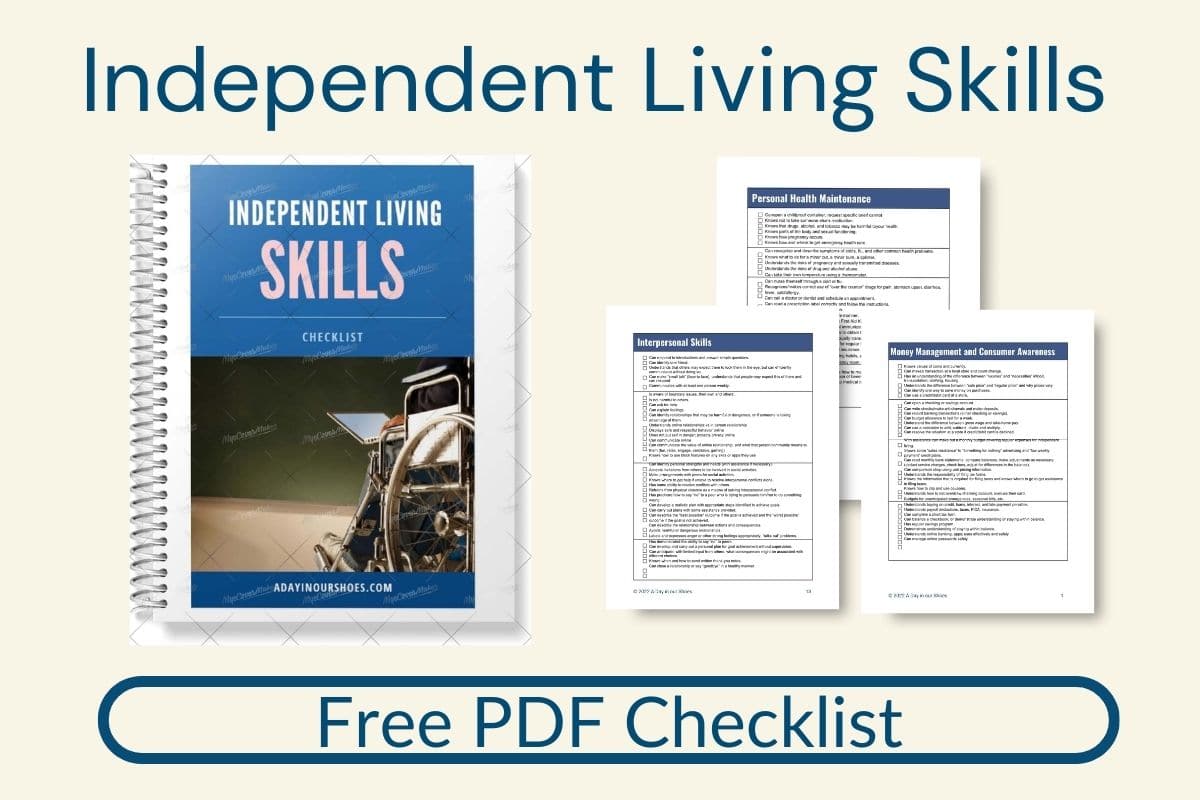
Independent Living Skills Checklist (PDF)
Transition IEP Goals
- Community Safety and Transportation IEP Goals
- Independent Functioning and Independent Living IEP Goals (life skills goals)
- IEP Transition Goals Bank
- Low Functioning Students IEP Goals
- Money Skills IEP Goals
- Personal Hygiene and Health IEP Goals
- Postsecondary IEP Goals
- Self-Advocacy IEP Goals
- Vocational IEP Goals