
Can a School or IEP Team Demand Access to Medical Records or Information?
Questions about schools, IEP teams, medical records and medication come up all the time.
Can a school ask for medical information? Can an IEP team demand access to your child’s medical records? Do you have to tell the school what medication your child takes? Can a teacher ask about medication? Can the school tell you to medicate your child?
There are several different issues tangled together here, so I’m going to try and help you understand it from a special education advocacy perspective.
Yes, a school can ask for medical information. Asking is not the same as requiring you to turn over your child’s entire medical record or giving the IEP team blanket permission to communicate with every doctor your child sees.
And no, a school cannot require you to medicate your child as a condition of attending school, being evaluated for special education or receiving IDEA services.
Let’s sort through all of this.
Can a School Ask for Medical Information?
Yes. A school or IEP team can ask you for medical information.
I see parents online being told, “They can’t even ask you that!” That’s not necessarily true. They can ask.
The better questions are what information they are asking for, why they need it and whether you are required to provide it.
There are legitimate situations when a school needs health information about a student. If your child has seizures, diabetes, severe allergies or another condition that could require care during the school day, the school needs enough information to keep your child safe and provide appropriate care.
The school also may need documentation related to a student’s disability, health plan, accommodations or services.
That still doesn’t mean the school automatically needs access to your child’s entire medical history.
Can an IEP Team Demand Access to Medical Records?
Parents are sometimes handed a release form giving the school permission to communicate directly with a child’s doctors or other medical providers.
And it’s often presented as just one more form to sign. Us special needs parents get forms for everything. Forms to get forms. Forms acknowledging that we received the other forms. I get it.
Still, read what you’re signing.
A broad medical release may authorize much more than providing the specific piece of information the school says it needs.
If the IEP team says it needs medical information, ask exactly what information it needs and why. In many situations, you can provide the relevant documentation yourself rather than giving the school broad access to your child’s medical providers.
For example, the school may need a seizure action plan, documentation of a vision or hearing impairment, medication instructions for the school nurse or information needed to develop an appropriate health plan.
Those are very different from signing a blanket release allowing school personnel to obtain or discuss your child’s medical records.
Do I Have to Sign a Medical Release for the IEP Team?
Don’t sign a release simply because someone puts it in front of you and says, “We need this.”
Read it.
Ask what it authorizes. Ask which providers the school wants to contact, what information it wants, who will receive the information and how long the authorization lasts.
If the school says the information is necessary for an evaluation or another part of the IEP process, ask the team to explain what information it needs.
You can also ask whether the specific information can be provided another way.
Your child’s doctor may be able to write a letter, complete a form or provide specific documentation without giving the school access to the child’s complete medical record.
Can a School Withhold an IEP if I Don’t Provide Medical Records?
A school cannot simply make special education services conditional upon a parent handing over unrestricted access to a child’s medical records.
IDEA has its own requirements for evaluations, eligibility, IEP development and the provision of services.
If a school is telling you, “We cannot evaluate your child,” “We cannot provide this service” or “We cannot implement the IEP unless you sign this medical release,” don’t just accept that statement verbally.
Ask for the request and the school’s reasoning in writing.
If the school is proposing or refusing something related to your child’s identification, evaluation, educational placement or FAPE, procedural safeguards under IDEA may apply.
And yes, documentation matters. This is one of the many reasons I’m a fan of email instead of relying on phone conversations.
Why Would an IEP Team Want Medical Information?
Sometimes there is a perfectly reasonable answer.
A medical condition may affect the student’s attendance, alertness, behavior, communication, stamina, toileting, mobility, eating, learning or ability to participate safely at school.
The school may need information to understand those needs and provide appropriate supports.
But the IEP team should be evaluating the child’s educational needs, not rummaging through a medical history looking for something interesting.
Medical records for many of our kids are incredibly complicated. I spend a lot of time asking questions, reading information and talking with my son’s medical providers, and I’m his parent.
Handing an IEP team hundreds of pages of medical records isn’t necessarily going to provide better educational information. More information is not automatically better information.
What Is the Harm in Sharing Medical Records With the School?
Maybe there isn’t any.
There are families who are comfortable allowing school personnel and medical providers to communicate directly, and there are circumstances where that communication can be useful.
But parents should understand what they’re authorizing before signing a release.
I’ve also worked with families who felt that medical information was later taken out of context or used to support decisions they disagreed with, including placement decisions.
That doesn’t mean this happens every time a parent signs a release. It means I wouldn’t give anyone broad access to information when narrower access will accomplish the same purpose.
There’s another question parents don’t always consider: Do you know everything that’s in your child’s medical record?
A record may include family history or notes based on things you’ve reported about yourself, siblings or other family members. There also may be years of old notes that have little or nothing to do with your child’s current educational needs.
Again, I’m not saying never share medical information–I’m saying know what you’re sharing.
Do I Have to Tell the School About My Child’s Medication?
This is another question where the details matter. If the school is administering medication during the school day, obviously the school needs the information required to administer it safely.
State laws and school policies also may impose specific requirements. The original version of this article discussed California Education Code § 49480, which requires a parent or guardian of a public-school student on a continuing medication regimen for a non-episodic condition to inform the school nurse or another designated certificated employee about the medication, dosage and supervising physician.
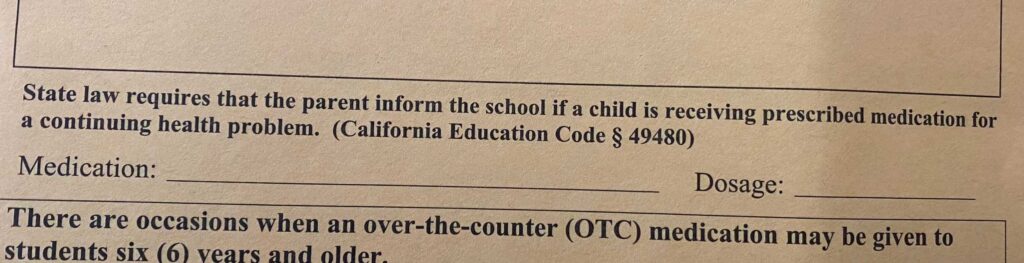
So don’t assume that something you read about another parent’s state applies to yours. Check your own state requirements and school medication policy.
There also may be very good practical reasons for the school nurse to know about medication even when the medication isn’t administered at school.
Reasons You May Want the School Nurse to Know About Medication
My son takes medications for seizures, and those medications have been adjusted many times.
His school nurse knows what he takes. When we’re changing medications, I also want relevant school staff watching for changes in behavior, mood, alertness or seizure activity.
That’s useful information for me and his medical team.
Other medications can cause drowsiness, increased thirst, frequent toileting or other side effects that may show up during the school day. In an emergency, medication information also may be important for medical personnel.
So I’m not advocating for hiding useful medical information from a school. I’m advocating for parents making an informed decision about who needs the information and why.
Can a School Force a Child to Take Medication?
No. Full stop.
IDEA specifically addresses mandatory medication.
Under 34 CFR §300.174, “state and local education personnel cannot require parents to obtain a prescription for a controlled substance covered by the regulation as a condition of the child attending school, receiving an IDEA evaluation or receiving IDEA services.”
The regulation also makes clear that this doesn’t prevent teachers and other school personnel from sharing classroom observations with parents about a student’s academic or functional performance, behavior or possible need for an evaluation. Pasted text
A teacher can tell you, “We’re seeing significant difficulty sustaining attention during independent work” and that’s useful information.
Turning that observation into “You need to put him on medication before we can help him” is another matter entirely.
Can a School Tell You to Change Your Child’s Medication?
Medication decisions belong with the parent, child when appropriate, and qualified medical providers.
School staff can provide valuable observations. In fact, I want them to.
If my son’s teacher notices a dramatic change in alertness after a medication adjustment, please tell me. If his seizure frequency changes, I absolutely want to know.
The teacher is observing my child for hours when I’m not there. That information can be incredibly valuable to his medical team.
But the teacher isn’t his neurologist. School personnel providing observations is different from making medical decisions for the family.
If someone starts giving me unsolicited medical advice, my response is usually some version of, “Thanks, I’ll discuss that with his medical team.” Depending on the day, my delivery may vary.
Can a Teacher Ask a Student if They Took Their Medication?
Nothing in the IDEA provision discussed above creates a blanket rule prohibiting a teacher from asking a student about medication.
But context matters.
A private question asked because a student appears ill or because there is a legitimate safety concern is very different from announcing a child’s medication information in front of classmates.
If you’re uncomfortable with how a teacher is discussing medication with your child, address it. Ask why the questions are being asked, explain your concerns and establish how you want medication issues handled.
Not every irritating thing requires a federal complaint; sometimes a very clear email does the job.
Are School Medical Records Covered by HIPAA?
Parents often assume that every piece of health information is automatically governed by HIPAA. That’s not necessarily how student health records work.
In schools, it’s usually FERPA vs HIPAA that provides the guidance.
Health information maintained by a school may instead become part of the student’s education record and be governed by FERPA. The exact rules depend on who maintains the record and the circumstances.
This is another reason I want parents to pay attention to what information they authorize a medical provider to send to the school.
Once information leaves your child’s medical provider and enters the school system, you’re dealing with a different recordkeeping environment.
Can I Let the School Talk to the Doctor Without Giving Blanket Access?
You can decide how much involvement makes sense for your situation and what authorization you’re comfortable providing.
Sometimes direct communication is useful. Sometimes I’d rather act as the liaison.
If an IEP team has questions for a doctor, one option is to ask the team to put those questions in writing. You can provide them to the physician and return the answers or documentation to the team.
Another option may be a narrowly written authorization covering a specific provider, type of information or period of time. You don’t have to treat this as an all-or-nothing decision.
I will say this–and this is a personal observation. Over almost two decades of being an advocate, I cannot even count the number of times I’ve heard school staff say that they don’t have time to do this, or that, or the other thing. And it’s valid–schools are under-resourced.
So part of my gets a little skeptical when I hear IEP teams talking about how they want to talk to doctors. Now they have time to chase down a busy doctor and talk to them? And, in this current society, doctors rarely talk on the phone even with patients, let alone schools. Even when I try to do this as a patient or parent, it’s a long game of phone tag.
Chances are, whatever information the IEP team needs, can be provided through something you can print from your online medical portal. I’d start there.
What if I Already Signed a Medical Release to the School?
First, get a copy and read it. Find out what you authorized, which providers are covered and whether the authorization includes information about how or when it can be revoked.
You can also contact your child’s medical provider and ask about its procedures for authorizations and revocations.
I wouldn’t rely on sending a generic letter saying that a provider “MUST” obtain your permission if you’ve already signed a valid authorization permitting disclosure. Find out what the existing authorization actually says and follow the appropriate process for changing or revoking it.
Medication and the IEP
Medication itself shouldn’t become a substitute for identifying and addressing a child’s educational needs.
A child may do extremely well on medication, and that’s great.
That doesn’t mean an IEP team should assume the child’s disability-related needs have disappeared or tell the family that services will be available only if the child takes medication.
On the other hand, medication can affect what a child needs at school. Side effects or medical needs may lead to accommodations such as access to water, bathroom breaks, rest periods, food, nursing services or other individualized supports.
For older students, medication management also can be an important independent living skill. If your child will need to manage medication as an adult, that may be something to consider during transition planning.
What Parents Should Do When a School Asks for Medical Information
Don’t panic when the school asks for medical information, and don’t automatically sign everything either.
Find out what they want and why they want it. Read every authorization. Ask whether the school needs the entire record or just specific documentation. Decide whether you’re comfortable facilitating communication yourself or authorizing direct communication.
And when something doesn’t make sense, ask questions.
Parents sometimes feel like they’re being difficult when they don’t immediately sign whatever is handed across the IEP table.
You’re not being difficult by reading a document before signing it, that’s just being an informed parent.
And with the amount of paperwork we sign as disability parents, somebody around here has to read the fine print.
FAQs about Schools, IEP Teams, Medical Records
Can a school demand medical records?
A school can ask for medical information when it believes that information is relevant to a student’s needs at school. That does not automatically mean the school is entitled to your child’s complete medical record or that you have to sign a blanket medical release. Ask what specific information the school needs, why it needs it and whether you can provide that information yourself.
Can a school request medical records?
Yes, a school can request medical records or other medical documentation. A request is not the same thing as an automatic right to access the records. Before signing a release, find out exactly what records are being requested and how they relate to your child’s education, health or safety at school.
Do schools have access to a child’s medical records?
Schools do not automatically have access to all of a child’s medical records by default. A medical provider generally cannot simply open its records to school personnel because they ask. Parents may choose to authorize the release of particular information, and schools may separately maintain health information that parents have provided to them.
Are schools allowed to ask for medical evidence?
Yes. Schools can ask for medical documentation when it is relevant to something happening at school, such as a health plan, attendance issue, accommodation or disability-related need. That doesn’t necessarily mean the school needs the child’s entire medical history. Ask what documentation is needed for the specific issue being addressed.
Do I have to disclose medical information to my child’s school?
It depends on the circumstances, your state requirements and what your child needs during the school day. A school may need certain information to safely administer medication or address a medical condition at school. That is different from giving an IEP team unrestricted access to your child’s medical providers and records.
Can a school call my child’s doctor?
A school can contact a doctor’s office, but that doesn’t mean the doctor can disclose your child’s protected medical information just because the school called. If the school wants to communicate directly with a medical provider, ask what information it wants and whether it is asking you to sign an authorization. You can also ask the school to give you its questions so that you can take them to the doctor yourself.
Can a school ask for proof of a doctor’s appointment?
Schools may have attendance or truancy policies that allow them to request documentation for an absence, including documentation of a medical appointment. Requirements vary by state and school district, so check your school’s attendance policy. Providing proof that an appointment occurred is also different from providing the school with the child’s medical records.
Can a school call a doctor to verify that my child had an appointment?
A school may attempt to verify an absence under its attendance procedures, but a doctor’s office is still subject to privacy requirements regarding what information it can disclose. If the school is requesting verification or if you are in danger of going to truancy court, ask exactly what documentation is required under the school’s attendance policy. A doctor’s note may be sufficient without giving the school access to additional medical information.
Can an IEP team require a doctor’s note before providing special education services?
IDEA evaluations and eligibility decisions are made using the IDEA evaluation process, and a doctor’s diagnosis by itself neither automatically creates nor rules out eligibility for an IEP. If an IEP team says it will not evaluate your child, determine eligibility or provide a service unless you obtain particular medical documentation, ask the school to put that position and its reason in writing.
Can a doctor approve a child for special education classes while an IEP is being developed?
A doctor can provide diagnoses, recommendations and other information for the IEP team to consider, but the doctor does not independently determine IDEA eligibility or special education placement. Those decisions are made through the special education evaluation and IEP process.