School Choice and Vouchers: What Parents Need to Know (Especially for IEPs)
School vouchers are being pushed again at the federal level, and if you’re a parent, it probably sounds appealing. More choice. More control. The ability to leave a situation that isn’t working.
I get it. I really do. Remember, parents only call me for my special education advocacy services when things are bad–so I’ve heard more school horror stories than most people. Is school choice good or bad? That depends on who you ask.
This is one of those topics where what sounds good in a headline and what actually happens for families—especially families with IEPs—can be two very different things. And it’s important for parents and taxpayers to fully understand what school choice means for all students.
What are school vouchers and why are they controversial?
Before we get into the school choice controversy, let’s be clear about what people mean when they say school choice.
In most current proposals, “school choice” refers to programs like vouchers, education savings accounts (ESAs), or tax-credit scholarships. These allow public funds to be used for private schools, religious schools, or other alternatives outside the public school system.
Supporters often describe this as giving parents more options or more control over their child’s education. And on the surface, that sounds reasonable, especially if your current school situation isn’t working. I talk to dozens of parents each week who tell me that their current situation isn’t working, and it has real consequences like their child even refusing to go to school.
But here’s where it matters: When lawmakers talk about expanding school choice, they’re not just talking about options. They’re talking about shifting how public education is funded and who is responsible for educating certain groups of students.
And that shift has real consequences, especially for disabled students.
Federal School Vouchers
Right now, the federal government is moving forward with the first nationwide school voucher–style program, though it’s not being called a “voucher” outright. Instead, it works as a tax-credit system. Under the law passed in 2025, individuals can redirect up to about $1,700 of the taxes they owe into nonprofit scholarship organizations, which then distribute that money to families for private school tuition, tutoring, and other education expenses.
States have to opt in, which means governors are now deciding whether to participate, and many already have or are under pressure to do so.
What makes this significant is that it shifts federal policy in a way we haven’t seen before. School vouchers used to be a state-by-state issue. Now there is a federal mechanism that can funnel billions of dollars toward private education over time, depending on how many states participate and how widely the program expands. Supporters say it gives families more options and flexibility.
Critics point out that it effectively redirects public money—through the tax system—into private and religious schools, raising the same concerns about funding, oversight, and access that have been debated at the state level for years.
While it technically allows funds to be used for some public or charter school expenses, those schools are already free to attend. The real impact of this program is on private school tuition, which is where most of the money will go.
Why School Choice Is So Controversial
For what it’s worth, there is not a single private school near me that would take my disabled child (and legally they’re allowed to refuse him), and not one that costs anywhere near $1700.
School choice isn’t a new idea, but it’s one of the most debated topics in education policy. Some families support it because they want alternatives to their local public school.
Others—including many advocates, educators, and disability rights groups—have serious concerns about how these programs affect access, accountability, and legal protections.
If you’re a parent of a child with an IEP, those concerns aren’t theoretical. They can directly impact your child’s rights, services, and support.
Arguments Against School Choice
Legislators and school choice proponents are very good at selling this idea.
School choice. You have options. You get to choose what school your child attends. It sounds empowering. And if you’re frustrated with your current school, it can feel like the answer.
But once you look past the messaging, the reality is more complicated, and for many families, especially those with disabled children, it’s not better.
One of the biggest misconceptions about school voucher programs is that they create a large number of new students leaving public schools for better options. The data just doesn’t support that. Across multiple studies, private school enrollment only increases by about 3–4% in states with voucher programs.
And even more telling, the majority of voucher recipients were already attending private schools before these programs existed. Research consistently finds that in many cases, over 90% of voucher users did not come from public schools at all. State data shows the same pattern.
In Florida, only about 13% of voucher recipients moved from public school to private school for the vouchers, and in Arkansas, that number was closer to 5%, meaning about 95% were already in private education.
What that means in practice is that these programs are not driving a large shift of students into new or better opportunities. Instead, they are primarily redirecting public funds to families who had already chosen private schooling, while only a small percentage of students are actually leaving public schools.
In other words, our tax dollars are just being used to give a private school rebate to families who could already afford private school.
The Bigger Problem Isn’t “Failing Schools”
Before we even get into vouchers, we have to talk about the story people are being told about public schools.
You’ve heard it. Schools are failing because of wasteful spending, unions, or mismanagement.
But that doesn’t make sense when you actually think about it. Are we really supposed to believe that in thousands of school districts across the country, nearly every teacher, administrator, and school board member suddenly became bad at their jobs?
That’s not what’s happening.
Most educators are doing the best they can with what they’ve been given. The issue is what they’ve been given hasn’t been enough for a long time. Public education has been underfunded for decades. IDEA has never been fully funded. Not once since 1975. Budgets reflect priorities, and public education has not been treated like one.
When schools struggle, it’s not because everyone inside them stopped caring or stopped trying. It’s because they are being asked to do more with less, year after year.
“You don’t find failing public schools and charter schools in wealthy neighborhoods.”
Susan Spicka, Education Voters PA
Because higher income neighborhoods add more burden on their local taxpayers, who can afford it and are willing to do it. And the quality of the education is fine.
Why do some people oppose school choice policies?
This is the part that rarely gets explained clearly. School choice doesn’t come with a bigger pot of money. It takes the same funding and spreads it across more options.
So instead of fixing underfunded schools, we take money away from them.
Every district works off a per-pupil funding model. When a student leaves with a voucher, that funding leaves too. And it doesn’t just disappear once. It leaves every year that student is gone.
So now the school has fewer resources, but the same responsibilities, or often greater ones.
Public schools are left with:
- less funding
- higher-need populations
- fewer resources to meet those needs
And somehow, they’re expected to improve under those conditions. That’s not realistic.
The Voucher Reality for Families
On paper, vouchers sound flexible. You’re given a set amount and told you can use it toward private school tuition. But the numbers don’t always work out.
In many places, the voucher doesn’t cover the full cost of the private schools most families would actually want. That leaves parents trying to make up the difference, and a lot of families simply can’t.
So the “choice” becomes more limited than it first appeared. And while some families may find an option that works for them, the public school they left behind loses that funding.
You receive a set amount, say $13,000, and can use it toward private school tuition.
But here’s the reality for many families: The private schools most parents would actually consider often cost $20,000 or more.
So now you’re expected to make up the difference. Many families can’t. Which means the only accessible options tend to be lower-cost private or religious schools. Or, just not participate and stay in the public schools. Only the higher income families can usually participate and make up the difference.
Another thing that parents don’t realize until they try to get a voucher is that these programs are not unlimited. Most states who offer vouchers only offer a limited number, so there often are waitlists that are in the tens of thousands of students. Private schools do not have unlimited numbers of seats either. Many parents may receive a voucher only to learn that the school they desire is full and also has a waitlist.
What Happens to Public Schools Over Time
If you follow this long enough, the pattern becomes pretty predictable. A district is already struggling because it hasn’t been adequately funded.
Vouchers are introduced, and funding starts to leave with students. The students who leave tend to be those whose families have the resources to make it work, or whose needs are easier to meet elsewhere.
What’s left is a school with fewer resources and a higher concentration of students who need more support.
Performance declines, not because anyone stopped trying, but because the situation became harder. Then the same schools are pointed to as proof that the system isn’t working.
Texas School Choice Program
Texas just passed one of the largest school voucher programs in the country, a $1 billion Education Savings Account system that will begin in the 2026–2027 school year. Families can receive roughly $10,000 per student, and up to $30,000 for students with disabilities, to use toward private school tuition and other expenses.
The program is open to almost all students, and notably, children do not have to come from public schools to qualify—meaning many recipients may already be in private education. Families must select a private school by a set deadline (for example, July 15 for the first year), but those schools are not required to accept every student who applies.
The Texas school choice program highlights a problem that shows up in voucher systems across the country. Private schools are allowed to accept students, receive public funds through vouchers or ESAs, and still maintain full control over enrollment decisions.
That means if a student isn’t a good fit, academically, behaviorally, or because they need more support, the school can dismiss them. And when that happens (and it will!), the student returns to their public school, which is required to take them back.
What makes this especially concerning is that the funding doesn’t always follow the same timeline as the student. In many programs, funds are distributed in chunks or tied to enrollment periods, not daily attendance. So a private school can receive a portion—or in some cases most—of that funding even if the student doesn’t stay the entire year.
The result is a system where private schools can take the funding and send the student back, while public schools are left to pick up the pieces, with even fewer resources than before.
School Choice Pros and Cons
I’m certainly listing a lot of cons against school choice. Are there any pros? What are the pros of school choice?
I suppose those families on the cusp of being able to afford a private school get the nudge they need to move their child. Statistically, this is 5-13% of voucher recipients. The other 95% were already attending private school regardless of whether they received a voucher.
School choice does offer benefits for some families, particularly those who already have access to private options or whose children need a different environment than their local public school can provide. It can create flexibility and, in some cases, a better fit. But those benefits are not experienced equally. They tend to favor families with more resources and students with fewer needs, which is why many parents—especially those of children with IEPs—find that the promised “choice” doesn’t actually apply to them in the same way.
Public Money, Private Interests
There’s also the issue of where this money is going. We’re talking about public funds being redirected to private schools, religious institutions, and in some cases, for-profit education companies.
That raises real questions about oversight and accountability. Public schools operate under rules that are designed to ensure access and transparency. Private entities are not always held to those same standards. Just one example is Freedom of Information (FOIA) requests, or Right to Know requests.
A parent can submit a FOIA request to learn where their school tax dollars are being spent. The same does not always apply to private schools.
Once profit enters the equation, priorities can shift in ways that don’t always benefit students.
How School Choice Affects Students with Disabilities
This is the part that rarely gets the attention it should. Students with disabilities are often the ones most impacted, and least considered, in these policies. On average, about 14-17% of all students have an IEP.
Private schools are not required to provide special education services in the same way public schools are. Most do not offer them at all. Others offer limited services that do not meet a child’s needs, and it’s often an additional cost. (think of the child with very mild learning disability)
And yes, some schools do a good job, but they are the exception, not the rule. Families are often left with fewer protections and fewer options than they had before.
What IEP Families Often Don’t Realize
When you accept a voucher in many states, you may be asked to give up certain rights.
Including:
- FAPE (Free Appropriate Public Education)
- Due process protections
- the ability to seek compensatory education
So if the placement doesn’t work out, your options are limited. That’s not a small trade-off. That’s a fundamental shift in your child’s legal protections.
Signing away FAPE is a big deal. I have heard from several Ohio families who signed a FAPE waiver to get their child and out of district placement. That placement failed their children miserably, and now the families have no recourse. They wasted 3-4 years of their child’s school years, and no progress was made.
Selection, Access, and Who Gets Left Behind
In theory, GOP politicians want to make the money available to you in the form of a voucher, and you can spend it on any education you want for your child.
The federal figure they’re proposing is $1700 per family (not per child, per family). For some state voucher programs, that amount is around $5000.
The problem is, at least around here, the private schools that I would consider for my son (and this is only my non-disabled son) are at least $20,000 a year. Most families don’t have the money to make up the difference.
Mind you, Catholic and Christian schools are often much less, so I could choose one of those. Part of their hidden agenda is to use public money to pay for religious education.
Because basically, the only private schools that any middle-class family could afford with a voucher are the religious ones.
So, let’s start connecting the dots here. With vouchers:
- Public schools have less money to work with because what they used to receive is now a voucher that is handed out.
- The only families left are those who cannot make up the difference of the voucher (thus, lower-income families) and those with disabled children because private schools do not have to take disabled children.
Do These Schools Perform Better?
That’s often the assumption, but it’s not consistently true. Some do well and some don’t. And when they do perform better, it’s important to look at who they’re serving.
Despite their financial and operational advantages, it’s a myth that charters and privates out-perform public schools. And cyber charters? Some studies indicate that cyber charters do so poorly at educating students; it’s like they didn’t even attend school!
Cyber charters are a good example of how this can go wrong. In Pennsylvania, not one has met acceptable performance benchmarks on the School Performance Profile. Not one.
So the idea that these options automatically produce better results just doesn’t hold up.
School choice is presented as a simple solution. But it doesn’t fix the underlying problem, which is that public schools have not been adequately supported.
It shifts funding. It changes who has access to what. And it creates trade-offs that are often not explained clearly to families, especially those raising children with disabilities.
If the solution is to pull resources out of public schools rather than invest in them, then we have to be honest about what that means.
Because the impact doesn’t fall evenly. And the students who rely on the system the most are usually the ones who feel it first.
What we can do about this
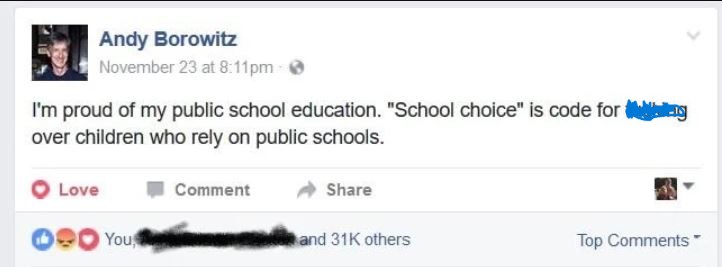
Contact your legislators. Any time a school choice, voucher or deregulation of charters bill comes up…contact them. Be heard.
