
What All Parents Need to Know About Life-Threatening Sepsis: Symptoms for Teenagers and Children
I wrote this years ago after learning how quickly sepsis can turn deadly. Sadly, with the recent news about Kyle Busch’s loss, many families are hearing the word sepsis again and realizing they don’t actually know the warning signs. But for those who are familiar with sepsis and how fast it can happen, we understand.
A few months ago, Kevin was in the hospital with two types of pneumonia, and it was very serious. He was being constantly monitored for sepsis. Hearing about the NASCAR driver, that really hit home for me.
Listen–for Kevin, it happened.so.fast. On Thursday afternoon his 1:1 nurse at school texted me, “He seems not himself today” and by Saturday afternoon, the ER team at the local children’s hospital is debating whether or not he should be in the ICU. That’s how quickly it happens. That’s how someone can win a NASCAR race on Sunday and die four days later.
In the past 20 years, I have actually known several people who have died of sepsis. I mean, I know thousands more have, but these were people who I actually knew and had met, two were related to me.
One was a child and they thought that she had the flu. The other was a mom, and she was just doing the mom-thing being super busy around the holidays. She got sick, kept going and going (like Moms do!) thinking it would pass. A few days later she was dead. It happens that fast.
I’m a worrier. It’s my nature. Having a disabled child, and one who is both non-verbal and medically complex only exacerbates my worrying.
What is Sepsis?
- Sepsis is the body’s extreme response to an infection. It is life-threatening, and without the treatment, sepsis can rapidly cause to tissue damage, organ failure, and death.
- Sepsis happens when an infection you already have: in your skin, lungs, urinary tract or somewhere else, triggers a chain reaction throughout your body.
- Anyone can get an infection, and almost any infection can lead to sepsis.
- Sepsis is a medical emergency. More than 1.5 million people each year in America get sepsis, and at least 250,000 people die as a result. Delayed recognition and treatment increases patients’ risk of death.
What worries me more is that Kevin has a strange and extreme body reaction to bug bites. Not an anaphylactic shock, which is scary too. But bug bites affect him differently than they do most kids. Twice he has developed cellulitis from mosquito bites and cellulitis can turn into sepsis.
Sepsis is the body’s extreme and life-threatening response to an infection. Instead of fighting the infection normally, the body basically goes into panic mode and starts damaging its own tissues and organs.
That’s why I pay attention to it, particularly as a special needs parent. Many of our kids already have medical complexities, communication challenges, feeding issues, immune concerns, mobility limitations, or bodies that just don’t “follow the manual.” And when your child cannot always tell you exactly what feels wrong? Yeah. That changes things.
Just another thing for special needs parents to casually worry about at 2 a.m.
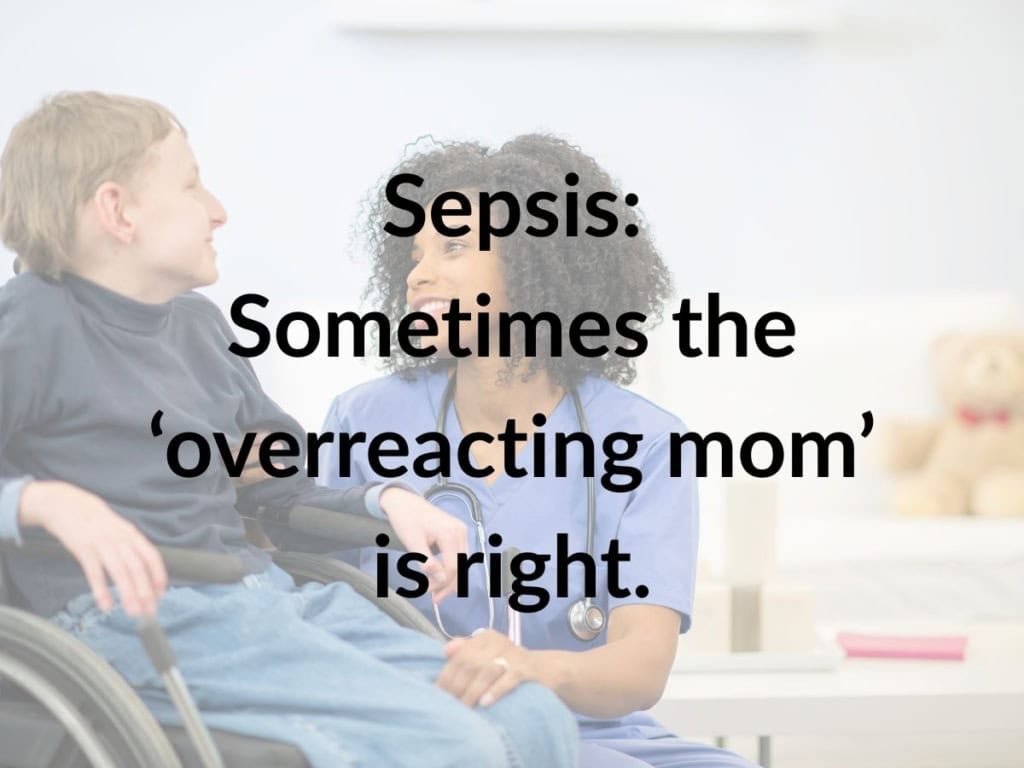
But honestly? Knowing the signs helped me panic less, not more. Because you stop assuming you’re “overreacting” and start recognizing when something needs immediate attention.
How do Kids get Sepsis?
Sepsis starts with an infection that the body does not handle correctly.
Almost any infection can lead to sepsis, but the most common ones usually begin in the:
- lungs
- urinary tract
- skin
- gastrointestinal tract
Kids cannot “catch” sepsis from another child. But they can catch infections that, in some situations, may lead to sepsis. In Kevin’s case this year, he first caught Flu A, which turned into pneumonia.
Yes, viral illnesses (including COVID, flu, RSV, and other infections) can sometimes lead to sepsis complications.
Signs and Symptoms of Sepsis in Children
One of the hardest parts about sepsis is that the symptoms can look like other illnesses…until suddenly they don’t.
Symptoms may include:
- confusion or unusual behavior
- shortness of breath
- rapid heart rate
- fever, shivering, or feeling unusually cold
- extreme pain or discomfort
- clammy, sweaty, or pale skin
- “something is very wrong” parent gut feeling
And listen, I know “trust your gut” gets thrown around online constantly. Usually right next to an MLM essential oil recommendation. But parents of medically complex kids often do notice subtle changes before anyone else does.
You know your child’s baseline. And just like at the IEP table….in the doctor’s office, in the hospital room….you have to advocate for your child.
Less obvious signs of sepsis parents should not ignore
Not every child with sepsis looks dramatically ill right away. Sometimes the early signs are subtle, strange, or easy to brush off as “just part of being sick.”
Some warning signs can include:
- mottled, patchy, or discolored skin
- blue, gray, or pale lips and gums
- skin that feels cold despite a fever
- extreme lethargy or difficulty waking
- unusual floppiness in babies or toddlers
- decreased urination or dry diapers
- a child who is suddenly “not acting like themselves”
- rapid breathing or struggling to breathe
- severe swelling or redness around a wound or bug bite
For me personally, mottled skin is one of those signs that instantly makes me pay attention. Same with lips or gums looking pale, grayish, or blue. Kids can go downhill fast, and sometimes those circulation changes are your clue that the body is struggling.
And this is where parenting medically complex kids gets hard. Because many of us are constantly trying to figure out:
- Is this serious?
- Am I overreacting?
- Is this ER-worthy or “wait and see” worthy?
It’s exhausting. But I’d rather have a parent feel “dramatic” for getting something checked than regret waiting too long. Even that Saturday morning, I knew Kevin was very sick, and I said to my husband, “Look, they’ll take a chest x-ray and trained ears will listen to his lungs. Maybe I’m an over-anxious mom, and then they’ll just send us home.” They didn’t.
As moms to disabled kiddos, that’s the best we can do. Know the signs and symptoms, and know what to do. Most of us have good and close relationships with our medical care providers since our kids are at high risk for so many things. Every night when I put on his pajamas and every morning before/during his shower, I inspect him for bumps, bruises and injuries. Just part of our daily routine.
How can parents get ahead of sepsis?
You cannot prevent every infection. If anyone figures out how, please notify every preschool classroom in America immediately.
But you can lower risks:
- stay up to date on vaccines
- practice good handwashing and wound care
- monitor infections closely
- follow up when something is worsening instead of improving
- know your child’s medical patterns and risk factors
For our family, skin checks became routine. Every night during pajamas. Every morning after showers. Not because I enjoy adding another task to parenting, obviously. But because catching infections early matters.
Especially for kids who may not communicate pain clearly.
Sepsis Risk Factors
Sepsis can happen to anyone. In fact, the two people I knew who died from sepsis both did not have any of these risk factors. However, there are risk factors associated with a higher risk of sepsis.
Healthy people get it too. But risk increases for:
- babies under 1
- adults over 65
- immunocompromised people
- people with chronic medical conditions
- people who previously survived sepsis
And honestly, this is why I always tell parents not to let themselves get brushed off when they know something is escalating.
You do not need to walk into the ER announcing a medical diagnosis you found on Google University. But you can say:
“This infection is getting worse, not better. Could this be turning into something more serious?”
That is advocating and paying attention. That is being informed, not dramatic.
And for special needs parents especially, we spend enough time being told we’re “too worried.”
Sometimes worried parents are the first warning system.
Sepsis is a medical emergency. If you or your loved one suspect sepsis or has an infection that’s not getting better or is getting worse, ask your doctor or nurse, “Could this infection be leading to sepsis?”
To learn more about sepsis and how to prevent infections, visit www.cdc.gov/sepsis.
For more information about antibiotic prescribing and use, visit www.cdc.gov/antibiotic-use.
Please note: I am not a doctor nor do I play one on the internet. This post was published with information provided to me by the CDC because they wanted to spread awareness of sepsis.