100 Independent Functioning and Independent Living IEP Goals (Life Skills)
Before I get started with this list of Life Skills Goals for an IEP, I want to make one thing clear. That is, remember, IEPs are all about the “I.” Any student who has life skills listed as an area of need can have life skills IEP goals. They do not need to be in the life skills classroom to receive this.
For the purposes of this giant list of IEP goals, I use the terms independent functioning IEP goals, life skills IEP goals and independent living IEP goals. Of course there is a bit of overlap among those terms and so I wanted to include them all.
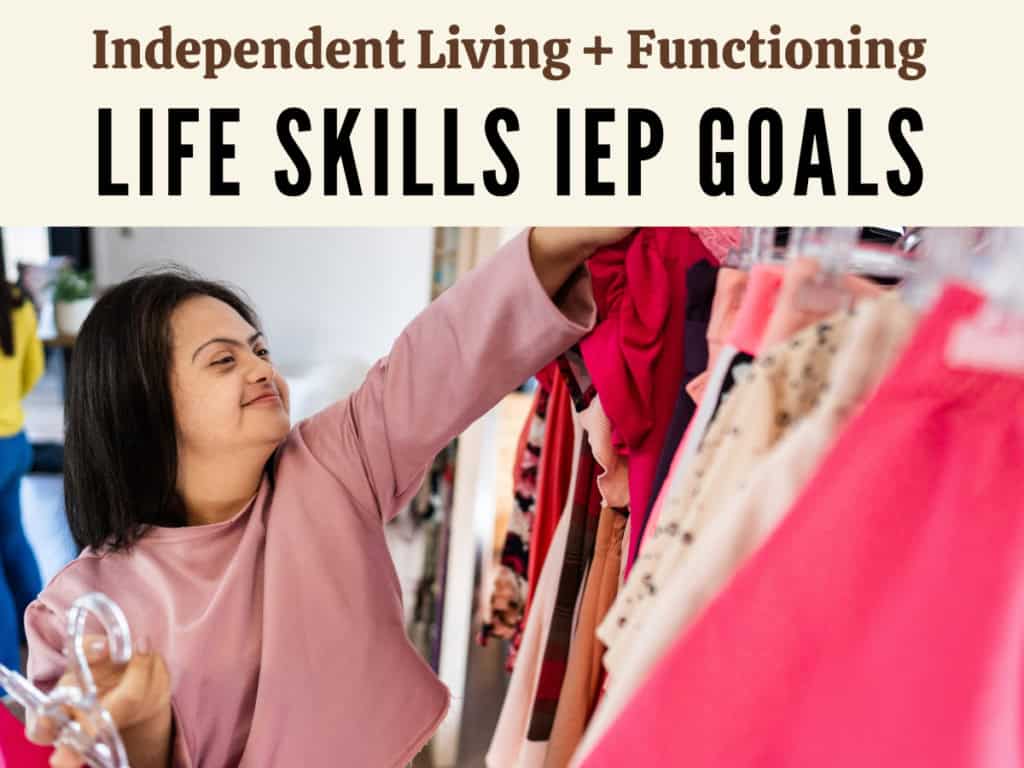
Yes, some students are on a functional path rather than an academic one. However, you can still be in general education classes and need extra help with some of your functional life skills. This would include social skills IEP goals, as we all need those to be successful. I have those in another post.
And, while it’s completely appropriate for a student to spend their 13th and 14th year working exclusively toward these goals, I’m leery of that idea. The reason is that 2-3 years is not enough time to learn them. That’s why a solid IEP with transition services is so important.
Adding CBI Community Based Instruction can be done at any age. It’s not just for those in a life skills classroom. That may be school policy and practice, but that’s not what IDEA says.
Looking for a broader checklist to spark ideas? Be sure to check out my full Independent Living Skills Checklist for more examples and guidance.
Independent Functioning IEP Goals
I compiled this list from numerous lists I saw online to make it more comprehensive. The printable list of independent living skills is at the bottom of the post. It may seem overwhelming. And, you might be doing some of these skills and tasks for your child. That’s fine! That is what supported living is all about. What’s important is that the maximum level of independence is being supported. And that your child is as independent and as safe as possible.
I saw some outdated sentences. Things like referencing payphones and phone books. So I changed those but please let me know if you find another error.
IEP Goals for Life Skills
Personal Information Awareness IEP Goals
- Identifying Personal Data: By ___, Student will identify personal information written by others (name, address, Social Security number) in written materials as measured by teacher-made probes with ___ accuracy.
- Name Recognition: By ___, Student will identify his/her written name in printed materials as measured by work samples with ___ accuracy.
- Address Recognition: By ___, Student will identify his/her written address in printed materials as measured by teacher observation with ___ accuracy.
- Social Security Number Recognition: By ___, Student will identify his/her written Social Security number in printed materials as measured by data collection with ___ accuracy.
- Identifying School Locations: By ___, Student will locate familiar school places (e.g., nurse, library, cafeteria, elective classrooms) in the school environment as measured by teacher observation with ___ accuracy.
- Home Address Identification: By ___, Student will identify his/her home address in written form as measured by work samples with ___ accuracy.
- Address and Phone Number Identification: By ___, Student will identify his/her full address and phone number in written materials as measured by teacher-created probes with ___ accuracy.
- Carrying Personal Identification: By ___, Student will carry personal identification in a wallet or designated location during school and community activities as measured by daily checks with ___ accuracy.
Functional Use of Household Tools and Appliances IEP Goals
- Following Written Operating Instructions: By ___, Student will operate household tools, appliances, and equipment in response to written instructions, labels, or markings on buttons, switches, dials, and gauges as measured by task analysis checklists with ___ accuracy.
- Kitchen Appliance Operation: By ___, Student will operate common kitchen appliances (e.g., refrigerator, microwave, toaster, stove, oven, dishwasher) in functional routines as measured by task performance data with ___ accuracy.
- Laundry Appliance Operation: By ___, Student will operate laundry equipment (washer, dryer, iron) during household maintenance tasks as measured by teacher observation with ___ accuracy.
- Telephone Use: By ___, Student will operate a telephone and answering device using written prompts or on-screen information as measured by structured practice data with ___ accuracy.
- Personal Grooming Appliances: By ___, Student will operate grooming appliances (hair dryer, shaver) using written indicators or controls as measured by teacher-made rubrics with ___ accuracy.
- Recreational/Educational Device Use: By ___, Student will operate recreational or educational devices (e.g., TV, radio, computer, gaming system) using written prompts and on-screen instructions as measured by task completion data with ___ accuracy.
- Health Monitoring Equipment: By ___, Student will operate basic health monitoring devices (scale, thermometer, heating pad) using written instructions as measured by performance checklists with ___ accuracy.
- Heating/Ventilation Controls: By ___, Student will operate heating and ventilation controls (thermostat, fan, air conditioner) using written labels and indicators as measured by observation with ___ accuracy.
- Household Cleaning Tools: By ___, Student will operate household cleaning tools (vacuum, hand vacuum, electric broom, Swiffer-type tools) in response to written instructions as measured by task analysis with ___ accuracy.
Functional Community Literacy IEP Goals
- Using Community Information: By ___, Student will use written information in the community (e.g., elevator signs, transit fare charts) to complete tasks such as operating a self-service elevator or paying correct fare as measured by community-based instruction data with ___ accuracy.
- Responding to Community Print: By ___, Student will comprehend and respond appropriately to written community information (symbols, words, phrases) as measured by curriculum-based assessments with ___ accuracy.
- Finding Public Restrooms: By ___, Student will locate public bathrooms for washing and toileting using written signs as measured by community instruction data with ___ accuracy.
- Identifying Public Transportation: By ___, Student will identify buses using number and destination signs for community travel as measured by travel training records with ___ accuracy.
- Obeying Traffic Signs: By ___, Student will identify and obey common traffic signs during community instruction as measured by observation with ___ accuracy.
- Understanding Warning Signs: By ___, Student will identify warning signs and avoid areas marked as dangerous as measured by community practice checklists with ___ accuracy.
- Interpreting Package Warning Words: By ___, Student will identify written warning words on packages and follow instructions accordingly as measured by structured tasks with ___ accuracy.
- Following Directional & Functional Signs: By ___, Student will identify and comply with common directional signs (e.g., PUSH, PULL, ENTRANCE, EXIT) as measured by teacher observation with ___ accuracy.
- Using Store Hours Signs: By ___, Student will locate signs showing business hours and determine whether a store is open or closed as measured by community-based tasks with ___ accuracy.
- Locating Public Telephones: By ___, Student will locate public telephones or communication booths using posted signage as measured by functional assessments with ___ accuracy.
- Seeking Assistance With Unfamiliar Print: By ___, Student will seek help from a responsible person to decode or explain written material he/she cannot read as measured by teacher observation with ___ accuracy.
Consumer Literacy IEP Goals
- Identifying Container Contents: By ___, Student will identify the contents of containers using written labels as measured by structured assessments with ___ accuracy.
- Understanding Package Sizes: By ___, Student will determine the quantity of items or substances in packages using size labels and notations as measured by classroom tasks with ___ accuracy.
- Identifying Prices: By ___, Student will identify prices using price labels, tags, and store signs as measured by shopping simulations with ___ accuracy.
- Following Food Storage/Cooking Directions: By ___, Student will identify and follow written storage and cooking directions on food packages as measured by task performance checklists with ___ accuracy.
Information-Seeking Skills for Employment & Daily Living
- Using Classified Ads: By ___, Student will locate information in print or online classified ads to support job seeking or purchasing decisions as measured by teacher-developed tasks with ___ accuracy.
- Using Advertisements: By ___, Student will locate information in printed advertisements and use it to make informed purchasing decisions as measured by work samples with ___ accuracy.
- Using Pamphlets and Manuals: By ___, Student will review brochures, pamphlets, and manuals to make decisions about recreational, educational, vocational, or personal activities as measured by curriculum-based assessments with ___ accuracy.
Safety Skills (School, Home, and Community)
- Practicing Safety Rules With Support: By ___, Student will practice basic safety rules with verbal or visual reminders as measured by teacher observation with ___ accuracy.
- Practicing Safety Rules Independently: By ___, Student will practice basic safety rules without reminders as measured by behavior data with ___ accuracy.
- Following Pedestrian Signs & Conventions: By ___, Student will follow pedestrian signs, crosswalk rules, and conventions as measured by community-based instruction checklists with ___ accuracy.
- Stranger Safety Awareness: By ___, Student will identify rules for interacting with strangers and apply them in structured scenarios as measured by teacher observation with ___ accuracy.
- Transportation Safety: By ___, Student will use appropriate and safe transportation procedures (e.g., boarding, seating, exiting) as measured by community-based instruction data with ___ accuracy.
- General Safety Rule Compliance: By ___, Student will follow safety rules in school and community settings as measured by teacher documentation with ___ accuracy.
- Reading & Following Safety Signs: By ___, Student will read common safety signs and follow the expectations associated with each as measured by performance tasks with ___ accuracy.
- Pedestrian Skill Demonstration: By ___, Student will demonstrate safe pedestrian skills (e.g., stopping, looking, listening, crossing safely) as measured by task analysis with ___ accuracy.
Transportation & Travel Training
- Meeting Transportation Services: By ___, Student will meet buses, carpools, or shuttle services using written departure schedules as measured by community-based monitoring with ___ accuracy.
- Paying Taxi Fares: By ___, Student will pay the correct fare using a taximeter and provide an appropriate tip when taking a taxi in designated situations as measured by task analysis with ___ accuracy.
- Taking Correct Transportation to Work: By ___, Student will select and board the correct bus or public transportation vehicle to work using number and destination signs as measured by travel training data with ___ accuracy.
- Selecting Alternate Travel Routes: By ___, Student will select alternate routes to get to work using written maps or digital directions as measured by performance tasks with ___ accuracy.
- Driving Route & Sign Compliance: By ___, Student will obey traffic signs and signals and follow written or prescribed driving routes to work as measured by driver training documentation with ___ accuracy.
- Using Community Maps: By ___, Student will use community maps and public transportation guides to locate destinations as measured by structured tasks with ___ accuracy.
Functional Reading: Family, School, and Everyday Vocabulary
- Reading Everyday Words: By ___, Student will identify high-frequency functional words (family names, relationship names, object names, action words, prepositions) in written form as measured by teacher-made probes with ___ accuracy.
Possible Objectives:
• Identify written names and relationship names of family members.
• Identify written names of familiar household and school objects.
• Identify frequently used action words when written.
• Identify frequently used prepositions when written. - Reading Basic Numeracy Information: By ___, Student will identify written numeracy information (numbers 1–12, time notations, money amounts) as measured by work samples with ___ accuracy.
Possible Objectives:
• Identify written numbers 1–12.
• Identify written time notations.
• Identify money designations written as numerals.
Following Written Directions in Daily Life
- Using Written Packaging Instructions: By ___, Student will follow written directions on food, household products, and other packages as measured by task analysis checklists with ___ accuracy.
Possible Objectives:
• Follow written directions on food packages.
• Follow written directions on household cleaning products.
• Identify and follow storage and cleaning instructions on laundry and cleaning agents. - Using Written Labels for Purchasing: By ___, Student will use written labels during purchasing activities as measured by community-based instruction data with ___ accuracy.
Possible Objectives:
• Verify clothing and linen size labels when shopping.
• Identify correct postage needed for mailing letters/cards.
• Identify cost of admission at public facilities.
• Identify types of stores or businesses based on window displays and sign keywords. - Using Environmental Written Cues: By ___, Student will use written environmental cues to navigate home and community locations as measured by functional assessments with ___ accuracy.
Possible Objectives:
• Locate doorbells and mailboxes of friends and relatives.
• Operate vending machines using written instructions.
• Operate coin-operated washers and dryers.
Functional Eating & Mealtime Skills
- Ordering Food in Community Settings: By ___, Student will order food in a cafeteria or restaurant using written menus or visual prompts as measured by community-based instruction data with ___ accuracy.
Possible Objectives:
• Order in a cafeteria.
• Order from a restaurant menu. - Understanding Nutrition: By ___, Student will describe food groups and identify foods that contribute to a healthy lifestyle as measured by teacher-made assessments with ___ accuracy.
Functional Cooking & Meal Preparation
- Using Kitchen Utensils Safely: By ___, Student will use common kitchen utensils safely and effectively (e.g., knives, can opener, peeler, grater) as measured by task analysis with ___ accuracy.
- Using Kitchen Appliances Safely: By ___, Student will use kitchen appliances safely and effectively as measured by structured cooking tasks with ___ accuracy.
- Preparing Simple Meals: By ___, Student will prepare simple meals independently as measured by performance tasks with ___ accuracy.
Possible Objectives:
• Prepare breakfast for one.
• Prepare lunch for one.
• Prepare dinner for one. - Following Written Recipes: By ___, Student will prepare foods using written instructions or recipes as measured by cooking lab checklists with ___ accuracy.
Possible Objectives:
• Prepare recipes from a cookbook.
• Adjust recipes to serve more or fewer people.
• Follow instructions for canned or frozen foods. - Food Storage & Safety: By ___, Student will demonstrate appropriate food safety practices as measured by task analysis with ___ accuracy.
Possible Objectives:
• Store perishable items under refrigeration.
• Recognize signs of food spoilage.
• Use date labels to prevent spoilage.
• Prepare and eat a reasonably balanced diet (not perfect, but not candy bars for dinner).
Functional Grocery Shopping
- Creating and Using Lists: By ___, Student will create and use a grocery shopping list to complete a shopping task as measured by community-based instruction with ___ accuracy.
- Menu Planning & Budgeting: By ___, Student will plan meals for a week and shop within a food budget as measured by teacher-developed rubrics with ___ accuracy.
- Executing a Shopping Trip: By ___, Student will complete a grocery-shopping trip (locating items, comparing prices, paying cashier) as measured by task analysis with ___ accuracy.
- Using Unit Pricing: By ___, Student will use unit pricing to comparison shop and make cost-effective purchasing decisions as measured by shopping simulations with ___ accuracy.
Household Cleaning & Maintenance Skills
- Dishwashing Skills: By ___, Student will wash dishes using soap and hot water and complete all steps of the routine as measured by task analysis checklists with ___ accuracy.
- Replacing Light Bulbs: By ___, Student will change a household light bulb safely and correctly as measured by teacher observation with ___ accuracy.
- Bed-Making Skills: By ___, Student will make a bed following a multi-step sequence as measured by work samples with ___ accuracy.
- Garbage Disposal & Waste Management: By ___, Student will dispose of household garbage appropriately and follow household waste routines (including garbage day expectations) as measured by teacher observation with ___ accuracy.
- Using a Vacuum Cleaner: By ___, Student will use a vacuum cleaner appropriately, including emptying bags or canisters, as measured by task performance data with ___ accuracy.
- Changing Bed Linens: By ___, Student will change bed linens and replace them correctly as measured by structured tasks with ___ accuracy.
- Preventing Household Clogs: By ___, Student will describe and demonstrate ways to prevent sinks and toilets from clogging as measured by teacher-created assessments with ___ accuracy.
- General Cleaning Skills: By ___, Student will clean household surfaces and rooms using appropriate tools and products (e.g., sweeping, mopping, dusting, cleaning bathrooms) as measured by task analysis with ___ accuracy.
Possible Objectives:
• Sweep floors and stairs.
• Wash wood and linoleum floors.
• Dust surfaces and polish furniture.
• Clean toilets, bathtubs, and sinks.
• Wash windows. - Selecting Appropriate Cleaning Products: By ___, Student will select appropriate cleaning products for different household tasks as measured by teacher-made checklists with ___ accuracy.
- Stopping a Running Toilet: By ___, Student will demonstrate how to stop a toilet from running using basic troubleshooting steps as measured by teacher observation with ___ accuracy.
- Using a Plunger: By ___, Student will use a plunger to unstop a toilet or sink as measured by task performance data with ___ accuracy.
- Refrigerator Defrosting: By ___, Student will defrost a refrigerator safely (when needed) as measured by task analysis with ___ accuracy.
- Stove Cleaning: By ___, Student will clean a stove using appropriate tools and products as measured by teacher observation with ___ accuracy.
- Energy & Water Conservation: By ___, Student will demonstrate strategies to conserve household energy and water as measured by curriculum-based assessments with ___ accuracy.
- Routine Home Cleaning: By ___, Student will perform routine house cleaning to maintain the home in a reasonably clean state as measured by performance checklists with ___ accuracy.
- Using Storage Spaces: By ___, Student will use drawers and closets appropriately to store clothing and personal items as measured by teacher observation with ___ accuracy.
Personal Functional Math Goals for an IEP
Please note that I have previously done another post about IEP goals for Money Skills.
- Identifying Important Personal Numerals: By ___, Student will identify numerals of personal importance (e.g., age, birthdate, address, phone number, SSN) when appearing in written materials as measured by work samples with ___ accuracy.
- Writing Personal Numerals: By ___, Student will write numerals needed when supplying personal data on forms and documents as measured by teacher review with ___ accuracy.
- Reading Written Number Words: By ___, Student will identify written expressions for numerals when they appear in printed materials as measured by assessments with ___ accuracy.
- Writing Number Words for Transactions: By ___, Student will write number words (e.g., “twenty-five”) when completing checks or financial documents as measured by task performance data with ___ accuracy.
Functional Measurement Skills
- Using a Ruler: By ___, Student will use a ruler to measure objects using whole numbers as measured by performance tasks with ___ accuracy.
- Using Measuring Cups & Spoons: By ___, Student will use measuring cups and spoons accurately during cooking or functional activities as measured by cooking lab checklists with ___ accuracy.
- Using Scales: By ___, Student will use personal and food scales to measure weight or ingredients as measured by teacher observation with ___ accuracy.
- Using Yardsticks & Measuring Tapes: By ___, Student will use a yardstick or measuring tape to measure length, width, depth, or height as measured by task analysis with ___ accuracy.
- Measuring With Whole & Fractional Units: By ___, Student will measure objects or recipe items using whole numbers, fractions (½, 1/3, ¼), and simple mixed numbers as measured by work samples with ___ accuracy.
- Estimating Measurements: By ___, Student will estimate size, distance, and quantity in functional activities as measured by teacher-developed tasks with ___ accuracy.
Functional Use of Directories & Schedules
- Using Directories: By ___, Student will locate information in directories (e.g., phone lists, building directories, apartment/unit lists, supermarket guides) as measured by teacher observation with ___ accuracy.
- Using Schedules & Timetables: By ___, Student will use schedules (mail pickup, transportation departures/arrivals, school/activity schedules) to identify needed times or locations as measured by functional assessments with ___ accuracy.
Community Participation, Recreation & Leisure
- Engaging in Structured Play: By ___, Student will participate in a variety of games (e.g., table games, card games, strategy games, physical games, make-believe/role-play) as measured by teacher observation with ___ accuracy.
- Selecting Safe & Appropriate Play Materials: By ___, Student will choose durable, safe, and appropriate toys, games, or recreational items as measured by structured choice tasks with ___ accuracy.
- Participating in Recreational Activities: By ___, Student will engage in a range of recreational activities (e.g., water play, balance/target games, low- and high-activity games, video games) as measured by teacher documentation with ___ accuracy.
- Participating in Community Activities: By ___, Student will participate in community-based leisure activities (e.g., dining out, movies, parks, events, clubs, outings) as measured by community-based instruction data with ___ accuracy.
- Planning Social or Recreational Events: By ___, Student will plan and participate in simple social events or outings (e.g., parties, picnics, excursions) as measured by work samples with ___ accuracy.
- Exploring Hobbies & Interests: By ___, Student will identify and participate in preferred hobbies (e.g., nature exploration, collections, crafts, photography, caring for plants/pets) as measured by teacher checklists with ___ accuracy.
- Engaging in Independent Quiet Activities: By ___, Student will engage in quiet leisure activities (e.g., reading picture books, electronic games, listening to music, watching videos) appropriately as measured by observation with ___ accuracy.
- Using Technology for Leisure: By ___, Student will use electronic devices (e.g., TV, computer, handheld gaming) for recreation following established routines as measured by teacher observation with ___ accuracy.
- Participating in Outdoor Exploration:
By ___, Student will participate in outdoor activities (e.g., walking/hiking, camping, nature exploration) as measured by community-based instruction data with ___ accuracy. - Visiting Community Members:
By ___, Student will visit relatives, friends, or neighbors as part of community-based instruction as measured by teacher logs with ___ accuracy. - Identifying Hobbies: By ___, Student will identify activities and opportunities for personal hobbies and recreation as measured by teacher-developed assessments with ___ accuracy.
This list of IEP goals is to help you and your team focus on independent functioning. Many students will need supported living situations, but just because a person needs support doesn’t mean we shouldn’t maximize their abilities. Remember, inclusion means contribution. We want our kids included in society as adults, and that means contributing to the maximum extent possible. Everyone has something to contribute. It’s important to remember, and encourage our kids, that for some of them, these skills may not be evident right now.
But, that doesn’t mean that they are not attainable. Some kids may not be ready for this until age 20, 25, or even later. And that’s ok. I’ve had several clients over the years who were not ready for these things by age 17 or 18 and felt defeated by that.
Life Skills IEP Goals and Objectives
To make it a goal with objectives, you add the subsets of skills to the main skill. For example “student will demonstrate independence in completing banking skills necessary for independent living” or something like that. Then, add in the objectives such as creating a budget, explaining the concept of saving, demonstrating how to use a check card, demonstrating what to do if a card is declined, etc.
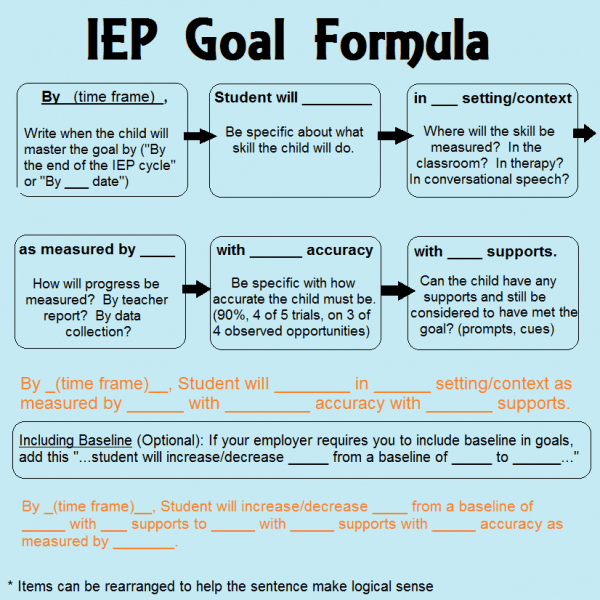
When writing IEP goals, every goal should follow a clear, measurable structure. The formula below helps teams stay consistent while still personalizing each goal to the student. Each goal includes a time frame, the specific skill the student will demonstrate, the setting or context where the skill will be measured, how progress will be assessed, the required level of accuracy, and any supports the student may use.
By _____(time frame)_____, Student will_____ in_____ setting/context as measured by_____ with_____ accuracy with _____supports.
If a baseline is required, it can be added to show where the student is starting and how much growth is expected. Using this structure ensures the goal is meaningful, measurable, and easy for any teacher or parent to understand.
Including Baseline (Optional): If your employer requires you to include baseline in goals, add this “…student will increase/decrease _____ from a baseline of _____ to ______.”
Printable List of Life Skills IEP Goals
Here is the printable list of Independent Living Skills. It is a work in progress, so check back often. But I didn’t want to delay in getting it out there for you.
I am aware that this is a huge list! However, the family and the school should work together on prioritizing the needs. And, it can point you toward what services are needed for transition and perhaps that 13th and 14th year.
Independent Functioning and Life Skills
- Basic Reading Skills IEP Goals: 25 Measurable Examples
- Community Safety and Transportation IEP Goals: 99 Ideas for Adult Life
- Personal Hygiene and Health IEP Goals (effective and measurable!)
- Independent Functioning and Living IEP Goals (Life Skills)
- Life Skills Classroom: What is a Life Skills Classroom?
- IEP Goals for Low Functioning Students
- Money IEP Goals including Functional Math, Budgeting and Banking
- IEP Goals for Severe and Profound Students
- Toileting IEP Goals (ideas for all ages)
- Vocational IEP Goals Including Work Habits and Job Skills