28 Spelling IEP Goals for All Ages, Abilities and Common Core Standards
With the advancement of technology, I feel like poor spelling skills get dismissed too easily. Too often, I’ve heard IEP team members say, “They don’t need IEP spelling goals, they can use a spell checker.”
It’s not just about the end product or making fewer spelling errors on an assignment.

The ability to spell, or not, can be very insightful information. For instance, the ability to spell strongly correlates to a child’s ability to encode and decode.
For example, if a student spells “cat” as “k,” they were able to encode the initial consonant sound. If they spelled “cat” as “kt,” they were able to capture the initial and final consonant sounds.
You Need IEP Data. You Also Need to Teach.
IEP progress monitoring has to get done, but it shouldn’t take hours. You need a system that’s simple enough to actually use in a real classroom.
Get teacher-created, ready-to-use tools that help you track IEP goals, document meaningful progress, and write progress reports faster, without adding more paperwork to your day. Save time, stay compliant.
When creating IEP goals for spelling letter sounds, it is important to assess the student’s ability to encode different types of sounds in words. The goal of a spelling sounds assessment is to see how many letter sounds a student can capture when spelling a word.
To create IEP goals for spelling letter sounds, it is helpful to start by assessing the student’s ability to spell CVC words. A list of CVC words that capture a wide variety of letter sounds can be used to see what sounds the student is able to capture.
The assessment should score the student’s ability to capture the first, last, and medial vowel sounds in each word.
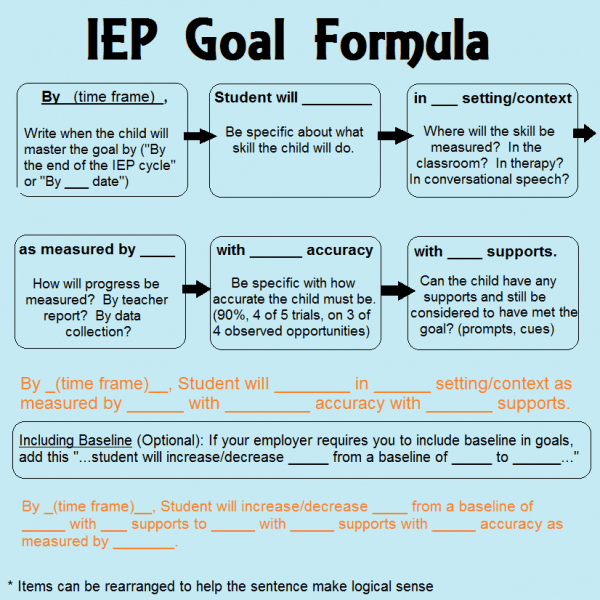
Remember you can put any IEP goal into the goal formula to make it measurable and a smart IEP goal.
IEP Goals for Spelling Letter Sounds
Here are ten IEP goals for spelling letter sounds:
- Letter-Sound Correspondence Goal: By the end of the IEP period, when presented with a letter, the student will correctly identify the corresponding sound for at least 20 out of 26 lowercase letters of the alphabet, as measured by teacher observation and periodic assessments.
- Beginning Sounds Goal: By the end of the IEP period, the student will accurately spell words using the correct beginning sounds for at least 80% of consonants and short vowels presented in isolation, as measured by weekly spelling assessments.
- Ending Sounds Goal: By the end of the IEP period, the student will correctly identify and spell words using the appropriate ending sounds for at least 80% of consonants and short vowels presented in isolation, as assessed through teacher observation and periodic assessments.
- Vowel Sounds Goal: By the end of the IEP period, the student will demonstrate proficiency in spelling words containing short and long vowel sounds, accurately distinguishing between them in written assignments with at least 90% accuracy, as measured by teacher observation and periodic assessments.
- Consonant Blends Goal: By the end of the IEP period, the student will correctly spell words containing consonant blends (e.g., bl, gr, st) with at least 80% accuracy in written assignments, as measured by teacher-created spelling assessments.
- Digraphs Goal: By the end of the IEP period, the student will accurately spell words containing common digraphs (e.g., th, sh, ch) with at least 85% accuracy in written assignments, as assessed through teacher observation and periodic assessments.
- R-Controlled Vowels Goal: By the end of the IEP period, the student will demonstrate proficiency in spelling words containing r-controlled vowels (e.g., ar, er, ir) with at least 75% accuracy in written assignments, as measured by teacher-created spelling assessments.
- Diphthongs Goal: By the end of the IEP period, the student will correctly spell words containing diphthongs (e.g., oi, oy, ou) with at least 80% accuracy in written assignments, as assessed through teacher observation and periodic assessments.
- Silent Letters Goal: By the end of the IEP period, the student will accurately identify and spell words containing silent letters (e.g., kn, wr, gh) with at least 75% accuracy in written assignments, as measured by teacher-created spelling assessments.
- Homophones Goal: By the end of the IEP period, the student will correctly spell commonly confused homophones (e.g., their/there/they’re, to/too/two) in written assignments with at least 85% accuracy, as assessed through teacher observation and periodic assessments.
IEP Goals for Spelling using Assistive Technology
Here are eight Individualized Education Program (IEP) goals for spelling that incorporate the use of assistive technology:
- Accuracy Goal: By the end of the IEP period, when given a list of 20 spelling words, the student will spell 80% of the words correctly using assistive technology (such as spell check or word prediction software) across three consecutive trials.
- Independence Goal: By the end of the IEP period, the student will independently use assistive technology tools to correct at least 90% of spelling errors in written assignments across all subject areas.
- Vocabulary Expansion Goal: By the end of the IEP period, the student will utilize assistive technology to correctly spell and incorporate at least 10 new vocabulary words per month into written assignments across all subject areas.
- Editing and Revising Goal: By the end of the IEP period, the student will demonstrate improved editing and revising skills by utilizing assistive technology to identify and correct spelling errors in written assignments, reducing errors by 50% compared to baseline data.
- Multisensory Learning Goal: By the end of the IEP period, the student will engage in multisensory spelling activities using assistive technology for at least 20 minutes per week, incorporating auditory, visual, and kinesthetic modalities to reinforce spelling concepts.
- Word Recognition Goal: By the end of the IEP period, the student will improve word recognition skills by correctly identifying and spelling high-frequency sight words with the assistance of assistive technology, achieving at least 90% accuracy on weekly assessments.
- Writing Fluency Goal: By the end of the IEP period, the student will increase writing fluency by utilizing assistive technology to spell frequently used words correctly in written assignments, resulting in a 20% increase in words written per minute compared to baseline data.
- Self-Advocacy Goal: By the end of the IEP period, the student will demonstrate self-advocacy skills by independently requesting and effectively using assistive technology accommodations for spelling tasks in classroom and homework assignments.
IEP Spelling Goals relating to Common Core Standards
Here are ten spelling IEP goals aligned with Common Core Standards:
- Phonics Mastery Goal (CCSS.ELA-LITERACY.RF.1.3.A): By the end of the IEP period, the student will demonstrate mastery of phonics rules by accurately spelling words with common phonetic patterns, such as CVC (consonant-vowel-consonant) words, with at least 90% accuracy on weekly spelling assessments.
- Word Analysis Goal (CCSS.ELA-LITERACY.RF.2.3.A): By the end of the IEP period, the student will apply word analysis skills to decode and spell multi-syllabic words with common prefixes, suffixes, and root words, achieving at least 80% accuracy on spelling assessments.
- High-Frequency Words Goal (CCSS.ELA-LITERACY.RF.3.3.D): By the end of the IEP period, the student will correctly spell grade-appropriate high-frequency words (e.g., the, and, said) in written assignments with at least 95% accuracy.
- Contextual Spelling Goal (CCSS.ELA-LITERACY.L.4.2.D): By the end of the IEP period, the student will apply spelling strategies, such as using context clues and morphological analysis, to spell unfamiliar words encountered in reading and writing tasks with at least 80% accuracy.
- Word Recognition Goal (CCSS.ELA-LITERACY.RF.5.3.A): By the end of the IEP period, the student will improve word recognition skills by accurately spelling grade-appropriate words encountered in reading materials, achieving at least 85% accuracy on weekly spelling assessments.
- Orthographic Patterns Goal (CCSS.ELA-LITERACY.L.6.2.B): By the end of the IEP period, the student will recognize and apply common orthographic patterns (e.g., silent letters, irregular plurals) to spell words accurately in written assignments, achieving at least 80% accuracy.
- Vocabulary Acquisition Goal (CCSS.ELA-LITERACY.L.7.6): By the end of the IEP period, the student will use various strategies, including using assistive technology tools, to correctly spell academic vocabulary words encountered in content-area texts, achieving at least 70% accuracy on spelling assessments.
- Spelling Strategies Goal (CCSS.ELA-LITERACY.L.8.2.C): By the end of the IEP period, the student will demonstrate proficiency in using spelling strategies, such as mnemonic devices, word roots, and word families, to spell unfamiliar words accurately in written assignments with at least 75% accuracy.
- Editing and Revising Goal (CCSS.ELA-LITERACY.W.9-10.5): By the end of the IEP period, the student will independently edit and revise written work, including spelling errors, to ensure clarity and coherence, reducing spelling errors by 50% compared to baseline data.
- Application of Spelling Conventions Goal (CCSS.ELA-LITERACY.W.11-12.5): By the end of the IEP period, the student will consistently apply standard spelling conventions, including grammar and punctuation rules, to written compositions across various genres, achieving at least 80% accuracy in spelling and mechanics.
Adjusting the Goals
To adjust the goals, change the type of support or adjust the benchmark. For instance, for students who struggle with spelling ending consonant sounds, I would change the type of support to include spelling dictation programs and text prediction programs. Additionally, I would adjust the benchmark to ensure that 80% of the words in a writing sample are spelled correctly.
It’s worth noting that many districts have assistive technology departments with experts who do evaluations. They also require that if a student is using district-provided assistive technology, they have an IEP goal that uses the tech.
Therefore, it’s essential to write the actual assistive technology program more vaguely to allow the next case manager to shift the program if needed.
Using assistive technology and tools can significantly impact a student’s spelling skills. By setting appropriate IEP goals and adjusting them as needed, we can help students achieve their full potential.