Math IEP Goals and Objectives, including Calculation and Computation
I will never forget this one day when Kevin was a preschooler. We had an IEP meeting, and one of his proposed math IEP goals was to be able to visualize and identify what two of something looks like or what three of something looks like.
That same day, my younger son came up to me with two baby blankets, one in each hand, and said, “Look, mommy, TWO blankies!” Ouch. He’s two and a half years younger, and he already had the skills that his brother lacked, a beginning math skill.
Math IEP goals are one of my nemeses as an advocate. Because here’s the thing: very few math skills are stand-alone skills. And, when parents ask me for assistance, they’ll ask for things like a 6th grade math IEP goal, even though their child is not performing at the level of 6th grade math content.
We often forget that math skills often begin with memorization. Parents and teachers sing songs about counting to ten. So is a child actually counting to ten? Or are they just singing a memorized song?
You Need IEP Data. You Also Need to Teach.
IEP progress monitoring has to get done, but it shouldn’t take hours. You need a system that’s simple enough to actually use in a real classroom.
Get teacher-created, ready-to-use tools that help you track IEP goals, document meaningful progress, and write progress reports faster, without adding more paperwork to your day. Save time, stay compliant.
A child can tell you 2+2=4. But is that a memorized phrase, much like memorizing sight words but not being able to decode? Can that child actually visualize what two of something looks like?
Being able to memorize your home address and knowing where you live are two different skills. See my point?
If a child has unaddressed reading issues, they cannot do word problems. Math learning cannot occur without either working memory or accommodations for a lack of working memory. And there are many other subsets that our kids lack.
The child also has to be able to assign symbols to an idea. Three, III, and 3 all mean the same thing.
As an exercise, let’s say we put 3 donut holes in front of a child. Ask them to count them. They get to 3. But could they assign the number 3 in a matching exercise? Furthermore, can the child look at a plate with 5 donut holes, and one with 3 donut holes, and tell you which plate has more donut holes?
- Functional Math IEP Goals
- Math Problem Solving IEP Goals
- Math Word Problem Solving IEP Goals
- Money Skills IEP Goals
Foundations of Math Skills
What happens is that some kids are great at either memorizing or masking, until they can’t. And math skills, such as these listed below, require more than memorizing.
- Understanding size and measurements
- Number sense
- Ability to count verbally (first forward, then backward)
- Recognizing numerals
- Spatial awareness, visualizing what “3” of something looks like.
- More than, less than
- Understanding one-to-one correspondence (i.e., matching sets, or knowing which group has four and which has five)
- patterns
- estimating
- sequences
- problem-solving
- comparison
- sorting
- language
- working memory
When the masking runs out, it is assumed that they have sort of stalled out on math skills when the fact is that they likely always lacked the basics, but it wasn’t evident.
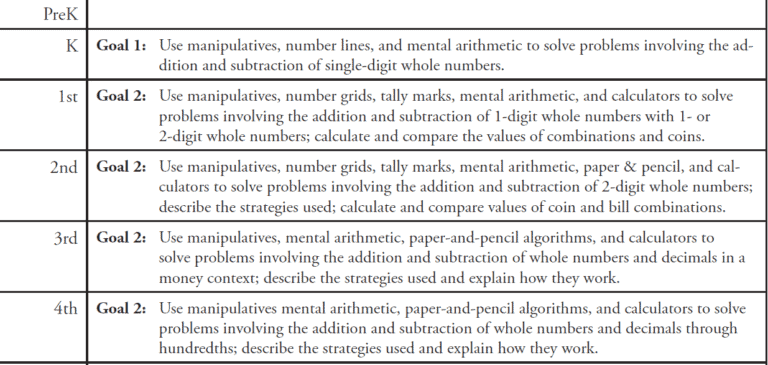
Too many people who write math goals approach it from the point of view of a mathematician. Look at the goal above for 1st grade, the part where it says “calculate and compare the values of combinations and coins.”
It makes me cringe. We all know that a nickel is bigger than a dime but worth less. To know and memorize this also requires flexible thinking, as in “bigger is not always more.”
I get that this is a standards-based list, but I just cannot stress enough how important it is to address what lies underneath successful math skills. Ok, so my point is…or I am pleading with you, if you have found this list of IEP goals for math, to make sure that the underlying skills have been evaluated and addressed.
| Math Goal | Foundation Skill |
|---|---|
| Number and Operations | * Understand place value and the base-ten number system * Develop fluency with addition, subtraction, multiplication, and division * Solve problems involving fractions, decimals, and percentages |
| Algebra | * Understand patterns, functions, and relationships * Solve equations and inequalities * Analyze and interpret graphs and data |
| Geometry | * Understand basic geometric concepts such as points, lines, and angles * Identify and classify shapes * Calculate perimeter, area, and volume |
| Measurement | * Develop an understanding of units and systems of measurement * Measure and estimate length, weight, capacity, and time * Solve problems involving conversions between units |
| Data Analysis & Probability | * Collect, organize, and represent data * Analyze and interpret data using measures of central tendency and variability * Understand basic concepts of probability |
Math IEP Goals
I have a whole separate list of money IEP goals, if you want more details and more specificity.
Functional Math Skills for Independent Living
- Money Management (Counting and Making Change): By the end of the IEP period, the student will accurately count money and make change using dollars and coins in/with real-life or simulated purchasing situations as measured by teacher-collected data across three consecutive trials with 80% accuracy.
- Budgeting and Financial Planning: By the end of the IEP period, the student will create and maintain a personal budget for a specified time period (e.g., one month) in/with tracked income, expenses, and savings goals as measured by review of budgeting documents and teacher observation with 90% accuracy.
- Functional Measurement Skills: By the end of the IEP period, the student will measure and estimate length, weight, and volume of commonly used items in/with appropriate measurement tools and units as measured by teacher-created performance tasks across five opportunities with 80% accuracy.
- Time Management and Time Concepts: By the end of the IEP period, the student will read analog and digital clocks and apply time-related concepts, including schedules and elapsed time, in/with daily routines and real-life contexts as measured by structured time-based tasks across settings with 80% accuracy.
- Practical Math Problem Solving: By the end of the IEP period, the student will solve functional math problems encountered in daily living, such as recipe measurements, sale prices, and transit schedules, in/with real-world or simulated scenarios as measured by task-based performance data with 75% accuracy.
These goals are designed to help students develop functional math skills that are directly applicable to real-life situations, promoting independence and success in various environments.
Foundational Math and Number IEP Goals
Please use the search box on the right hand side if you are looking for life skills goals and other more specific IEP goals for low functioning students.
- One-to-one correspondence: By the end of the IEP period, the student will match objects to objects using one-to-one correspondence in/with hands-on materials and real-life tasks as measured by teacher-collected data across multiple trials with 80% accuracy.
- Counting with meaning: By the end of the IEP period, the student will count objects with meaning by assigning one count per item in/with functional activities as measured by observation and data collection with 80% accuracy.
- Numeral identification and matching: By the end of the IEP period, the student will identify and match numerals to corresponding quantities in/with instructional and real-life materials as measured by teacher-created assessments with 80% accuracy.
- Matching paired objects: By the end of the IEP period, the student will match objects that occur in pairs in/with functional daily living tasks as measured by teacher observation with 80% accuracy.
- Functional shape identification: By the end of the IEP period, the student will identify basic shapes (circle, triangle, square, rectangle) when they have functional relevance in/with real-life materials as measured by teacher-collected data with 80% accuracy.
- Left and right discrimination: By the end of the IEP period, the student will discriminate between left and right in/with body movements and functional directions as measured by observation and data collection with 80% accuracy.
- Number line use: By the end of the IEP period, the student will use a number line to locate and represent numbers in/with simple math tasks as measured by teacher-created probes with 80% accuracy.
- Ordinal position identification: By the end of the IEP period, the student will identify ordinal positions of people and objects (e.g., first, second, third) in/with classroom and real-life situations as measured by teacher observation with 80% accuracy.
- Ordinal-based directions: By the end of the IEP period, the student will follow oral directions involving steps described in ordinal sequence in/with structured activities as measured by task completion data with 80% accuracy.
- Numerals of personal importance: By the end of the IEP period, the student will identify numerals of personal importance (e.g., birth date, age, address, telephone number) in/with written materials and documents as measured by teacher-collected data with 80% accuracy.
- Writing numerals for personal information: By the end of the IEP period, the student will write numerals when supplying personal information on forms and documents in/with functional writing tasks as measured by work samples with 80% accuracy.
- Written number word recognition: By the end of the IEP period, the student will identify the written word form of numerals in/with printed materials as measured by teacher-created assessments with 80% accuracy.
- Writing number words for transactions: By the end of the IEP period, the student will write number words when completing checks or financial documents in/with simulated transactions as measured by review of completed forms with 80% accuracy.
- Fraction identification: By the end of the IEP period, the student will identify the fractions 1/2, 1/3, and 1/4 in/with visual models and simple mixed numbers as measured by teacher-collected data with 80% accuracy.
- Functional subtraction vocabulary: By the end of the IEP period, the student will correctly compute simple subtraction problems when presented with terms such as take away, minus, and subtract in/with instructional tasks as measured by accuracy data with 80% accuracy.
- Use of addition and subtraction symbols: By the end of the IEP period, the student will correctly use the symbols + and − in simple arithmetic problems in/with written math tasks as measured by teacher review with 80% accuracy.
- Numbers on common items: By the end of the IEP period, the student will identify and use numbers appearing on common equipment, appliances, and materials in/with functional activities as measured by teacher observation with 80% accuracy.
- Size comparison (big and small): By the end of the IEP period, the student will discriminate between large and small items in/with real-life objects as measured by teacher-collected data with 80% accuracy.
- Length and height comparison: By the end of the IEP period, the student will discriminate between short and tall and short and long items in/with functional materials as measured by observation with 80% accuracy.
- Full and empty discrimination: By the end of the IEP period, the student will discriminate between full and empty containers in/with daily living tasks as measured by teacher observation with 80% accuracy.
- Measuring with a ruler: By the end of the IEP period, the student will use a ruler to measure object dimensions in/with classroom and functional tasks as measured by teacher-created measurement activities with 80% accuracy.
- Measuring with cups and spoons: By the end of the IEP period, the student will use measuring cups and spoons during cooking and functional activities in/with appropriate tools as measured by observation and data collection with 80% accuracy.
- Using scales for measurement: By the end of the IEP period, the student will use a scale to measure body weight and a food scale during food preparation activities in/with functional tasks as measured by teacher observation with 80% accuracy.
- Measuring with yardstick and tape measure: By the end of the IEP period, the student will use a yardstick and measuring tape to measure length, width, depth, and height in/with functional materials as measured by task-based data with 80% accuracy.
- Measuring with whole numbers and fractions: By the end of the IEP period, the student will measure objects and recipe items using whole numbers, fractions, and mixed numbers in/with functional activities as measured by teacher review with 80% accuracy.
- Estimation skills: By the end of the IEP period, the student will estimate size, distance, and quantity in/with real-life contexts as measured by teacher-collected estimation tasks with 75% accuracy.
Math Computation and Reasoning Skills IEP Goals
Here are IEP goals for math calculation skills:
- Addition and subtraction fluency: By the end of the IEP period, the student will accurately solve basic addition and subtraction facts up to 20 in/with written and mental computation tasks as measured by bi-weekly curriculum-based probes with 90% accuracy.
- Multiplication and division fluency: By the end of the IEP period, the student will accurately solve multiplication and division facts up to 10 in/with written and mental computation tasks as measured by teacher-created assessments across multiple data points with 80% accuracy.
- Multi-step math problem solving: By the end of the IEP period, the student will solve multi-step math word problems involving addition, subtraction, multiplication, and division with numbers up to 100 in/with structured word problem tasks as measured by monthly problem-solving assessments with 70% accuracy.
- Place value understanding: By the end of the IEP period, the student will identify and represent the value of digits up to the thousands place in/with written numbers and place value models as measured by quarterly place value assessments with 80% accuracy.
- Mathematical reasoning and critical thinking: By the end of the IEP period, the student will apply mathematical reasoning skills to identify patterns, make predictions, and justify solutions in/with problem-solving tasks as measured by teacher-created rubrics and work samples with 75% accuracy.
These goals focus on building foundational math calculation skills, promoting fluency, problem-solving abilities, and mathematical reasoning.
Measurable IEP Goals and Objective for Math
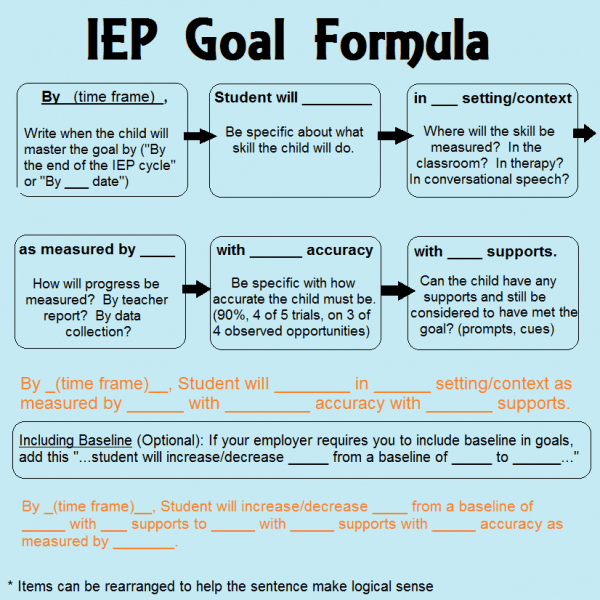
IEP teams can put any math skill into the IEP goal formula and add in the personal details that are relevant to the student.
That will make your IEP math goal measurable.
To add in objectives or benchmarks, most teachers just break down the final goal–so if the end goal is 80% proficiency, the first benchmark would be 25% proficiency, next one 50% proficiency, then 80% by the end of the school year. Of course this will vary depending on the child’s baselines.
Math Calculation IEP Goals
Here’s a list of IEP goals for math, covering various aspects including calculation, computation, problem-solving, and mathematical reasoning:
- Addition and Subtraction Strategies: By the end of the IEP period, Student will accurately add and subtract within a specified number range using appropriate strategies and tools in/with written and mental computation tasks as measured by curriculum-based assessments with 80% accuracy.
- Multiplication and Division Fluency: By the end of the IEP period, Student will demonstrate proficiency in multiplication and division facts up to a specified level in/with written and mental computation tasks as measured by teacher-created assessments with 80% accuracy.
- Multi-Step Word Problems (Addition and Subtraction): By the end of the IEP period, Student will solve multi-step addition and subtraction word problems involving regrouping in/with structured problem-solving tasks as measured by work samples with 80% accuracy.
- Multi-Digit Multiplication: By the end of the IEP period, Student will accurately solve multi-digit multiplication problems in/with written computation tasks as measured by curriculum-based probes with 90% accuracy.
- Division with Remainders: By the end of the IEP period, Student will accurately divide whole numbers by one-digit divisors with remainders in/with written computation tasks as measured by teacher-collected data with 80% accuracy.
- Order of Operations: By the end of the IEP period, Student will correctly apply the order of operations to solve numerical expressions in/with written math tasks as measured by accuracy on assessments with 80% accuracy.
- Fraction Addition and Subtraction: By the end of the IEP period, Student will solve fraction addition and subtraction problems with like and unlike denominators in/with structured math tasks as measured by work samples with 80% accuracy.
- Fraction and Mixed Number Multiplication: By the end of the IEP period, Student will accurately multiply fractions and mixed numbers in/with written computation tasks as measured by teacher-created assessments with 80% accuracy.
- Decimal Operations in Word Problems: By the end of the IEP period, Student will solve word problems involving decimal operations (addition, subtraction, multiplication, and division) in/with real-world problem scenarios as measured by problem-solving assessments with 85% accuracy.
- Factors and Multiples: By the end of the IEP period, Student will apply knowledge of factors and multiples to solve mathematical problems in/with structured tasks as measured by teacher observation and work samples with 80% accuracy.
- Area and Perimeter: By the end of the IEP period, Student will accurately calculate the area and perimeter of geometric shapes in/with written and applied math tasks as measured by assessments with 80% accuracy.
- Logical Reasoning and Math Puzzles: By the end of the IEP period, Student will solve mathematical puzzles and brain teasers involving logical reasoning and numerical patterns in/with structured problem-solving activities as measured by teacher-created rubrics with 75% accuracy.
- One-Variable Algebraic Equations: By the end of the IEP period, Student will accurately solve algebraic equations involving one variable in/with written algebra tasks as measured by work samples with 80% accuracy.
- Graphing Linear Equations: By the end of the IEP period, Student will graph linear equations and interpret the meaning of slope and y-intercept in/with coordinate plane tasks as measured by teacher-created assessments with 80% accuracy.
- Data Analysis and Interpretation: By the end of the IEP period, Student will analyze and interpret data displayed in tables, graphs, and charts in/with data analysis tasks as measured by teacher-created assessments with 80% accuracy.
- Probability and Predictions: By the end of the IEP period, Student will calculate probability and make predictions based on probability outcomes in/with structured probability tasks as measured by assessments with 80% accuracy.
- Geometric Transformations: By the end of the IEP period, Student will demonstrate understanding of geometric transformations (translations, rotations, reflections, dilations) in/with visual and hands-on activities as measured by teacher-created assessments with 80% accuracy.
- Measurement Conversions: By the end of the IEP period, Student will solve real-world mathematical problems involving measurement conversions (length, weight, volume) in/with applied math tasks as measured by work samples with 80% accuracy.
- Percentages: By the end of the IEP period, Student will accurately calculate percentages and apply percentage concepts in real-life situations in/with functional math tasks as measured by teacher-collected data with 80% accuracy.
- Mental Math Fluency: By the end of the IEP period, Student will demonstrate fluency in mental math strategies for addition, subtraction, multiplication, and division in/with timed or structured activities as measured by curriculum-based probes with 80% accuracy.
- Ratios and Proportions: By the end of the IEP period, Student will solve mathematical problems involving ratios and proportions in/with structured problem-solving tasks as measured by teacher-created assessments with 80% accuracy.
- Geometry Properties and Classification: By the end of the IEP period, Student will apply knowledge of geometry to identify and classify shapes based on their properties in/with written and visual tasks as measured by assessments with 80% accuracy.
- Time and Elapsed Time: By the end of the IEP period, Student will accurately solve mathematical problems involving time, including elapsed time and time conversions, in/with functional and academic tasks as measured by teacher-created assessments with 80% accuracy.
- Math Tools and Technology: By the end of the IEP period, Student will demonstrate proficiency in using mathematical tools and technology (e.g., calculators, spreadsheets, geometric software) in/with structured math tasks as measured by teacher observation and work samples with 80% accuracy.
- Two-Step Equations and Inequalities: By the end of the IEP period, Student will accurately solve two-step equations and inequalities involving integers and rational numbers in/with written algebra tasks as measured by work samples with 80% accuracy.
PDF List of Math IEP Goals
Here you go: the printable list of Math IEP Goals. I have a love/hate relationship with this list. I liked that it does list the skills incremental skill sets by age/grade.
But, it is just that–a list. It does not go into any of the pre-skills that are necessary. “Do mental arithmetic” is a useless command if you lack working memory or the ability to visualize quantity.
I hope this helps. In some cases, the child will need a good neuropsychological evaluation to determine what the root of the issue is.
Here you go: the printable list of Math IEP Goals. Shared with permission.
These goals cover a range of math skills and concepts suitable for students with diverse learning needs and abilities. Adjust goals based on individual student requirements and grade level expectations. And as always, tie the goal to baselines in present levels.