
25 SDI Examples for an IEP, by subject area.
If you’re a parent navigating the IEP process, you’ve likely come across the term Specially Designed Instruction (SDI). Understanding what SDI is—and how it differs from accommodations—is critical to ensuring your child gets the support they need in school.
This post will provide a brief overview of SDI, explain why SDI doesn’t appear on 504 Plans, and share real-world SDI examples across key areas like reading, math, social skills, behavior, and executive functioning skills.
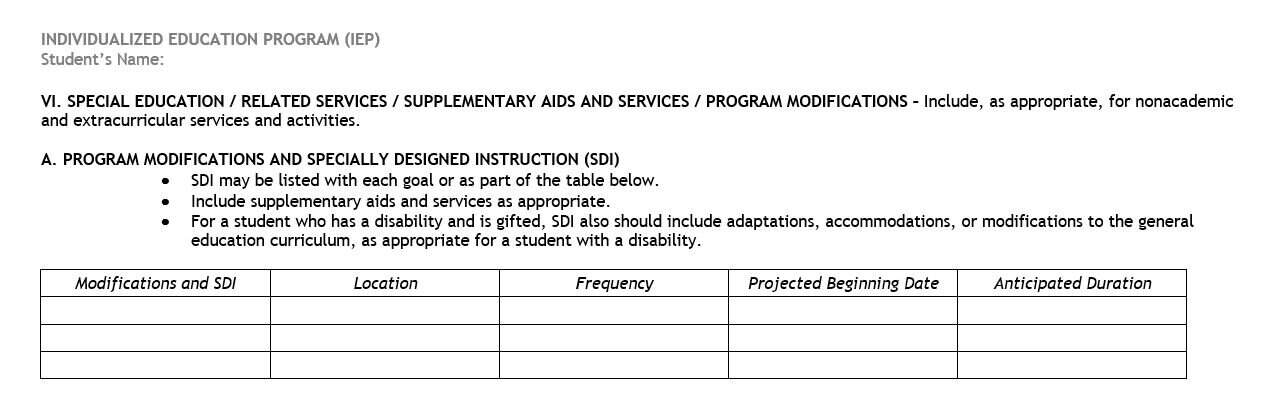
What Is Specially Designed Instruction (SDI)?
SDI refers to the individualized instruction and teaching methods designed to address a student’s unique needs due to their disability. These are not one-size-fits-all strategies but tailored interventions. The key factor that makes something SDI is that it modifies the content, methodology, or delivery of instruction to enable a student to access the curriculum and make progress on their IEP goals.
If you want a deeper dive into what SDI is and isn’t, I have another post that explains it in detail. For now, think of SDI as the “how” teachers deliver instruction in a way that works for your child.
IEP Writing Shouldn’t Feel This Hard
IEP Data, Present Levels, goals, accommodations—
they’re supposed to connect. Most IEPs fall apart because they don’t.
This bundle shows you exactly what to write, where it goes, and why it works.

Why SDI Will Not Appear on a 504 Plan
SDI is a specific component of an Individualized Education Program (IEP), which is governed by IDEA (Individuals with Disabilities Education Act). A 504 Plan, on the other hand, is part of Section 504 of the Rehabilitation Act. While both are designed to support students with disabilities, their purposes differ:
- 504 Plans provide accommodations to remove barriers and ensure access to the general education curriculum.
- IEPs provide special education services, including SDI, to help students make meaningful progress based on their unique needs.
Because 504 Plans don’t include specialized instruction, SDI will only ever be found in an IEP.
SDI Examples for IEPs
When considering SDI, it’s important to differentiate between instructional changes (SDI) and environmental or procedural supports (accommodations). Below are examples of true SDI in five areas:
SDI for Reading
- Multi-sensory Reading Programs: Using Orton-Gillingham or Wilson Reading System to teach phonics and decoding with a multi-sensory approach.
- Modified Reading Materials: Providing text at a lower reading level while still maintaining grade-level content for comprehension.
- Direct Instruction in Fluency: Teaching specific strategies for reading fluency through repeated readings or timed drills.
- Chunking and Scaffolded Texts: Breaking text into smaller, more manageable sections and explicitly teaching comprehension strategies.
- Structured Word Study: Systematic instruction in morphology (roots, prefixes, and suffixes).
SDI for Math
- Explicit Instruction in Problem-Solving: Teaching step-by-step approaches for solving word problems with visual models or graphic organizers.
- Number Sense Development: Providing direct instruction on foundational math concepts using manipulatives and visual aids.
- Modified Math Curriculum: Breaking down multi-step math problems into discrete steps with direct teaching of each step.
- Re-teaching in Small Groups: Conducting daily or weekly small-group sessions to reteach challenging math concepts.
- Math Fact Strategies: Teaching alternative strategies for memorization, such as touch math or mnemonic devices.
SDI for Social Skills
- Direct Social Skills Instruction: Using role-playing and modeling to teach conversation skills, turn-taking, and perspective-taking.
- Video Modeling: Using pre-recorded videos to demonstrate appropriate social behaviors in various settings.
- Social Narratives: Creating personalized stories that outline social expectations and appropriate responses in specific situations.
- Peer Coaching Programs: Structured activities pairing the student with a peer for guided practice in social interactions.
- Self-Monitoring Techniques: Teaching students to use checklists or visual aids to reflect on their social interactions.
SDI for Behavior
- Functional Behavior Skills Training: Teaching replacement behaviors through explicit instruction based on the student’s behavior plan.
- Self-Regulation Instruction: Teaching students specific strategies to recognize and regulate their emotions, such as Zones of Regulation.
- Behavioral Modeling: Providing direct teaching and practice for expected behaviors in different settings (e.g., transitioning between classes).
- Structured Behavior Interventions: Implementing teaching sequences to address skills like waiting, requesting help, or problem-solving conflicts.
- Individualized Visual Schedules: Explicitly teaching the student to follow and adapt to a personalized daily schedule.
SDI for Executive Functioning
The differences between an accommodation and an SDI can be subtle. Think of it this way– you can either tell a kid to “use a graphic organizer” or you can teach them how to use a graphic organizer. You could insert almost any accommodation in for the graphic organizer.
As an advocate, I see a lot of accommodations being granted to students, but they have no idea how to implement them. And, that’s the problem.
- Task Analysis Instruction: Teaching students to break larger tasks into smaller, manageable steps with explicit guidance.
- Time Management Strategies: Using timers, calendars, and direct instruction to plan and complete assignments.
- Goal-Setting and Reflection Skills: Teaching students to set realistic goals, track progress, and reflect on their work.
- Organization Instruction: Teaching how to use color-coded folders, binders, or digital tools to organize materials and assignments.
- Memory Aids and Chunking: Direct instruction in using mnemonic devices, visual organizers, or breaking tasks into smaller parts.
Understanding SDI is essential for parents advocating for their child’s IEP. Unlike accommodations, which change how a student accesses learning, SDI modifies how instruction is delivered to meet the child’s unique needs.
By incorporating SDI into an IEP, educators create a personalized roadmap for helping students succeed. Whether your child struggles with reading, math, social skills, behavior, or executive functioning, SDI can be a game-changer in ensuring their educational progress.
Want more guidance on advocating for your child’s IEP? Check out my other posts or connect with me through my advocacy tools and training.
Clear, Actionable IEP Tools
- IEP Toolkit for Parents
- Special Education Advocacy Training
- Professional Development Hours for Teachers and Staff