10 Auditory Memory IEP Goals for Verbal Instruction Challenges
If your child can answer a question when it’s written down, but falls apart when it’s said out loud, you’re not imagining things. Auditory memory is the skill that helps a student hold onto spoken information long enough to use it.
This matters in school because so much instruction is verbal: directions, classroom routines, explanations, discussions, read-alouds. When auditory memory is weak, students may need directions repeated, miss key details, or struggle to retell what they just heard. It can look like inattention or “not listening,” but the issue is often retention, not effort.
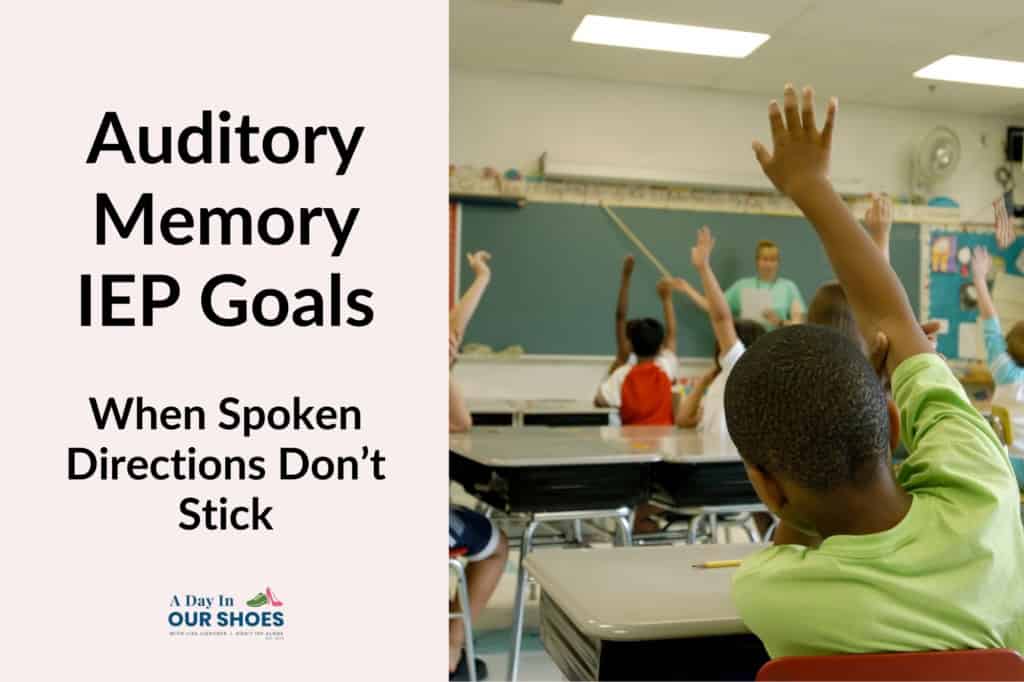
Auditory memory goals in an IEP should focus on real classroom demands—following spoken directions, recalling information from a lesson, or repeating and using verbal information accurately. The goal is educational access: making sure the student can participate and learn when instruction is delivered verbally.
Please note: Auditory Memory IEP Goals are often confused with both Working Memory IEP Goals and Auditory Processing IEP Goals. I have lists of all 3 on this site–as they are different issues.
IEP Goals for Auditory Memory
- Auditory Word Sequence Recall: By ___, Student will recall and verbally repeat a sequence of 6–8 spoken words in/with one presentation as measured by staff data collection with 85% accuracy.
- Following Multi-Step Spoken Directions: By ___, Student will recall and follow a sequence of 3–5 spoken instructions in/with classroom activities as measured by teacher data collection with 90% accuracy.
- Auditory Number Sequence Recall: By ___, Student will recall and verbally repeat a sequence of 8–10 spoken numbers in/with one presentation as measured by staff data collection with 80% accuracy.
- Auditory Syllable Sequence Recall: By ___, Student will recall and verbally repeat a sequence of 10 unrelated spoken syllables in/with one presentation as measured by staff data collection with 75% accuracy.
- Auditory Sentence Recall: By ___, Student will recall and verbally repeat a sequence of 4–6 spoken sentences in/with one presentation as measured by staff data collection with 85% accuracy.
- Listening Comprehension Recall: By ___, Student will recall and state at least 3 key details from a verbally presented passage in/with classroom instruction as measured by teacher data collection with 80% accuracy.
- Oral Direction Retention During Task Completion: By ___, Student will follow multi-step spoken directions during independent work in/with no more than one repetition as measured by teacher observation in 4 out of 5 opportunities.
- Verbal Information Note Capture: By ___, Student will accurately record key information from orally presented instruction in/with guided note-taking supports as measured by work samples with 80% accuracy.
- Story Retell After Oral Presentation: By ___, Student will retell a verbally presented story including beginning, middle, and end in/with visual supports as measured by teacher or SLP rubric scoring with 80% accuracy.
- Question Response After Oral Presentation: By ___, Student will answer comprehension questions following verbal instruction in/with no more than one repetition as measured by classroom data collection with 80% accuracy.
Quick Check: Is This an Auditory Memory Issue? Auditory memory goals address retention of spoken information, not comprehension or behavior. This page is for students who:
– Forget spoken directions quickly
– Miss details from verbal lessons
– Do better with written instructions than spoken ones
– Need repeated directions to complete tasks
What Is Auditory Memory?
Auditory memory is the ability to remember information that is presented verbally. In practical terms, it’s what allows a student to hear something and still have it available a few seconds later to act on it, answer a question, or explain it back.
In school, auditory memory supports skills like:
- Following multi-step directions
- Recalling details from a class discussion
- Retelling a story or summarizing a lesson
- Answering questions after a teacher explanation
- Learning new vocabulary and content presented orally
When auditory memory is a weak spot, students can be trying hard and still miss information. They may ask “What?” frequently, start tasks incorrectly, or lose track of what they were supposed to do next.
Quick Answer: What Are Auditory Memory Goals?
Auditory memory IEP goals address a student’s ability to remember and use information they hear. These goals are appropriate when a student:
– Forgets spoken directions quickly
– Cannot recall information from class discussions
– Struggles to retell stories or verbal information
– Loses details when listening to lectures
If hearing information once isn’t enough, and it affects classroom performance, auditory memory may need to be addressed in the IEP.
Types of Auditory Memory That Show Up in School
You don’t need a deep dive into brain science to write IEP goals, but it helps to know what you’re actually measuring.
Short-Term Auditory Memory
This is holding spoken information briefly—long enough to repeat it or act on it.
Examples in school:
- Repeating directions before beginning work
- Recalling 2–3 key details after listening to a short passage
- Remembering a sentence well enough to write it down
Auditory Working Memory
This is holding spoken information while doing something with it.
Examples in school:
- Following directions while completing a task
- Solving a problem that’s explained verbally
- Listening and taking notes at the same time
Long-Term Auditory Memory
This is retaining information that was taught verbally and recalling it later.
Examples in school:
- Remembering information from a lesson the next day
- Recalling content from a lecture for a quiz
- Retaining vocabulary taught through discussion and instruction
Auditory Memory vs Listening Comprehension
These two are often confused on IEPs, but they are not the same skill. Auditory Memory is about retaining spoken information. Can the student hold onto what was said long enough to use it?
Examples:
- Repeating directions
- Remembering details from a read-aloud
- Following 3–5 spoken steps
Listening Comprehension is about understanding spoken information.
Does the student grasp the meaning of what was said? Examples:
- Explaining the main idea of a story
- Answering “why” or “how” questions
- Making inferences from a lecture
A student can remember the words but not understand them. Or they can understand the lesson but forget it before they respond. The goal you write should match the actual breakdown. If the issue is retention, write an auditory memory goal. If the issue is understanding language, write a listening comprehension goal. Evaluation data should guide that decision.
Auditory Memory vs Working Memory
These terms get used interchangeably on IEPs, but they aren’t the same thing. Working memory is the broader skill. It’s the brain’s “mental workspace” for holding and using information, whether that information is heard, seen, or read. Auditory memory is narrower. It focuses specifically on retaining and recalling spoken information.
You Need IEP Data. You Also Need to Teach.
IEP progress monitoring has to get done, but it shouldn’t take hours. You need a system that’s simple enough to actually use in a real classroom.
Get teacher-created, ready-to-use tools that help you track IEP goals, document meaningful progress, and write progress reports faster, without adding more paperwork to your day. Save time, stay compliant.
A quick way to tell the difference:
- If the student struggles even when information is written down, you may be looking at working memory (or another executive functioning need).
- If the student does much better with written directions than spoken directions, auditory memory is more likely the issue.
Either way, your goal should match what’s actually happening in the classroom.
Why Auditory Memory Belongs in the IEP Conversation
Auditory memory weaknesses can affect access in very real ways:
- Directions have to be repeated multiple times
- The student misses steps and gets marked “noncompliant” or “off task”
- Retells are incomplete or disorganized
- Listening comprehension looks low even when decoding is fine
- Class participation drops because the student can’t hold onto what was said
If there’s data showing this is interfering with progress, it’s appropriate to consider goals, accommodations, or both.